What Is a Permanent-Magnet EV Motor? Rotor Magnets, Efficiency and Materials
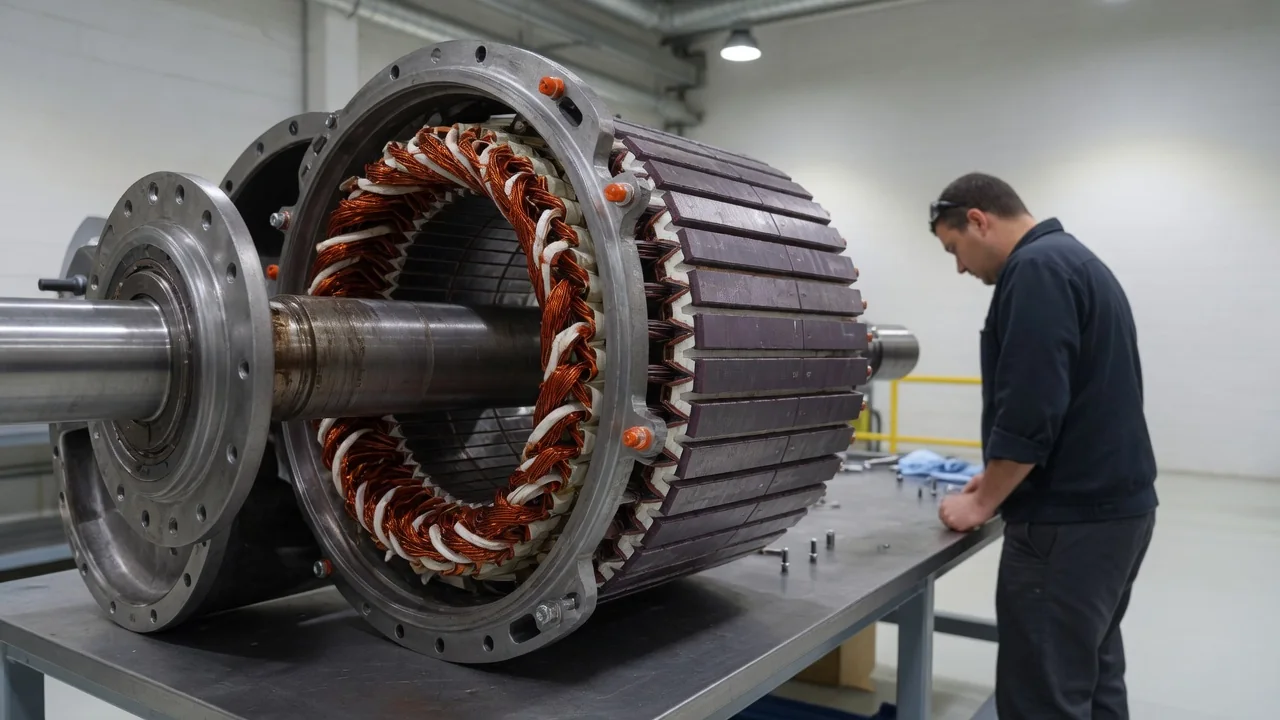
A permanent-magnet EV motor is an electric traction motor whose rotor carries permanent magnets. Its magnetic field is always present instead of being created by electric current. The stator windings, fed by the inverter, produce a rotating magnetic field, and the magnetized rotor follows it in step. That is why engineers call it a permanent-magnet synchronous motor. Where the magnets sit, why the design saves energy, and which materials it uses explain much of how a modern permanent magnet traction motor behaves.
Rotor magnets
The stationary part of the motor, called the stator, holds copper windings. The rotating part, the rotor, is built from stacked thin steel laminations. It carries a set of permanent magnets arranged in alternating north and south poles. In a surface-mounted design, the magnets are bonded to the outside of the rotor and often held by a retaining sleeve. In an interior permanent-magnet design, the type widely used for traction, the magnets sit in slots cut inside the laminations. Placing them inside protects the magnets from centrifugal force at high rpm. It also shapes the steel so the rotor produces reluctance torque, an extra pull that comes from the rotor seeking the path of least magnetic resistance.
Because the rotor field has a fixed strength, the motor is synchronous: the rotor turns exactly in step with the rotating field created by the stator currents. To keep that relationship, the inverter must know the rotor's precise angle. It usually gets this from a resolver or a similar position sensor and times each pulse of current to match. A spinning magnetized rotor also induces voltage back into the stator windings, known as back electromotive force. This effect lets the same machine work as a generator during regenerative braking.
Efficiency
Efficiency is the main reason permanent magnets are popular in EV drive units. In an induction motor, the rotor field must be created by currents induced in rotor bars, and those currents heat the rotor and waste energy. A permanent-magnet rotor needs no excitation current, so that source of loss largely disappears. The remaining losses come from several places: resistance in the stator copper, magnetic losses in the steel laminations from hysteresis and eddy currents, small eddy currents within the magnets themselves, and bearing friction and air drag. Designers reduce these losses with thin laminations, segmented magnets and careful cooling.
The advantage is not the same at every operating point. Back electromotive force rises with speed, and at high rpm it can approach the voltage that the battery and inverter can supply. To keep accelerating, the controller applies field weakening, feeding in current that partly opposes the magnets' field. That current produces no useful torque and adds losses. As a result, permanent-magnet motors tend to be at their best at low to moderate speeds and partial loads, which covers much of ordinary driving. The exact efficiency map depends on the individual motor, inverter and software, so a general description cannot predict the figure for any particular vehicle.
Material choices
Most permanent-magnet traction motors use neodymium-iron-boron magnets. These magnets are very strong for their size and weight, which lets designers build compact motors with high torque density. Their weakness is temperature: as they get hotter, they become easier to demagnetize. To counter this, manufacturers have traditionally added heavy rare-earth elements such as dysprosium or terbium. These elements are scarce, and their supply is geographically concentrated. The industry has therefore worked to use less of them. One approach is grain boundary diffusion, which places the heavy rare earths only where they are most needed. Better rotor cooling is another.
Other options exist, and each involves tradeoffs. Samarium-cobalt magnets tolerate heat well but are costly and less common in mass-produced traction motors. Ferrite magnets are inexpensive and contain no rare earths, but they are much weaker. A ferrite design therefore needs more magnet volume or a rotor shaped to rely heavily on reluctance torque. Some manufacturers avoid magnets entirely by using induction motors or electrically excited synchronous motors, whose rotor field comes from a wound coil supplied with current. Beyond the magnets, the motor depends on other materials: thin electrical steel laminations, copper windings that are often formed as rectangular hairpin conductors to fill the slots better, and insulation systems rated for high voltage and heat.
Practical implications and limits
For an owner, a permanent-magnet motor has few wear items in the conventional sense. In everyday ownership, the bearings, seals, cooling fluid and inverter matter more than the magnets themselves. Heat is the main limit. During repeated hard acceleration, towing or sustained high-speed driving, vehicle software may reduce available power to protect the magnets and windings from overheating. This is a protective strategy, not necessarily a fault, and the thresholds vary by vehicle. Where the manufacturer specifies a service interval for the drive unit's coolant or oil, following it supports the cooling the design relies on.
Because the magnets are always active, a turning rotor generates voltage even when the car is switched off. This is one reason manufacturers publish specific towing instructions, often recommending transport with the driven wheels off the ground. The owner's manual for the specific vehicle is the authority here. Spinning magnets also cause some iron losses in the stator when the motor produces no torque. This is one consideration behind pairing different motor types in some multi-motor layouts. For repairs, the strong magnets mean rotor removal requires proper tooling, and the high-voltage system requires trained technicians following the manufacturer's procedures.
Finally, the label alone says little. Knowing that a car uses a permanent magnet EV motor does not tell you its real-world energy consumption. That also depends on vehicle mass, aerodynamics, tires, the battery, temperature and driving style. The motor type points to a tendency toward strong efficiency at low and moderate speeds, not a guaranteed result.