What Does AC Charging Mean for an EV?
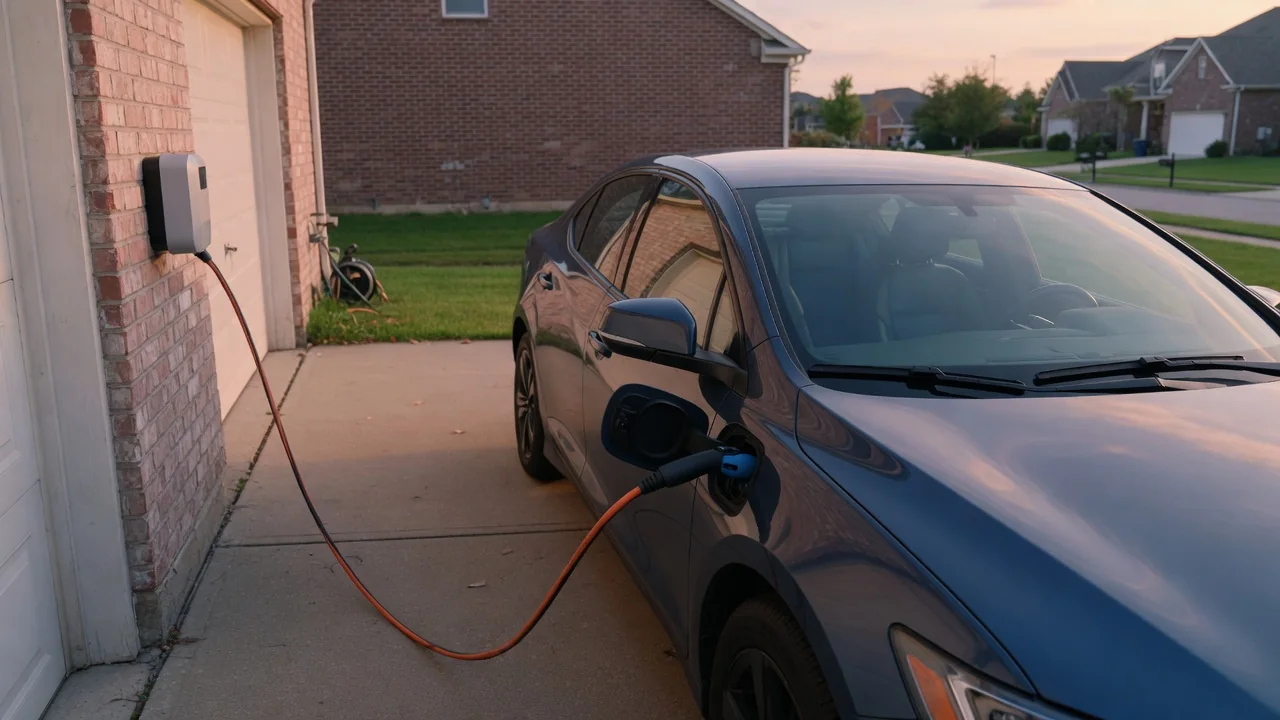
Drivers who ask what does AC charging mean for an EV are really asking where the power conversion happens. The grid delivers alternating current, but a battery can store only direct current. With AC charging, the vehicle does the conversion itself through a component called the onboard charger. That one detail shapes how quickly a car charges at home and at many public stations.
Power path
Electricity leaves the household panel or a public station as alternating current and travels through the charging cable to the vehicle's inlet. The wall unit or portable cord, properly called electric vehicle supply equipment, does not convert anything. It acts as a safety-controlled switch that confirms a secure connection, tells the car how much current the circuit can provide, and then closes its contacts so power can flow. The real charger sits inside the car.
Once inside, the current reaches the onboard charger, which rectifies it into direct current and regulates voltage to suit the high-voltage battery pack. The battery management system directs this process, requesting more or less power according to cell temperature and state of charge. Drivers can observe the sequence as a click from contactors, an indicator light at the charge port, and sometimes a cooling pump or fan. Port location, light colors, and sounds differ between manufacturers.
Charging levels
In the United States, AC charging is grouped into two levels. Level 1 uses a standard 120-volt household outlet and the portable cord supplied with many vehicles. It adds range slowly, which suits plug-in hybrids with small batteries or drivers who cover modest daily distances and can leave the car plugged in overnight. No special installation is typically needed, although the outlet and its circuit should be in sound condition to carry a sustained load.
Level 2 uses a 240-volt supply, the same kind that feeds an electric dryer or range, and delivers considerably more power through a wall-mounted unit or a higher-capacity portable cord. Home installations and many public stations at workplaces, hotels, and parking garages fall into this category. DC fast charging is a different arrangement: there the station performs the conversion and sends direct current straight to the battery, bypassing the onboard charger entirely.
Real-world limits
The rate of an AC session is set by the weakest link among three items: the circuit, the supply equipment, and the onboard charger. A powerful public station cannot push more than the car's onboard charger is rated to accept, and a capable car cannot draw more than the station offers. This explains why two different vehicles plugged into identical stations may show noticeably different charging rates. Onboard charger ratings vary by model, trim, and model year, so the owner's manual is the right reference.
Other factors trim the rate further. A cold battery may accept power slowly or divert some energy to warming itself, and charging usually tapers as the pack approaches full. Conversion also produces heat, so a portion of the energy drawn from the wall never reaches the battery, which is why the utility meter records more than the dashboard reports. Shared public stations may split available power between two connected vehicles, and some homes use load management that reduces current when other appliances are running.
Everyday Use and Observations
For many owners, AC charging becomes a routine much like plugging in a phone. The car is connected in the evening, the onboard charger works for several hours at a moderate rate, and the battery is ready by morning. Many vehicles let drivers schedule charging for off-peak hours or set a target charge level below full for daily driving, through either the infotainment screen or a companion app. The menus and available options depend on the manufacturer.
During a session, the instrument cluster or app typically shows power in kilowatts, estimated time remaining, and range added. Watching these figures helps confirm that everything is behaving normally. A rate much lower than usual may trace to a reduced current setting in the vehicle, a cord set limited by its plug type, or cold weather. Connector type matters at public stations too, since vehicles use either a J1772 or a NACS inlet, and some need an adapter between the two.
Limits and Next Steps
AC charging is not designed for quick stops on a long trip. Because the onboard charger caps the rate, even a strong Level 2 station takes hours to refill a large battery, so highway travel generally relies on DC fast charging instead. AC charging fits best wherever the car sits parked anyway: at home, at work, or at a destination such as a hotel. Its steady, moderate pace matches the way daily driving energy is normally replaced.
Anyone planning home charging should first look up the vehicle's maximum AC charging rate, since buying equipment far beyond it brings no speed benefit for that car. A licensed electrician can assess panel capacity and install a dedicated circuit that meets local code. If a session stops repeatedly, a warning message appears, or the plug or outlet feels hot, stop using that equipment and have it inspected. A charging fault message points toward an area to investigate, not proof that the onboard charger itself has failed.