What Is a Wheel Speed Sensor?
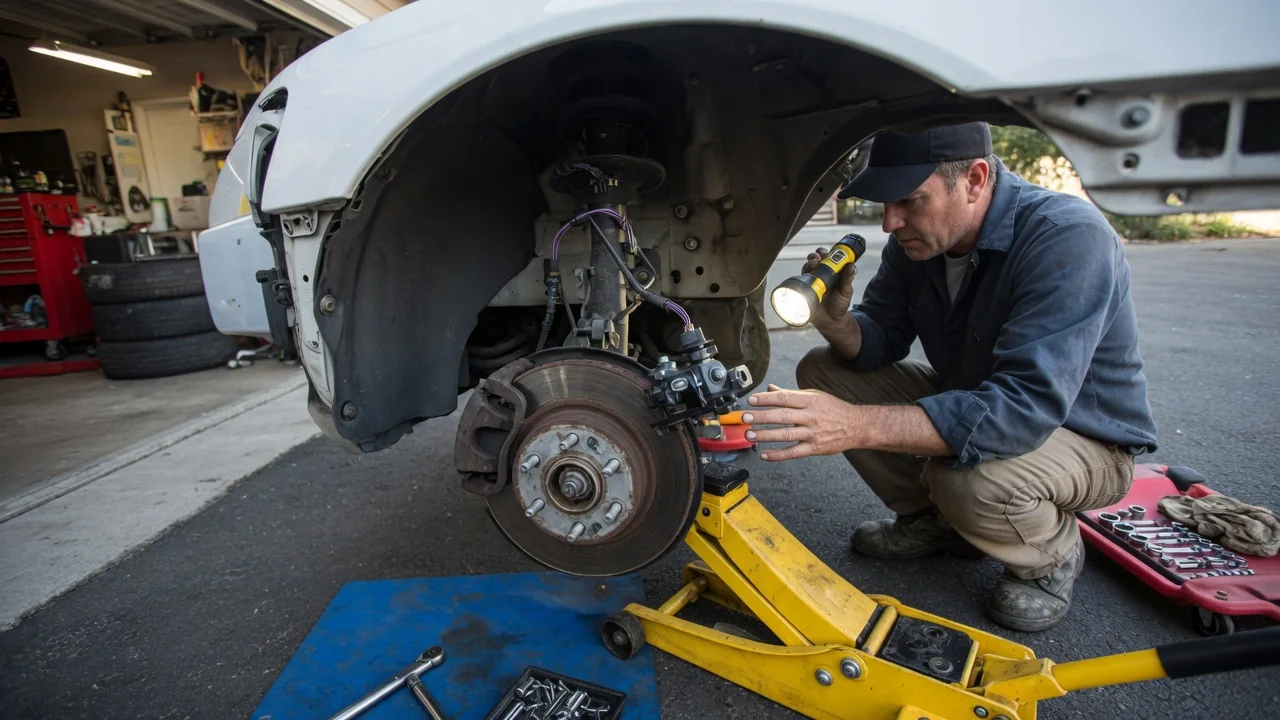
What is a wheel speed sensor? It is a small electronic device mounted near a wheel that reports how fast that wheel is turning. Anti-lock brakes, traction control and stability control all depend on this rotation data to decide when a tire is slipping or locking. Knowing where the sensor sits, how its signal is used and how faults appear helps drivers interpret warning lights sensibly.
Sensor location
On most modern passenger vehicles, a wheel speed sensor sits at each wheel, fixed to the steering knuckle, hub carrier or axle housing so its tip faces a rotating target. That target may be a toothed tone ring pressed onto an axle shaft or CV joint, or a magnetic encoder ring built into the wheel bearing seal. The sensor itself stays stationary while the target spins past it, separated by a small air gap that must remain consistent for a clean reading.
Layouts differ by design and age. Some older trucks and rear-wheel-drive vehicles use a single rear sensor mounted on the differential housing rather than one at each rear wheel, and some hubs carry the sensor as an integral, non-separable part of the bearing assembly. Looking behind a wheel, a reader can often trace a thin wiring lead running from the hub area along the suspension to a connector in the wheel well. Service information for the specific vehicle confirms the exact arrangement.
Signal use
As the target rotates, the sensor produces a signal whose frequency rises and falls with wheel speed. Passive sensors generate a small alternating voltage from a coil and magnet as teeth pass, while active sensors use Hall-effect or magnetoresistive elements, are powered by the control module and produce a digital pulse that stays readable at very low speeds. Some active designs can also indicate rotation direction, which supports features such as hill-start assistance, though capability depends on the vehicle.
The anti-lock brake module compares all the wheel signals many times each second. If one wheel decelerates far faster than the others under braking, the module treats it as approaching lockup and modulates hydraulic pressure to that brake. Traction control looks for the opposite pattern, a driven wheel spinning faster than the rest, while stability control combines wheel speeds with steering angle and yaw data. Depending on the vehicle, the same signals may also feed the speedometer, transmission shift logic, adaptive cruise control or indirect tire pressure monitoring.
Fault clues
The most common sign of a problem is an illuminated ABS warning lamp, frequently accompanied by traction or stability control lights because those systems share the same inputs. A driver may also notice the anti-lock function activating at low speed on dry pavement, felt as pedal pulsation just before a stop, which can happen when one signal drops out or reads erratically. On vehicles that derive road speed from these sensors, an erratic speedometer or unusual shifting may accompany the warnings.
A stored fault code pointing to a particular wheel circuit narrows the search but does not prove the sensor itself has failed. The same code can result from a chafed wire, a corroded connector, a cracked or rust-swollen tone ring, metal debris clinging to the sensor tip, or excess play in a worn wheel bearing that changes the air gap. Many of these codes are manufacturer-specific, so their precise meaning should be confirmed against information for the exact vehicle before any part is replaced.
Everyday Use and Observations
In normal driving the sensors work unnoticed. Their contribution becomes apparent during a hard stop on wet or icy pavement, when the brake pedal pulses and the vehicle remains steerable, or when pulling away on a slick surface and engine power briefly cuts as a wheel begins to spin. A flashing stability indicator during a slippery corner is another visible sign that wheel speed data is being acted upon. These are normal operating behaviors rather than symptoms.
Everyday conditions do affect these parts. They live in a harsh spot exposed to road salt, water, brake dust and heat, and the wiring flexes with every suspension and steering movement. Warning lights that appear after brake, bearing or suspension work, or after driving through deep slush or mud, can hint at a disturbed connector or contaminated sensor. Mismatched tire sizes or a significantly underinflated tire can also create wheel speed differences that some systems interpret as a fault or a pressure warning.
Limits and Next Steps
When the ABS lamp is on, the base hydraulic brakes generally continue to work, but anti-lock, traction and stability functions may be reduced or disabled, so stopping distances and control on slippery roads can suffer. That makes prompt diagnosis sensible even if the vehicle feels normal. A red brake warning light, a soft pedal or any change in ordinary braking feel is a different and more urgent situation that calls for having the vehicle inspected before it is driven further.
A visual check for a damaged lead or a loose connector behind the wheel is a reasonable observation for an owner, but confirming the cause usually requires a scan tool that can read ABS codes and display live wheel speed data from each corner side by side. A technician may compare readings during a road test, inspect the tone ring and bearing, and test circuit integrity. Because sensor types, mounting and calibration requirements vary, replacement parts and procedures should follow vehicle-specific service information.