What Is a Vehicle Assembly Line?
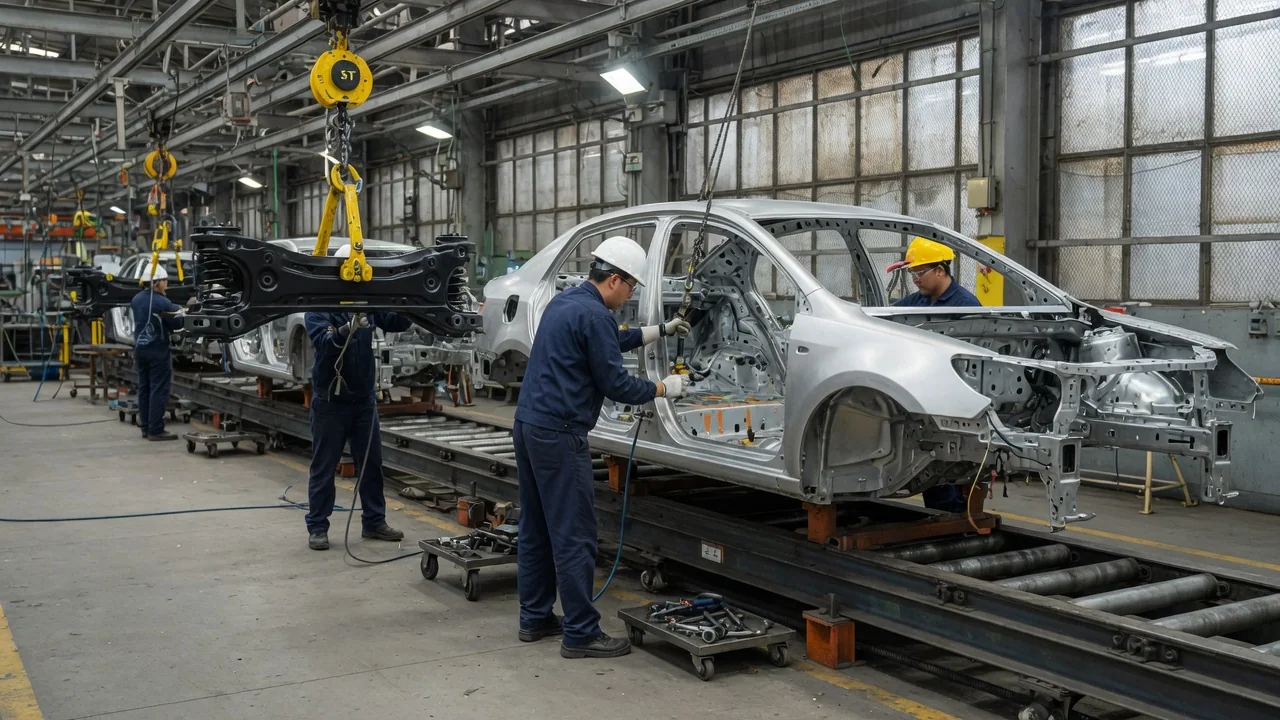
What is a vehicle assembly line? It is a production system in which a car or truck moves through a sequence of stations, each one adding parts or completing a defined task until a finished vehicle rolls off the end. Understanding the main stages, from welded body shell to final inspection, explains why modern vehicles are built consistently and where individual plants differ.
Body and paint
Production typically begins in the body shop, where stamped steel or aluminum panels are joined into a rigid shell often called the body-in-white. Floor pans, side frames, roof panels, and pillars are clamped in fixtures so that robots or operators can apply spot welds, adhesives, rivets, or laser seams in a repeatable pattern. Each station handles a limited set of joints, and the shell advances on a conveyor or carrier once that work is done, gradually gaining doors, a hood, and a trunk lid or liftgate.
The bare shell then moves into the paint shop, a clean, tightly controlled area because dust and moisture show up as defects. Common steps include cleaning and pretreatment, a corrosion-resistant coating applied by immersion, seam sealing, primer, color coat, and clear coat, with baking ovens between layers. Readers can see the results in details such as sealer beads along door hems or the uniform finish inside the engine bay. The joining methods, materials, and number of coating layers vary by manufacturer, plant, and vehicle design.
Component installation
After paint, the body enters general assembly, sometimes called trim and final, where most of the parts an owner touches are fitted. Doors are often removed temporarily so workers can reach the cabin to install wiring harnesses, sound insulation, the instrument panel, headliner, carpet, glass, and seats. Parts arrive at each station in the order needed, frequently sequenced to match a specific build, so a vehicle with a sunroof or a different interior color can follow a standard version down the same line.
A key moment is the joining of body and powertrain, often called the marriage. The engine or electric drive unit, transmission, suspension, exhaust or battery pack, and axles are commonly prepared on a separate subassembly line, then lifted into the body from below and fastened with tools that record tightening torque. Wheels, fluids, bumpers, and lamps follow. Truck plants that use a separate frame may build up the chassis first and lower the cab onto it, so the exact order depends on the vehicle's construction.
Quality checks
Inspection is built into the line rather than saved for the end. In the body shop, measuring systems compare key points on the shell against the intended dimensions, because a small error there affects how doors, glass, and trim fit later. Paint is examined under bright light tunnels for runs, dirt, and uneven color. During assembly, fastening tools can flag a joint that did not reach its target, and many plants let a worker signal a problem so it is corrected before the vehicle moves on.
Finished vehicles usually go through end-of-line tests before release. Typical examples include wheel alignment and headlamp aiming, a roller test that exercises the drivetrain and brakes, a water spray booth to find leaks, and an electronic check confirming that control modules communicate and store no unexpected faults. A stored fault at this stage is treated as a prompt for investigation, not proof that a part is defective. Vehicles needing correction are routed to a repair area, and the specific tests depend on the plant and model.
Everyday Use and Observations
Owners rarely see a factory, yet evidence of station-based production is all over a finished car. A label in the door jamb commonly shows the build month and other identification, and the vehicle identification number includes characters related to where the vehicle was assembled, though decoding them requires manufacturer-specific references. Under the hood, paint marks on bolts, inspection stickers, and stamped part labels are often left by workers or machines confirming that a step was completed.
Consistency is the practical benefit. Because each task is done the same way at the same station, panel gaps tend to be even from side to side, replacement parts fit without hand finishing, and service procedures can be written for every vehicle of a given design. Looking at how door edges line up, how evenly weatherstrips seat, or how wiring is clipped along the body gives a fair sense of assembly care. Differences between trim levels usually reflect parts chosen during sequencing rather than a different process.
Limits and Next Steps
A general description only goes so far, because no two plants are laid out identically. Automation levels, the number of stations, line speed, and whether several models share one line all depend on the manufacturer and the product. Electric vehicles change the picture by adding battery pack installation and high-voltage checks while removing fuel and exhaust steps. Low-volume and specialty vehicles may rely on more manual work at fewer stations, so broad statements about how every car is built should be treated with caution.
Readers who want detail about a particular vehicle should turn to the manufacturer's own information, such as the owner's manual, the identification labels on the car, or a dealer who can interpret build data for that model. Some factories offer public tours, which are the clearest way to watch body, paint, and final assembly in sequence. For buyers, knowing the basic flow also helps when evaluating a car: uneven gaps, paint texture changes, or disturbed fastener marks may suggest later repair work worth asking about.