What Is a Reach Envelope in Car Design?
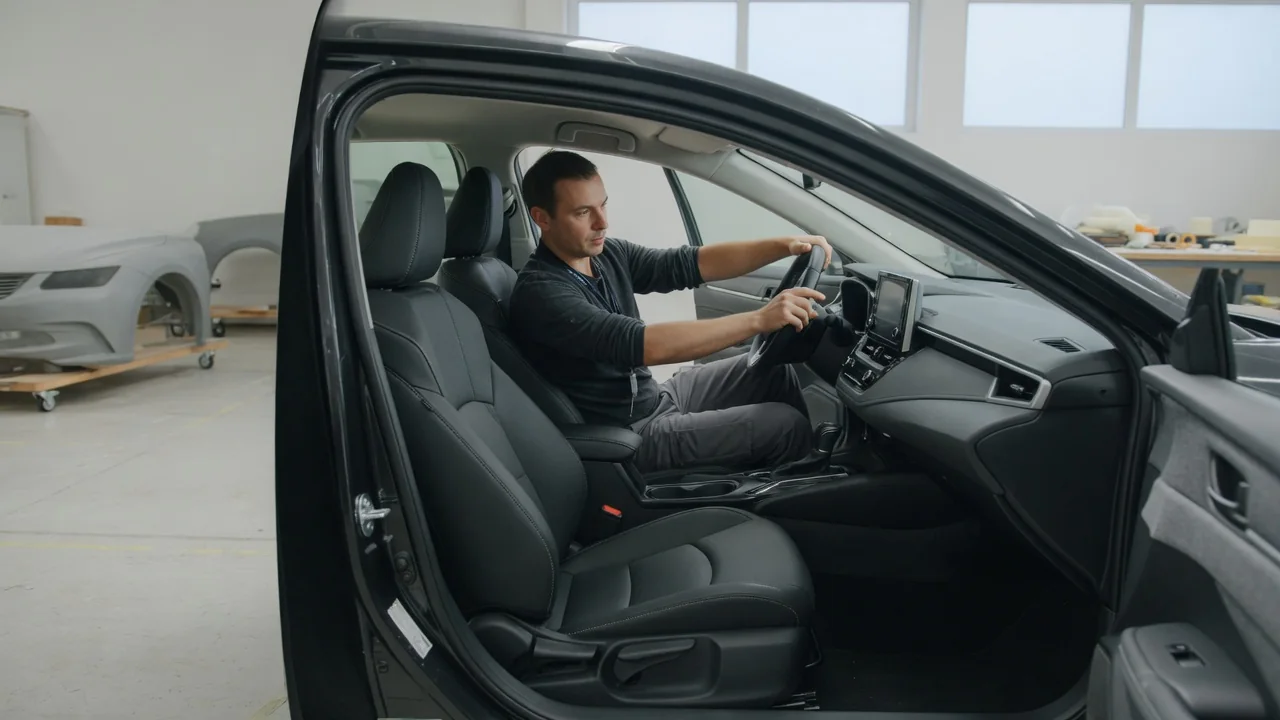
A reach envelope in car design is the three-dimensional space around the driver's seat that a seated, belted driver can comfortably reach with their hands. Engineers use it to decide where steering wheel buttons, switches, screens, and levers can go so that most drivers can operate them without leaning out of position. Understanding the vehicle control reach envelope helps explain why cabin layouts look the way they do and why seat and wheel adjustments matter.
Driver sizes
No single body defines a reach envelope. Designers work from anthropometric data, which describes how body dimensions such as arm length, shoulder height, and torso length vary across a population. A common approach is to accommodate a span that runs from a small adult woman to a large adult man, often expressed as percentiles of the target population. The exact range and the population data behind it depend on the manufacturer, the market, and the intended buyers, so the numbers are not universal.
Within that span, different drivers set different limits. Shorter drivers with shorter arms usually determine how far away a control can be, because anything beyond their reach fails them first. Taller drivers more often set limits for clearance, such as knee room under the dashboard and head room. Body proportions complicate the picture further: two people of the same height can have noticeably different arm and leg lengths, which changes where they sit and how far they can reach.
Seat position matters as much as body size. A driver typically places the seat to reach the pedals and see the road, then adjusts the steering wheel. The reach envelope is therefore built around a seating reference point, tied to the hip-point location used in vehicle packaging, and around the adjustment range of the seat and wheel. A driver who sits farther back for leg comfort carries their whole reach zone rearward with them.
Control location
A reach envelope is not a simple sphere. Arms reach farther straight ahead and toward the same side than across the body, and comfortable reach shrinks at extreme heights near the floor or roof. Reach also depends on how the hand interacts with the control. A fingertip press needs less extension than a three-finger grasp of a knob, and both need less than a full-hand grip on a lever. Engineering guidance, including SAE recommended practices on driver hand control reach, describes reach boundaries in terms of a specified grasp so that measurements are comparable.
Designers then rank controls by importance and frequency of use. Primary driving controls, such as the steering wheel, turn signal stalk, wipers, and horn, belong well inside the envelope so they can be used without changing posture. Frequently used secondary controls, such as climate and audio adjustments, usually sit in an easy zone on the center stack, console, or steering wheel spokes. Controls used rarely, or only while parked, can sit nearer the edge of the envelope, where a slight lean is more acceptable.
Location is also about how the control behaves at the end of a reach. A touchscreen area at the far edge of the envelope may be technically reachable but harder to hit accurately, because an outstretched arm has less support and steadiness than a bent one. A seat belt that locks during braking can further limit forward movement. These factors push designers to place precise, frequently used inputs closer to the driver than the envelope boundary alone would require.
Testing
Much of the early work happens in computer models. Digital human modeling software lets engineers place virtual drivers of different sizes into a vehicle package, adjust seat and wheel positions, and check whether each control falls within the modeled reach. Standardized reference tools, such as the H-point manikin and the seating reference points used in vehicle packaging, help keep these positions consistent from one design study to the next.
Physical evaluation commonly follows. Teams build seating bucks or mockups that reproduce the driver's seat, wheel, pedals, and dashboard surfaces, then invite people who represent the target range of body sizes to sit in them and perform reaching tasks. Observers can record whether participants reach a control comfortably, need to lean, or cannot reach it while belted, and participants can rate effort and comfort. Findings from these sessions feed back into the design before the layout is finalized.
Testing methods and pass criteria differ among manufacturers and programs, and some markets have regulations covering control location or operability that add their own requirements. Because the details of each company's internal process are rarely published, it is safest to treat any specific vehicle's reach performance as something to confirm in the driver's seat rather than assume from general principles.
Practical implications and limits
For owners, the reach envelope explains why setup order matters. Setting seat height and distance for the pedals first, then adjusting the backrest so the shoulders can stay against it while operating the wheel, and finally setting steering tilt and telescope tends to put the driver closer to the posture the layout was planned around. If an often-used control still requires leaning forward or pulling away from the backrest, it may be worth revisiting the seating position before concluding the layout is the problem. The owner's manual for a specific vehicle describes its available seat and steering adjustments.
The concept also has clear limits. A reach envelope describes static reach, not how long a driver must look away from the road to find a control, how intuitive the layout is, or how easily a button can be found by feel. It reflects the population data and range chosen by the designer, so people outside that range, drivers wearing bulky winter clothing, and those with limited shoulder or arm mobility may find some controls harder to use. In those cases, adaptive equipment, voice controls, or steering-wheel-mounted alternatives, where available on a given vehicle, can help bridge the gap.