How Do Designers Choose a Car Seat's Adjustment Range?
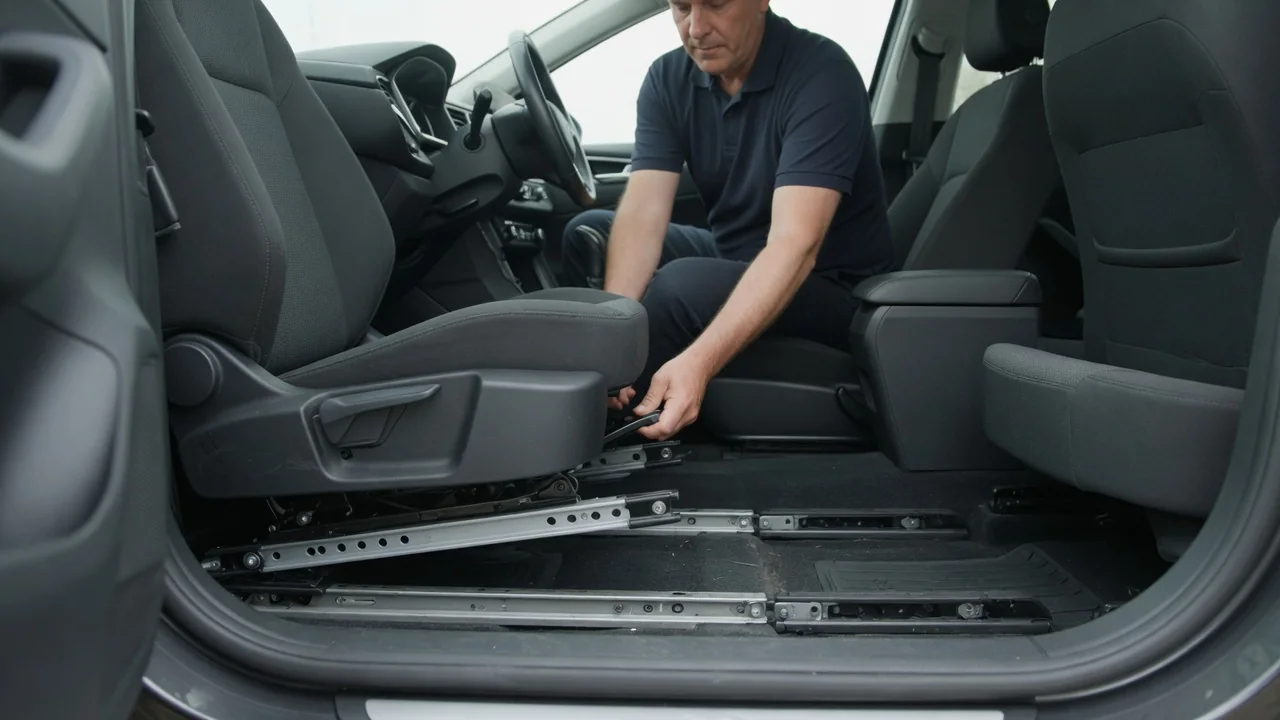
A driver's seat has to fit people who differ widely in height, leg length, torso length, and preferred posture, yet the cabin around it has fixed boundaries. Designers choose a car seat's adjustment range by working backward from the drivers the vehicle must accommodate and the controls, sightlines, and clearances each of them needs. This guide explains how body size data, pedal reach, and headroom shape driver seat adjustment design, and why the result is always a compromise.
Body sizes: designing for a range of drivers
Seat design starts with anthropometry, the measurement of human body dimensions across a population. Engineers do not design for an average driver, because a person who is average in every dimension barely exists. Instead they define a target range. A common convention in vehicle ergonomics is to accommodate drivers from roughly a small adult female to a large adult male, usually expressed as percentiles of stature for the markets where the vehicle will be sold. The exact targets are chosen by each manufacturer and vary with the vehicle's purpose and market. Height alone is not enough, because body proportions differ: two people of the same stature can have very different leg lengths and sitting heights. A long-legged driver with a short torso stresses pedal reach, while a long-torso driver with shorter legs stresses headroom. Designers therefore consider several body dimensions together rather than treating stature as a single slider.
To turn body dimensions into hardware, designers work with the hip point, or H-point, which approximates the pivot between a seated person's torso and thigh. It is located with a standardized measuring manikin and serves as the reference from which most interior dimensions are measured. The seat's adjustment range is essentially the region the H-point can occupy: how far it travels forward and back, how far it moves up and down, and how much the backrest can recline. Industry practice also uses statistical models, such as those published as SAE recommended practices, that predict where drivers of different sizes tend to place the seat in a given cabin layout. These predictions help engineers decide how much travel is needed so that most of the target population can find a position without hitting an end stop.
Pedal reach and fore-aft travel
Fore-aft travel is driven mainly by the pedals. The shortest drivers in the target range must be able to press the brake fully, and depress the clutch in a manual car, while keeping enough knee bend to control the pedal and brace firmly in an emergency stop. That requirement sets how far forward the seat must go. The tallest drivers set the rearward limit: they need enough distance for their knees to clear the steering column and lower dashboard, and for their legs to operate the pedals without being cramped. Designers typically reference the accelerator heel point, where the driver's heel rests on the floor, and lay out leg postures from there for drivers at both ends of the range.
Pedal reach does not exist in isolation. Raising the seat changes the angles of the thighs and lower legs, so a short driver who lifts the seat to see better may also need to slide farther forward. Some seat track layouts are inclined so that moving forward also raises the seat slightly for this reason. The steering wheel matters as well: a telescoping column lets drivers set arm reach separately, which reduces how much seat travel must compensate. Rearward travel is further limited by things the driver rarely thinks about, such as rear-seat legroom, seat belt anchorage geometry, and the space needed for the seat mechanism itself.
Headroom and vertical adjustment
Headroom is the main reason seats need to move down. A tall driver, especially one with a long torso, needs the seat low enough that the head clears the roof lining, roof rails, and any sunroof hardware, with some margin for movement over bumps. Head clearance is generally assessed along a line from the H-point that follows the backrest angle, which is why recline changes it. The lowest achievable position is constrained by the floor, the cushion and foam thickness needed for comfort, the adjustment mechanism, and any components packaged beneath the seat. If the seat cannot go low enough, the roof height or seat construction has to change instead, which is why headroom decisions are made early in a vehicle's design.
Upward travel exists mostly for shorter drivers. They need to raise their eye level enough to see over the hood and dashboard, read the instrument cluster through or over the steering wheel, and use the mirrors effectively. Designers check these sightlines against the predicted spread of driver eye positions, often called the eyellipse, rather than a single fixed eye point. Raising the seat must not push a driver's head toward the roof or tilt the thighs in a way that makes pedal operation awkward. Cushion tilt and backrest recline add further options: reclining lowers the head for a tall driver but moves the shoulders away from the wheel, which then has to be offset with column adjustment or a different seat position.
Practical implications and limits
For owners, the main implication is that every adjustment range is a negotiated compromise. Drivers near the middle of the target population usually find a comfortable position easily, while those at the extremes may reach an end stop first, for example running out of rearward travel or headroom before arriving at an ideal posture. Optional equipment such as a sunroof or a different seat design can change the available space within the same model line, so fit can differ between versions of what looks like the same car. Sitting in the exact configuration being considered is more informative than a single published headroom or legroom figure, because such figures are measured at defined reference positions rather than at an individual driver's preferred setting.
More adjustment is not automatically better. Additional motors, longer tracks, and extra adjustment directions add weight, cost, and packaging demands, and the cabin's fixed geometry still limits what any seat can achieve. Steering wheel airbags, seat belts, and head restraints are designed around the expected range of seating positions, so positions far outside it can reduce their intended protection. That is one reason to follow the owner's manual guidance on seating distance and head restraint height, and to be cautious with aftermarket seat risers or spacers, which can alter belt geometry and, in vehicles with occupant detection systems, how those systems behave. When the factory range does not suit a driver, an assessment by a qualified professional is a better route than improvised modifications.