What Are Floating Headrests in Car Design?
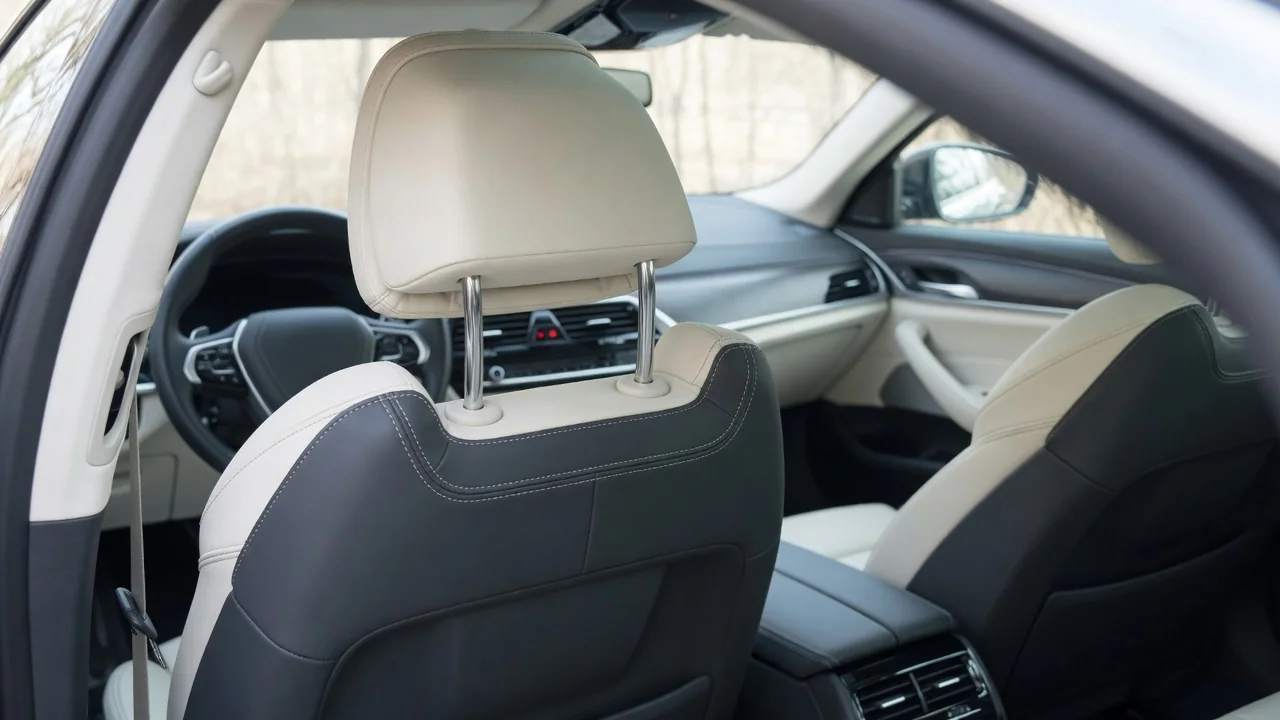
Floating headrests are head restraints designed to look as if they hover above the seatback instead of growing out of it. A visible gap, slim support posts or a single central stem separate the cushion from the seat, which gives the cabin a lighter, more open look. Explaining floating headrests in car design means looking at three things together: how the headrest is held in place, why designers choose the look, and how adjustment works in everyday use.
Support structure: what holds a floating headrest up
Most head restraints share the same basic skeleton, whether or not they float. Inside the cushion is a rigid frame, usually metal or reinforced plastic, wrapped in foam and covered in fabric, vinyl or leather. The frame connects to the seat through one or more support members. These pass into the seatback and anchor to the seat frame, not just to the upholstery. In the common two-post layout, steel rods slide into guide sleeves at the top of the seatback. Notches on one rod engage a spring-loaded lock that holds the chosen height.
A floating design changes how much of that structure is exposed and how it is shaped. Designers may lengthen the visible part of the posts and finish them in chrome, satin metal or color-matched plastic. They may also replace two posts with a single wider stem or a blade-shaped bracket at the center or rear of the cushion. Some designs hide the real attachment behind the seatback, so the cushion appears to sit on a thin spine. Whatever the look, a head restraint has a safety job. In a rear impact, it limits how far the occupant's head moves backward relative to the torso. The supports therefore have to be stiff enough to carry crash loads. In the United States, front outboard head restraints are covered by a federal motor vehicle safety standard, FMVSS 202a, which addresses height, backset and strength. A floating headrest has to meet the same functional demands as a conventional one.
Styling: why designers use the floating look
The floating car headrest appearance is mostly about visual mass. A tall seat whose headrest blends into the backrest reads as one solid block. This is most noticeable in a row of front seats viewed from the rear or from outside the car. A gap between cushion and seatback breaks that block into two lighter shapes and lets light and sightlines pass between them, so the cabin feels less enclosed. For rear passengers, the gap and the slimmer forms can reduce the boxed-in feeling of facing a wall of seatbacks.
The look also carries design-language cues. Thin, sculpted headrests on exposed supports echo furniture and minimalist product design. They are often paired with clean dashboards, slim screens and simplified trim. Designers can treat the support members as an accent by repeating a metal finish or color used elsewhere in the cabin. They can also keep the supports dark so the cushion itself seems to hover. The back of the headrest and its supports are visible from the rear seat, so those surfaces need finished materials and tidy seams. A fully integrated design can hide that detailing.
Floating headrests are different from integrated or high-back sport seats, where the head restraint is molded into the backrest as one piece and often has a fixed height. The two approaches pursue different visual goals. Integrated seats emphasize a wrap-around, enclosing shape. Floating headrests emphasize openness and separation.
Adjustment: how floating headrests move
Adjustment depends on the support design, not on the floating label. Two-post floating headrests usually adjust like conventional ones. You pull the headrest up to a detent, and you press a release button on the post sleeve to lower it. Some seats add a fore-aft tilt that moves the cushion closer to the back of the head, and some higher-equipped seats adjust height electrically. Single-stem and blade designs vary more. Some slide on a concealed track, while others are fixed in place and rely on the seat's geometry to position the cushion.
The general positioning guidance is the same as for any head restraint. Ideally, the top of the cushion is level with the top of the head, and it should be at least as high as the top of the ears. The gap between the back of the head and the cushion should be as small as is comfortable with the seatback in a normal upright position. Reclining the seatback far increases that gap, which works against the headrest's purpose. Recommended positions, adjustment ranges and whether the headrest can be removed vary by vehicle, so check the owner's manual for any particular seat.
Practical implications and limits
The gap that defines a floating headrest has some everyday side effects. It can improve the driver's rearward view past the rear-seat headrests and make the cabin feel more spacious. It also creates a spot where crumbs and dust collect, and an edge that some seat covers, neck pillows and headrest accessories cannot fit around. Accessories that clamp onto two round posts, such as tablet holders, hooks or seatback organizers, may not fit a single stem or a blade-shaped support. They may also end up sitting at an awkward angle.
Child seat installation is another practical point. Many forward-facing child seats use a top tether routed over or around the vehicle seatback. Some installations require raising or removing the head restraint to get the child seat flush against the seatback. Whether that is allowed, and how the tether should be routed, is set by the vehicle and child-seat manufacturers, not by the headrest's styling. If a removable headrest is taken out for any reason, reinstall it and make sure it is locked before an adult rides in that seat.
Finally, "floating headrest" is a styling description, not a technical classification or a safety rating. The floating look alone does not make a head restraint more or less safe. Protection depends on the restraint's height, its distance from the head, its structural strength and any active mechanism built into the seat. If a headrest rattles or feels loose at the posts, have it checked, because worn guide sleeves or locks affect how well it stays in position.