How Do Designers Check Headroom With a Helmet?
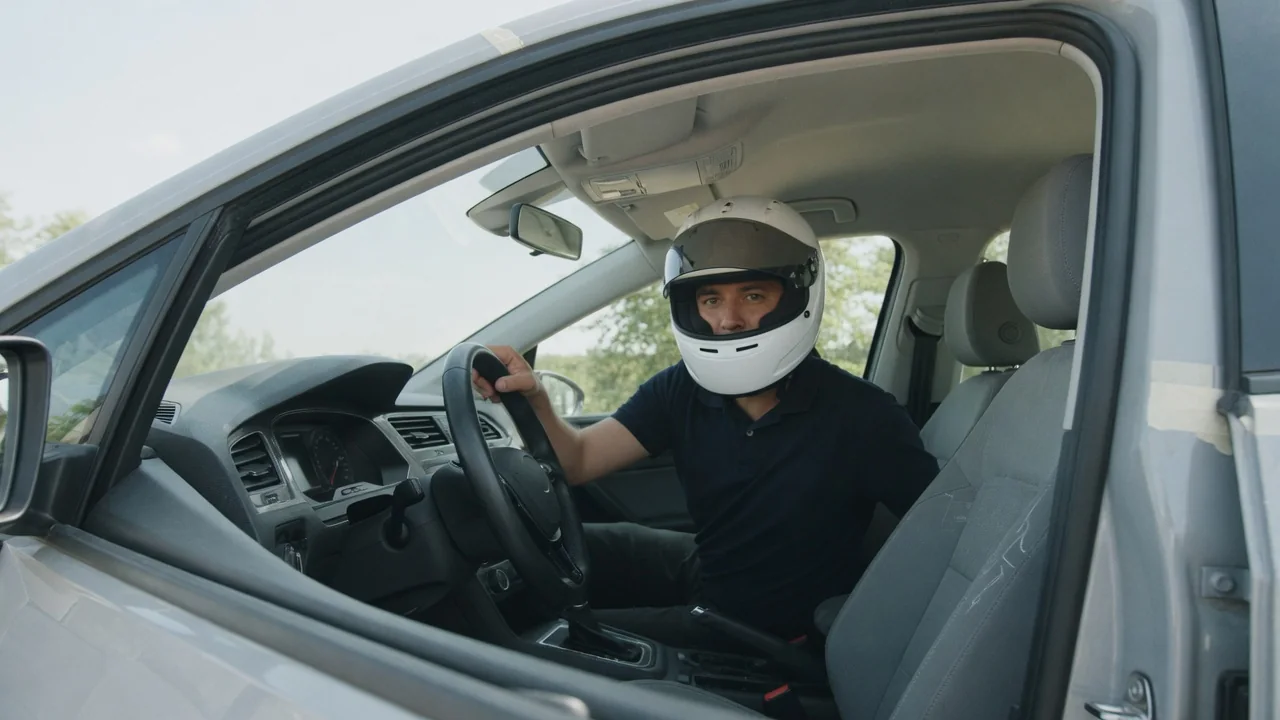
Headroom on a spec sheet is measured for a bare head. Anyone who drives on a track adds a shell, liner, and padding on top of that. So how do designers check headroom with a helmet? They treat the helmet as part of the occupant's head envelope. Then they test that larger envelope against the seat's range of adjustment and the roof structure, first in digital models and later in physical mockups and fitting sessions.
Track-use context
On public roads, interior headroom is normally evaluated for an occupant without a helmet. Industry practice, such as the interior dimensions defined in SAE J1100, describes headroom as the distance from a seating reference point to the headliner along a defined line, using standardized manikin and head contours. By default, those methods do not account for a helmet. When a vehicle is intended for track days, club racing, or a performance package marketed for circuit use, the design team has to decide whether helmeted clearance is a formal target or only a consideration. That early decision shapes every later check in vehicle helmet headroom design.
Track use also changes what enough clearance means. A helmeted head does not stay still. Under braking, cornering, and over curbs it moves forward, sideways, and upward relative to the cabin. Light contact with the headliner at rest may be tolerable on a slow lap and unacceptable at speed, because contact can push the head down, disturb vision, or transmit shocks into the neck. In motorsport, sanctioning bodies often add their own requirements, such as rules about how a helmet must sit relative to a roll cage or roll bar. Designers of production cars who expect owners to add such equipment may consider those constraints even if the car leaves the factory without them.
Seating position
Headroom is not a single fixed number. It depends on where the occupant's head ends up once the seat is adjusted. Designers start from a reference seating position. It is typically defined by the H-point, the approximate pivot of the hip, located with a standardized tool such as the SAE J826 H-point machine or its digital equivalent. From that point, statistical head-position contours describe where the heads of drivers of different sizes are likely to be. To check helmeted clearance, the team can enlarge the head contour by the dimensions of a representative helmet, or place a 3D helmet model on a digital human. They then measure the gap to the roof and surrounding trim at the critical seat positions.
The critical positions are usually the extremes of adjustment, such as the seat fully up and fully rearward, plus whatever seatback angle the intended use calls for. Seat height adjusters help, but they interact with other targets. Lowering the seat gains clearance, but it can reduce forward visibility over the hood and change the angle of the legs relative to the pedals. Reclining the seatback lowers the head but also moves it rearward. That can bring it closer to a B-pillar or roll hoop and change how shoulder belts or harness straps lie across the body.
Sitting height varies independently of overall stature, so designers generally check a range of body proportions rather than a single tall driver. Digital human modeling tools let them pose manikins of several sizes and body types. Those findings are then confirmed with real people in an adjustable seating buck. Fitting sessions with helmeted drivers can reveal issues a static model may miss, such as how far the head tilts when the driver looks up at the rearview mirror or through the top edge of the windshield.
Packaging
Once the helmeted envelope is defined, it becomes a packaging constraint that competes with everything above and beside the head. The roof panel, its reinforcements, the headliner and its padding, wiring, interior lighting, and any sunroof cassette all occupy that space. A sunroof mechanism in particular can use up height that would otherwise be available to the occupant. That is one reason some performance-oriented trims omit it. Designers check the helmet envelope against these components in CAD, looking for interference and confirming that the remaining gap meets the margin chosen for the program.
Lateral clearance matters as much as vertical clearance on a track. A helmet is wider than a bare head, and in hard cornering it moves toward the side window, roof rail, and B-pillar. These areas often house side curtain airbags and their mounting hardware. The team therefore has to confirm that a helmeted head does not sit against airbag trim in a way the safety engineers would reject. Where a factory or aftermarket roll structure is anticipated, its tubes and padding can be added to the model, so the clearance check reflects the equipped car rather than only the bare body.
Physical validation follows the digital work. Seating bucks, prototype bodies, or early builds are used to confirm that measured gaps match the model and that helmeted drivers can sit comfortably. Getting in and out is a separate check. A low roof combined with a wide sill or bolstered seat can force a helmeted driver to duck at an awkward angle, even when seated clearance is acceptable.
Practical implications and limits
For owners, the key point is that a published headroom figure is a bare-head measurement taken in a standardized way. It cannot tell you directly whether your helmet will fit. Helmets differ in shell size and shape between manufacturers, and even between sizes of the same model. Your sitting height may also differ from what your overall height suggests. The most reliable check is a trial fit. Sit in the car with your own helmet and set the seat where you would actually drive. Then look up, to the sides, and toward the mirrors to see whether the shell touches anything or forces your head into an unnatural angle.
There are also limits to what any design check can promise. Factory clearance targets for helmeted use, where they exist, are internal decisions that vary by vehicle and are rarely published, so they should not be assumed. Aftermarket seats, seat-lowering brackets, roll bars, or harnesses change the geometry the designers evaluated. They can also introduce new safety trade-offs, including effects on airbag deployment and belt routing. Track-day organizers and racing series may set their own helmet clearance or equipment rules. If clearance is marginal, check the owner's manual and the event rules, and consult a qualified installer rather than relying on a quick fix.