What Is a Minivan's Sliding-Door Advantage?
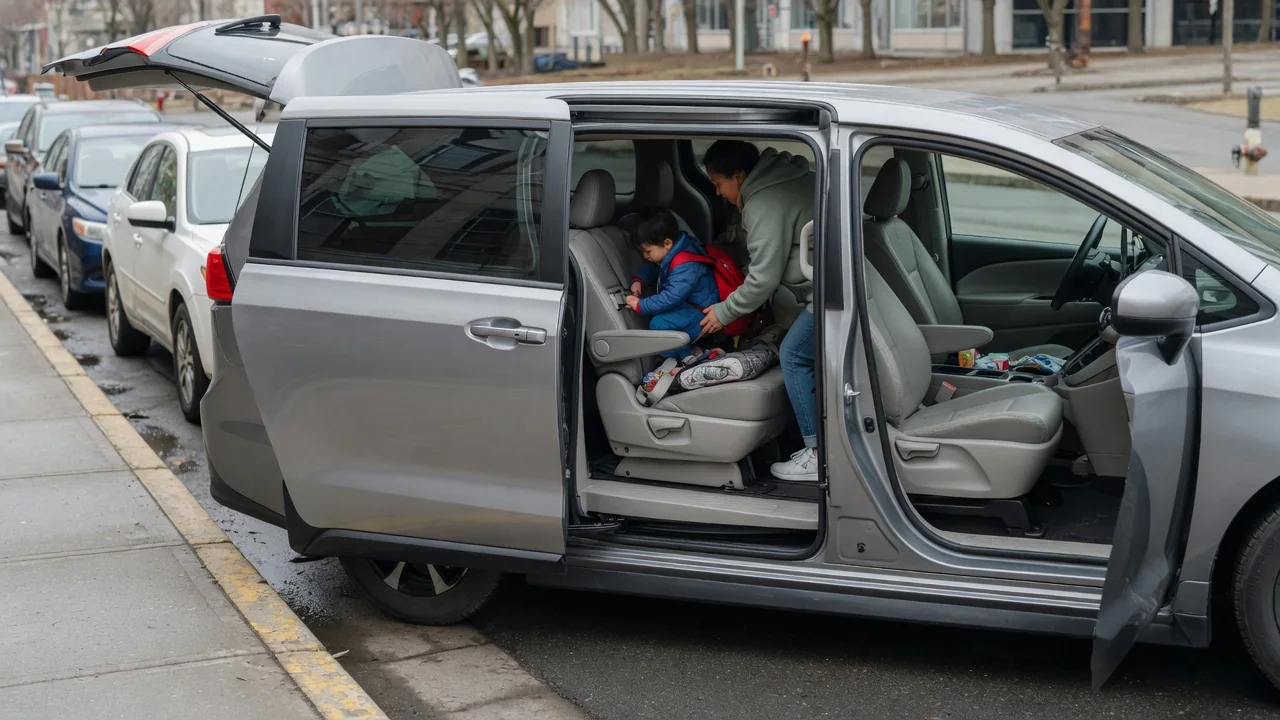
A minivan's sliding doors solve a simple problem: getting people and gear in and out of the second and third rows without needing much space beside the vehicle. Instead of swinging outward on hinges, each door moves rearward along the body on tracks. That design choice affects how the vehicle works in tight parking spots, how easily passengers climb aboard, and what owners should expect in upkeep. Here is how minivan sliding doors are used day to day, and where their advantage ends.
Tight parking
A conventional rear door pivots on hinges at its front edge, so its outer edge sweeps an arc away from the body. Opening it fully takes roughly the door's width in clear space alongside the car. In a narrow parking space, a garage with shelves on the wall, or a curbside spot beside a pole, that arc is often blocked and the door opens only partway. A sliding door moves out from the body just far enough to clear the side panel, then travels backward parallel to the vehicle. The side clearance it needs is small and barely changes with the size of the opening, so the doorway stays usable even when a neighboring car is close.
This also removes a common cause of parking-lot damage. A hinged door pushed open by a child or caught by a gust of wind can strike the next vehicle, a pillar or a wall. Because a sliding door stays close to the body as it travels, its edge is far less likely to hit anything nearby. On a slope, a sliding door does not swing under its own weight the way a hinged door can, though it still takes more effort to move uphill and relies on its open-position catch to stay put, which is worth confirming before letting go.
Passenger access
Once open, a sliding door sits alongside the body behind the opening instead of standing at an angle next to it. That leaves the full width of the doorway unobstructed, so people do not have to step around a door edge. The extra room helps when someone is carrying bags, guiding a child, or helping an older passenger who needs space to turn and sit. Minivans also tend to combine this opening with a fairly low floor and upright cabin, which can reduce climbing and ducking, although step-in height varies from vehicle to vehicle.
For households with young children, child seats are a large part of the case. Installing a seat, buckling a child in, or lifting an infant carrier means an adult has to lean into the cabin, and a wide, clear opening gives more room to do that without twisting around a door. In many layouts the opening also leads to the third row, either through a gap between second-row seats or by tipping or sliding a second-row seat forward. On the street side, a sliding door does not sweep outward into the path of cyclists the way a hinged door can, although passengers still need to check traffic before stepping out.
Many minivans offer power sliding doors that open and close from a button, the key fob or the door handle. They are convenient when hands are full and are typically designed to stop or reverse when they meet an obstruction, but that protection varies and is no substitute for watching the door. Manual doors avoid the extra hardware but need a firm push. Child locks, and whether the power function can be disabled from the driver's seat, depend on the specific vehicle and are explained in its owner's manual.
Maintenance
A sliding door is mechanically more involved than a hinged one. In a common arrangement it is carried by rollers running in upper, lower and center tracks, with latches at the front and rear to hold it closed and a separate catch to hold it open. Power versions add a motor, a cable or drive unit, sensors, and wiring that must flex as the door travels. Each of these parts can wear, collect dirt or drift out of adjustment.
Typical signs of trouble include a door that binds or moves unevenly, grinding or clicking during travel, a door that will not latch fully, or a power door that stops partway and reverses with nothing in the way. Sand, road salt and debris collecting in the lower track are frequent contributors, so keeping the tracks clean is basic preventive care. Lubrication can help, but the right product and the points to treat differ between designs, and heavy grease in an open track can attract grit. The owner's manual or service information for the vehicle is the reliable guide.
A power door that misbehaves is not always an electrical fault. A stiff roller or misaligned latch can make the system sense extra resistance and reverse. Some vehicles need a reset or relearn procedure after battery disconnection or repair. The weatherstripping around the opening deserves attention too, since a worn seal can admit wind noise and water. Because roller, cable and motor repairs are usually more involved than fixing a hinged door, small noises and new stiffness are worth addressing early.
Practical implications and limits
The sliding-door advantage matters most where space beside the vehicle is limited and rear-seat access happens often: narrow home garages, crowded school pickup lines, tight street parking, and routines built around child seats or frequent passengers. For a driver who rarely carries anyone in back and usually parks in open lots, the benefit is smaller, and the door mechanism is mostly one more thing to maintain.
The design has limits as well. The door needs a clear path along the body behind the opening, so a post or object close to the rear quarter panel can stop it short. The opening ends ahead of the rear wheel arch, so long or bulky items usually go through the rear hatch instead. In freezing weather, ice in the tracks or on the seals can make the door hard to move, and forcing a frozen power door strains its mechanism. Opening speed, noise and pinch-protection behavior also differ between vehicles, so the general mechanism does not predict how a particular minivan will perform.
Testing the doors under realistic conditions is the most direct way to judge the benefit: open them in a space similar to your garage or usual parking spot, try them on a slight incline, use every power control, and listen for grinding or hesitation. On a used minivan, uneven panel gaps or a door that must be slammed to latch are worth having inspected before purchase.