How Do Child Locks on Car Doors Work?
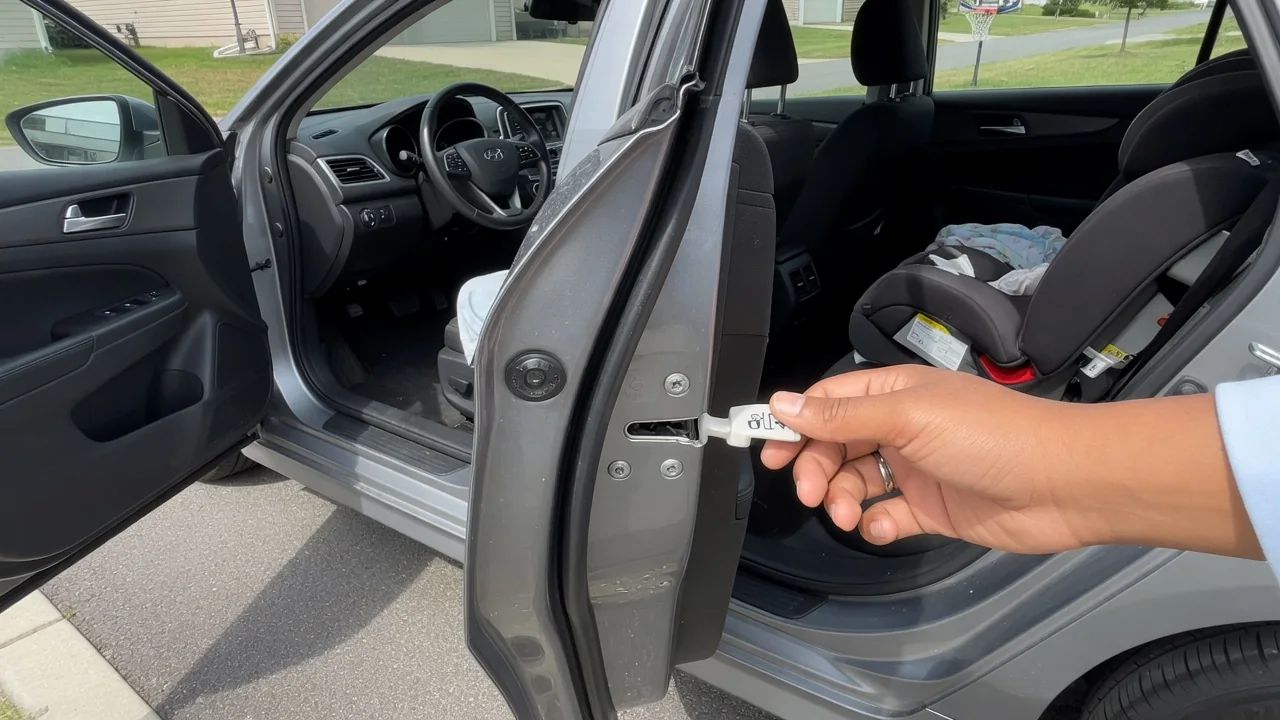
Rear seat passengers, especially young ones, can pull an inside handle at exactly the wrong moment. Understanding how do child locks on car doors work comes down to one idea: the feature disconnects the rear inside handle from the latch while leaving the outside handle working. This guide explains the mechanisms, how to confirm the setting, and what the feature cannot do.
Mechanical and electronic types
The traditional mechanical design is a small lever or slotted switch set into the rear edge of the door, visible only when the door is open. Moving it shifts a linkage inside the latch assembly so the inside handle's cable or rod no longer acts on the release mechanism. The handle still moves, but it pulls against nothing. Because the outside handle uses a separate path into the latch, an adult standing beside the car can still open the door normally.
Electronic versions replace that lever with a small actuator inside the latch, controlled by a button near the driver, often grouped with the window lockout switch, or by a menu in the infotainment screen. Pressing it typically engages both rear doors at once, and an indicator light or message usually confirms the state. Some vehicles link the function to the rear window switches, while others keep them separate. Layouts and behavior differ by manufacturer and model year, so the owner's manual is the reliable reference for a particular vehicle.
Check setting
Checking a manual child lock starts with opening the rear door and looking at its trailing edge near the latch. Most have a small icon, often a child figure or a padlock symbol, with an arrow showing which direction engages the lock. Some designs need the tip of the ignition key or a flat tool turned in a slot rather than a fingertip flick. Each rear door is set independently, so one side can be locked while the other remains free, which is an easy detail to overlook.
The practical confirmation is a simple functional test while parked. Close the door with the lock engaged, sit inside or reach through an open window, and pull the inside handle; the door should stay shut. Then open it from outside to confirm that path still works. With an electronic system, watch for the indicator lamp on the switch or a dashboard message, and repeat the same handle test. Because some vehicles may retain or reset the setting differently after the ignition cycles, checking again before a trip is worthwhile.
Emergency awareness
The most important consequence of an engaged child lock is that rear occupants cannot let themselves out. After a collision, a breakdown, or any situation where the vehicle needs to be left quickly, someone must open the rear doors from outside, or rear passengers must exit through a front door. Adults riding in the back are affected exactly as children are. Drivers who carry older passengers, rideshare riders or coworkers should tell them the lock is on, or switch it off for that journey.
Electronic systems add questions worth answering before an emergency arises. Depending on the design, the rear doors may or may not release their inside handles when power is lost or after an airbag deployment, and manufacturers handle this differently. The owner's manual usually describes that behavior, along with any manual release provisions. It also helps for every regular driver of the vehicle to know where the control is and how to tell its state, because a hidden setting someone else changed can cause confusion at a stressful moment.
Everyday Use and Observations
In daily driving the feature is nearly invisible. The rear doors close, lock and unlock with the central locking as usual, and the outside handles behave normally once the car is unlocked. The only difference appears when a back seat passenger pulls the inside handle and nothing happens. That is frequently mistaken for a broken handle or a failed latch, particularly after a car wash, a service visit, or a used car purchase, when a lever on the door edge may have been moved unnoticed.
Child locks are also separate from the central locking system and from window lockout. Central locking stops the doors being opened from outside and, on many vehicles, the inside handle overrides it with one or two pulls; the child lock removes that inside override on rear doors only. A window lockout switch disables the rear window controls and, on some models, shares a button with the electronic door function. Knowing which control does what avoids assuming the rear cabin is secured when only the windows are restricted.
Limits and Next Steps
A child lock controls one thing: whether the inside rear handle can open the door. It does not keep the door locked against someone outside, does not stop a child from unbuckling a seat belt or opening a window, and has no effect on front doors. It is also no substitute for supervision. Children should never be left alone in a vehicle, and the lock should be treated as one layer of protection against a door opening in traffic or into a passing cyclist.
If a rear door will not open from inside with the lock clearly disengaged, or opens from inside despite the lock being set, the latch, cable, or actuator deserves inspection. A lever that feels loose, an indicator that disagrees with the door's behavior, or a door that will not open from either handle are similar signs. Door latches sit close to side airbag components and wiring in many vehicles, so diagnosis is best left to a qualified technician who can check the vehicle-specific design.