What Is a Sliding Center Armrest?
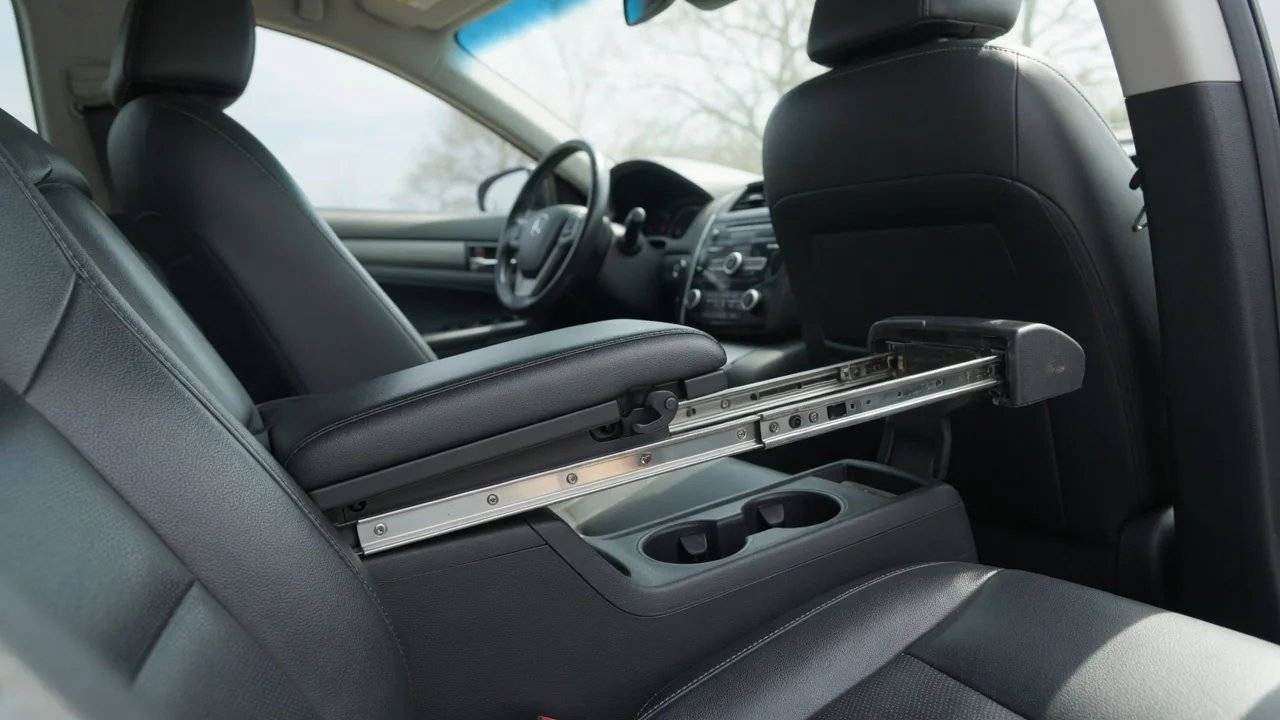
What is a sliding center armrest? It is the padded lid or pad on the console between the front seats that moves forward and backward on a track instead of staying fixed in one spot. That travel lets drivers of different heights rest an elbow comfortably and changes how the storage bin underneath is reached. Designs differ noticeably from one vehicle to another.
Comfort
A fixed armrest suits only the driver whose seat happens to sit in the position the designers assumed. Move the seat forward, as shorter drivers often do, and the pad ends up behind the elbow, leaving the forearm unsupported. A sliding armrest corrects that mismatch by following the seat, so the elbow lands on padding rather than hanging in the air or perching on the hard console edge. Supporting the forearm takes weight off the shoulder and neck, which matters most on long highway stretches.
Comfort also depends on what the right arm is doing. In a vehicle with a console-mounted shifter, a pad pushed fully forward can crowd the lever or the parking brake handle, so many drivers pull it back in town and slide it forward for cruising. Some designs add height adjustment through a ratcheting hinge, while others slide only. Padding thickness, covering material and total travel vary by model and trim level, so the feel in one car says little about the next.
Storage access
On most consoles the armrest doubles as the lid of a storage bin, and the sliding mechanism changes how that lid behaves. Typically the pad rides on rails attached to a hinged frame, so it can slide and lift as separate motions. In some vehicles the lid must be pushed back to its rearmost position before the latch releases; in others it opens from wherever it sits. Trying the latch at both ends of the travel quickly shows which arrangement a particular car uses.
Sliding the pad can also uncover or cover features around the bin. Pulled rearward, it may expose cupholders, a shallow tray or a charging port that the pad otherwise overhangs; pushed forward, it may shade those same items while giving the passenger behind easier reach to rear vents or outlets on the back of the console. Two-tier bins, with a shallow upper tray above a deeper compartment, sometimes use separate release tabs. The layout is specific to each console, and the owner's manual usually illustrates it.
Fit
Fit describes how well the armrest matches both the occupant and the vehicle. For the occupant, the test is simple: with the seat set for proper pedal reach and steering wheel distance, the elbow should rest on the pad with the shoulder relaxed and the hand still comfortably on the wheel or shifter. If the pad sits too low even at its best position, sliding alone will not fix it, and a height-adjustable design or a different seat height setting becomes the relevant variable.
For the vehicle, fit matters most when an armrest is added or replaced. Factory sliding armrests are engineered around a specific console, with mounting points, latch geometry and trim contours that rarely carry over between models or even between generations of the same model. Aftermarket units are sold in both vehicle-specific and universal styles, and their clearance around seat belt buckles, the parking brake and seat travel has to be confirmed against the actual car. Part listings should be checked for the exact model year and trim before purchase.
Everyday Use and Observations
In daily driving the mechanism reveals itself through feel. A healthy sliding armrest moves with steady resistance, holds wherever it is left, and stays put under the weight of an arm during braking. Some use detents that click into set positions, while others rely on friction and stop anywhere along the track. Households that share a car notice the benefit most, since each driver can reset the pad in a second after adjusting the seat and mirrors.
Wear shows up in recognizable ways. A pad that creeps backward when leaned on, rattles over rough pavement, rocks side to side or refuses to stay latched points toward worn guides, a tired friction mechanism or a loose hinge, though the exact cause depends on the design. Crumbs, coins and spilled drinks can also foul the track and make travel gritty or uneven. The covering tends to wear first where the elbow rests, so creasing or flattening of the padding in one spot is common on higher-mileage vehicles.
Limits and Next Steps
A sliding armrest has limits worth understanding. Travel is usually modest, so it will not close a large gap for a driver seated far forward, and it cannot compensate for a pad that is too low or too narrow. It is a comfort feature, not a structural support, so leaning body weight on it while climbing between seats or bracing against it can strain the rails and hinge. Not every trim level includes the feature either; a console may look identical yet carry a fixed lid.
The practical next step is to test the armrest in the vehicle itself. Set the seat first, then slide the pad through its full range, open the bin at several positions and check that nothing blocks the shifter, parking brake or seat belt buckle. When shopping for a vehicle, the equipment list or window sticker confirms whether the feature is fitted. If an existing armrest has become loose or will not hold position, a dealer or trim specialist can identify whether adjustment or replacement parts suit that particular console.