What Is a Lug-Centric Wheel? Centering, Installation and Vibration
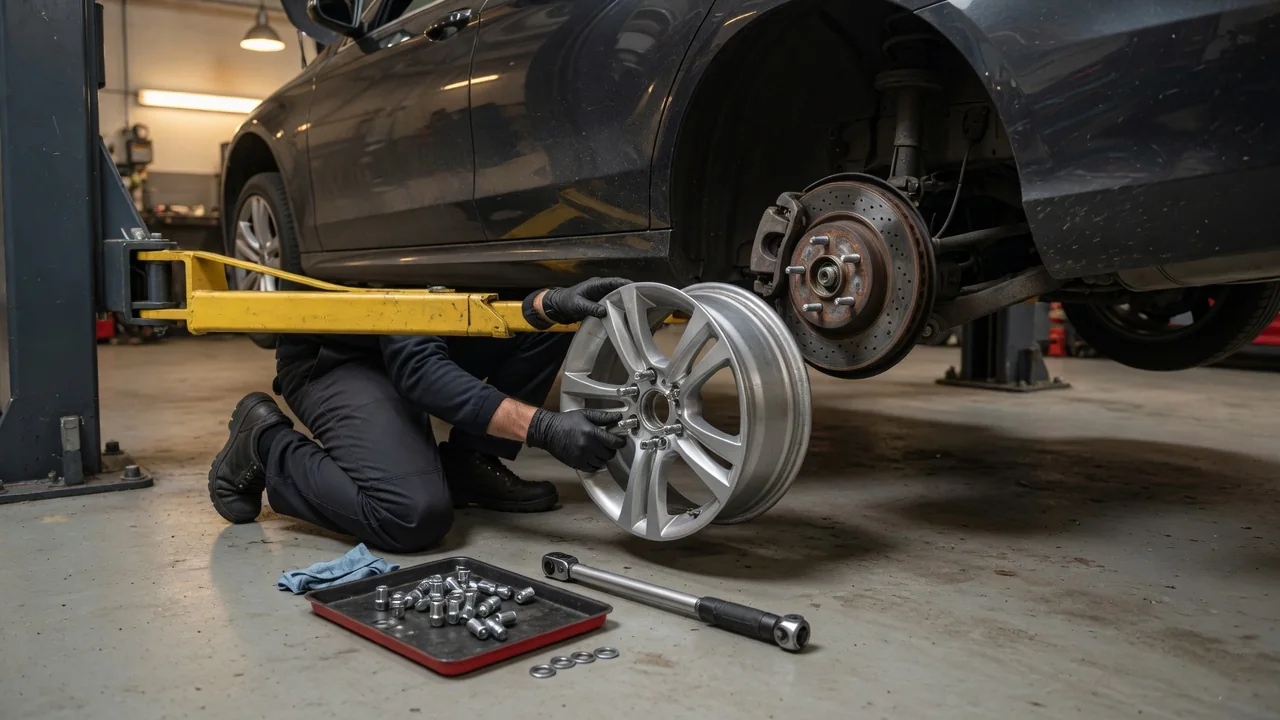
A lug-centric wheel is a wheel that is centered on the vehicle's hub by its lug nuts or lug bolts rather than by a close fit around the hub's center pilot. On a wheel fitment chart, the lug centric wheel meaning is simple: the shaped seats of the fasteners do the locating work. Knowing how that works explains why installation technique matters so much with this design and why mistakes often show up as vibration.
Fastener Centering
On a lug-centric wheel, the center bore is larger than the hub's raised center pilot, so the hub does not hold the wheel in position. Location comes from the bolt holes instead. Each hole has a machined seat, usually conical (tapered) or spherical (often called a ball or radius seat), that matches the seat on the lug nut or bolt. As the fasteners tighten, these mating surfaces push the wheel sideways until every hole sits concentric with its stud. Because the studs are arranged on a bolt circle centered on the axle, the wheel ends up centered on the axis of rotation once all fasteners are seated evenly.
A hub-centric wheel works differently. Its center bore closely matches the hub pilot, so the hub provides the location and the fasteners mainly supply clamping force. In both designs, though, the wheel is held in place by that clamping force pressing the wheel's mounting face against the hub face. Friction between those surfaces carries most of the driving, braking and cornering loads, which is why proper clamping matters no matter which part does the centering.
Centering only works when the seats match. A conical nut in a spherical seat, or the reverse, touches the wheel along a narrow line instead of across the full seat. That contact cannot locate the wheel accurately, and it can deform or loosen in service. Conical hardware commonly uses a 60-degree taper, but seat type and angle should always be confirmed for the specific wheel. Flat-seat nuts with a separate washer do not self-center at all and are generally intended for wheels that locate on the hub.
Installation
Good installation starts with clean surfaces. Rust, dirt, flaking paint or debris on the hub face or the wheel's mounting pad can tilt the wheel or keep it from seating flat. Studs and nut threads should be clean and undamaged, and the seats in the wheel should be free of burrs or grit. The fasteners must have the correct seat type and enough thread engagement for the wheel's mounting pad thickness.
The tightening sequence is where lug-centric wheels differ most in practice. With the vehicle raised, start every nut or bolt by hand, then snug them gradually in a star or crisscross pattern while the wheel is off the ground or just touching it. This lets the wheel move freely and settle into its centered position as all the seats engage together. Running one fastener fully tight first can pull the wheel off-center and lock it there. After snugging, lower the vehicle and bring the fasteners to the manufacturer's torque specification with a torque wrench, again in a star pattern and in more than one pass. Impact wrenches can overshoot and tighten unevenly, so they are a poor choice for final torque.
Aftermarket wheels are often made with a large center bore so they fit several vehicles. Hub-centric rings can fill the gap between that bore and the hub pilot. They help hold the wheel close to center while the fasteners are started, but on a conical or spherical seat wheel the fasteners still provide the final location. Many wheel makers and shops also recommend rechecking torque after a short distance, because seats can settle slightly, particularly on new wheels.
Vibration
If a lug-centric wheel is clamped even slightly off the axis of rotation, the whole wheel and tire assembly turns eccentrically. That creates radial runout, and the assembly's mass is no longer centered on the axle. The result is a vibration that grows with speed and is often most noticeable at highway speeds, felt through the steering wheel when a front wheel is affected or through the seat and floor when a rear wheel is affected. A wheel that was perfectly balanced on a machine can still vibrate on the car if it is mounted off-center.
Balancing adds another variable. Many balancing machines locate the wheel on a cone in the center bore. On a lug-centric wheel, that bore is not the reference the vehicle uses, so some shops use flange or lug-pattern adapters that locate the wheel through its bolt holes, the same way the car does. When a wheel is balanced on one reference and mounted on another, small differences can remain.
Off-center mounting is only one possible cause. Imbalance, a bent rim, a tire with internal irregularities, worn suspension or steering parts, and brake rotor problems can all produce vibration, and rotor issues usually show up mainly while braking. If vibration appeared right after wheels were mounted, loosening and re-tightening them in the correct sequence is a reasonable first check. A wheel that wobbles, clunks or shows loose fasteners is a safety issue and should be inspected before further driving.
Practical Implications and Limits
A lug-centric design is not inherently inferior. It is a legitimate engineering approach that performs well when the parts match and the work is done carefully. Its main trade-off is a smaller margin for error: the quality of the result depends heavily on the person installing the wheel, while a hub-centric fit adds a fixed mechanical reference that is less sensitive to technique.
For owners, the most useful step is knowing which system the vehicle and its wheels use. The owner's manual, factory service information or the wheel manufacturer can confirm this, and comparing the wheel's bore to the hub pilot gives a quick indication. Fasteners are not universal: switching between factory and aftermarket wheels often requires different lug nuts or bolts, so it makes sense to keep the correct hardware with each set. Wheel spacers and adapters add extra mating surfaces, and each one is another place where centering and clamping must be correct.
This explanation covers general mechanisms, not vehicle-specific procedures. Torque values, thread sizes, seat types and whether a centering ring is recommended depend on the particular vehicle and wheel, and those details belong to the manufacturer's documentation. Proper fastener centering also has clear limits: it cannot correct a bent wheel, an incorrect offset, or a bolt pattern that does not match the hub.