What Is a Factory Vehicle Software Flash?
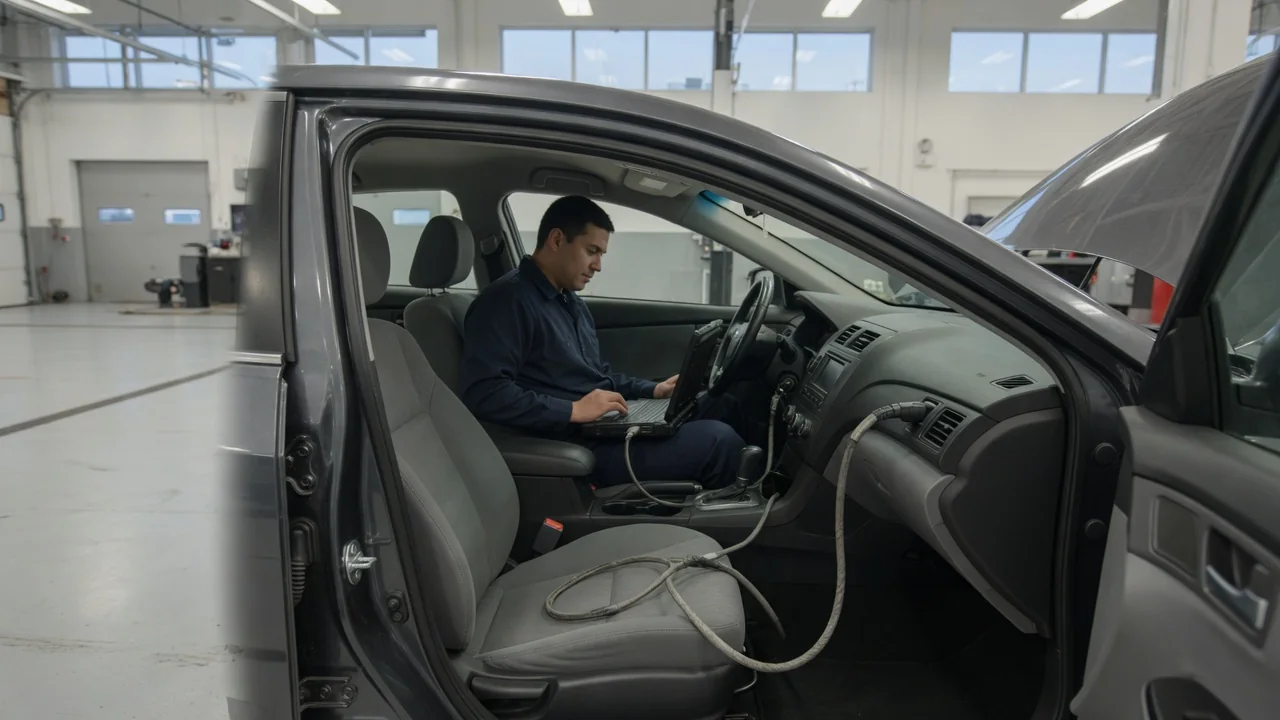
A factory vehicle software flash is the step on the assembly line where a car's electronic control modules receive the software and settings that match that specific vehicle. Modern cars rely on many onboard computers, and many leave the supplier with only basic or generic software. Car production software programming turns those generic parts into a working, correctly configured system. The process generally has three parts: setting up the control modules, coding the vehicle variant, and verifying the result.
Control module setup
Most control modules contain flash memory that can be rewritten. Examples include the engine controller, transmission controller, body controller, airbag module, and infotainment unit. A supplier typically ships each module with a bootloader, a small protected program whose job is to accept new software safely. Depending on the manufacturer's strategy, the module may also arrive with a complete application already loaded, or with a placeholder that must be replaced at the plant. Which approach a factory uses is a manufacturer decision and can differ between vehicle lines.
When the vehicle reaches a programming station, a tester connects through the diagnostic port or a dedicated connector. Communication commonly uses standardized diagnostic protocols carried over the vehicle's network, such as CAN or, on newer architectures, automotive Ethernet. The tester identifies each module, requests a programming session, and passes a security check so that only authorized tools can write to memory. It then erases the relevant memory areas and transfers the application software and calibration data in blocks.
The software for each module is chosen from records, not by the operator. The plant's manufacturing system links the vehicle identification number to its build order, which lists the engine, transmission, market, and options. That record tells the programming station which software package each module should receive. Because a vehicle may contain many programmable modules, plants often program several in parallel or spread the work across multiple stations to keep the line moving. Stable battery voltage matters during this step, so external power supplies are generally used to prevent an interrupted write.
Variant coding
Flashing loads software; variant coding tells that software which version of the vehicle it is running in. A single software build is often designed to cover many configurations. Coding sets parameters that switch features on or off and adjust behavior, such as the destination market, left- or right-hand drive, lighting type, wheel and tire size, the presence of a towing package, or which driver-assistance sensors are installed. Without correct coding, a module may expect hardware that is absent or ignore hardware that is present.
Coding data is usually stored as configuration values in nonvolatile memory, separate from the main program. Some manufacturers keep a central vehicle configuration that individual modules read, while others code each module directly. In either case, the values come from the same build record used to select the software. Modules that must recognize one another may also be paired at this stage. Immobilizer components, keys, and some security-related modules often require learning or matching procedures so that the parts work together only in that vehicle.
Some setup depends on the physical assembly rather than the order itself. Certain steering angle sensors, cameras, and radar units need initial calibration or zero-point learning once installed, because mounting tolerances vary from one vehicle to the next. Whether that happens during the coding step, on a dedicated alignment stand, or both depends on the system design.
Verification
After programming and coding, the plant confirms that each module holds what it should. A common method is to read back identification data, such as software part numbers, calibration identifiers, and hardware versions, and compare them with the expected values for that vehicle. Modules also typically check the integrity of their own memory using checksums or digital signatures, and will refuse to run an image that fails validation.
Verification extends beyond the stored data. End-of-line testing checks that modules communicate correctly across the network, that diagnostic trouble codes set during assembly are reviewed and cleared, and that functions controlled by the new software respond as intended. Lights, gauges, warning chimes, and driver aids may be exercised at test stations, and some checks continue on a rolling road or a short test track.
Results are logged against the VIN. That traceability record shows which software and coding each module received and whether every step passed. If a later quality concern or software update involves a specific software version, the record helps identify which vehicles are affected. A vehicle that fails verification is usually routed to a repair area for reprogramming and retesting before it can be released.
Practical implications and limits
For owners, the factory flash explains why two vehicles sold under the same model name can behave differently: they may carry different software releases or coding even when the hardware looks identical. It also explains why replacing a control module is rarely plug-and-play. A replacement part often arrives blank or generically programmed and needs software, coding, and sometimes component matching with a dealer or suitably equipped workshop tool before it functions correctly.
The software installed at delivery is not necessarily final. Manufacturers can release updates during service visits or, on vehicles designed for it, through over-the-air delivery. These updates rely on mechanisms similar to the factory process, which is why interrupting one, or attempting it with low battery voltage, can leave a module unusable until it is recovered. Aftermarket reprogramming changes the same memory the factory wrote and can affect emissions compliance, warranty coverage, or compatibility with future updates, depending on the vehicle and jurisdiction.
General descriptions have clear limits. Protocols, security methods, the number of programmable modules, and the division of work between supplier and plant vary by manufacturer, platform, and model year. For details about a particular vehicle, the manufacturer's service information is the reliable reference rather than a general overview of how factory software flashing typically works.