What Is a Car Factory Roll Test? How End-of-Line Vehicle Testing Works
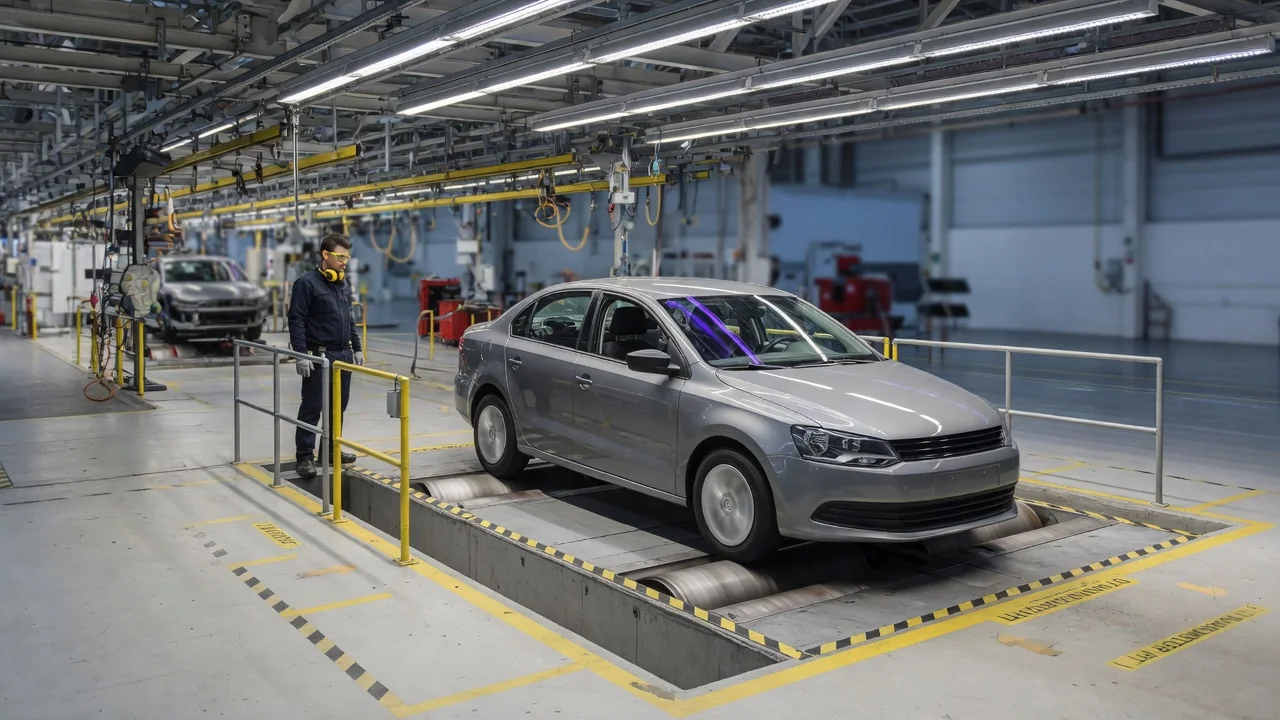
A car factory roll test is one of the final checks a new vehicle goes through before it leaves the assembly plant. Instead of being driven on a road, the finished car is positioned on a set of rollers built into the floor. There its powertrain, brakes and electronics can be exercised at speed while the vehicle stays in one place. This vehicle production roll test lets the plant confirm that major systems work together and catch faults while they are still easy to fix.
Drivetrain motion on the rollers
The roll test stand is essentially a chassis dynamometer adapted for production use. The car is driven or guided onto the stand so that its wheels rest on pairs of rollers, and lateral guides or restraints keep it centered. When the operator accelerates, power flows the same way it would on the road: from the engine or electric motor, through the transmission and driveline, to the wheels. Because the tires turn the rollers instead of pushing against pavement, the car can reach road-like wheel speeds without moving forward. Many stands can also apply resistance to the rollers through a brake unit or electric machine, so the drivetrain works against a load rather than spinning freely.
Drive layout matters. A front-wheel-drive or rear-wheel-drive car mainly needs the driven axle on powered or load-absorbing rollers. All-wheel-drive vehicles are usually tested on stands with roller sets for both axles, linked mechanically or controlled electronically so front and rear wheels turn at matched speeds. Without that synchronization, the center coupling or differential could be stressed, and the readings would not reflect normal operation. Electrified vehicles follow the same principle, with the added ability to check how the electric drive and regenerative braking behave under controlled conditions.
The sequence typically includes starting the vehicle, idling, accelerating through the gear range, shifting up and down, coasting and braking, and in some cases engaging reverse. The exact steps, speeds and durations are defined by each manufacturer and can differ between models and plants, so no single sequence applies to every car.
Instruments and test-stand equipment
The rollers themselves are measuring devices. Speed sensors or encoders on each roller record how fast the wheels are turning, and load units can measure the force or torque passing through the tire contact patch. These readings give the plant an independent reference that does not depend on the vehicle's own sensors. Where brakes are checked on the rollers, the stand can measure braking force at each wheel; some plants use a separate dedicated brake tester for this step instead.
At the same time, the vehicle is usually connected to the plant's test system through its diagnostic connector, often with a wireless adapter so the operator can move freely. Through this link the system can read data from the vehicle's control modules, check for stored diagnostic trouble codes, confirm that the correct software and configuration are installed, and trigger self-tests for systems such as anti-lock brakes or stability control. A screen in front of the operator typically displays step-by-step prompts, and the results are stored in the build record tied to the vehicle identification number.
Human perception still plays a role. The operator sits in the driver's seat during the test and can notice unusual sounds, vibrations through the steering wheel or seat, warning lamps on the instrument cluster, and anything that simply feels wrong. Some stands also use acoustic or vibration sensors, but the operator's observations remain part of the process at many plants.
Fault detection during the roll test
Comparing the stand's measurements with the vehicle's own data is one of the most useful ways to find problems. If the speedometer reading or a wheel speed sensor signal does not match the roller speed, the cause may be a faulty sensor, a damaged connector, a wiring error or an incorrect configuration. A wheel that shows drag when it should roll freely can point to a binding brake. Uneven braking force from side to side suggests an issue on one corner that would make the car pull under braking.
Other faults reveal themselves through behavior rather than numbers. Gear whine, clunks during load changes, harsh or delayed shifts, and vibrations at particular speeds can indicate assembly problems in the transmission, driveshafts, wheel mounting or tire balance. Diagnostic trouble codes that appear when systems are exercised at speed often trace back to loose plugs or modules that did not initialize correctly. Running the car under load can surface issues that a stationary electrical check would miss.
Each check is evaluated against limits set by the manufacturer. A vehicle that falls outside them is flagged rather than released, routed to a repair area, corrected and then tested again. Because results are recorded for every vehicle, recurring failures can also be traced back to a specific station, part batch or process upstream, which helps the plant prevent the same fault on later cars.
Practical implications and limits
For a car owner, a passed roll test means the vehicle met the factory's functional checks under controlled conditions. It does not reproduce everything a car experiences in daily driving. On rollers the car does not steer through corners, hit potholes, face crosswinds, drive in rain or sit in traffic for an hour of heat buildup. Wind noise, suspension rattles over rough pavement and water leaks fall largely outside what rollers can evaluate, which is why manufacturers generally rely on additional checks such as water tests, rough-surface tracks or sampled road drives alongside the roll test. Which of these a given plant uses is specific to that manufacturer.
Some problems also develop only with time and mileage, such as intermittent electrical faults, components that loosen after repeated heat cycles, or wear-related noises. A roll test cannot predict those, so the factory warranty and the dealer's pre-delivery inspection remain important. If a new car shows a warning light, vibration or unusual noise, it is worth having it checked rather than assuming the factory test rules out a defect.
The same roller principle appears outside the factory, in emissions testing and repair-shop dynamometers, but those setups serve different purposes and may not handle every drivetrain. Owner's manuals for many all-wheel-drive vehicles include specific guidance about dynamometer testing, so following the instructions for your vehicle before it is put on any roller equipment helps avoid driveline damage.