How Are Car Electrical Systems Checked at the Factory?
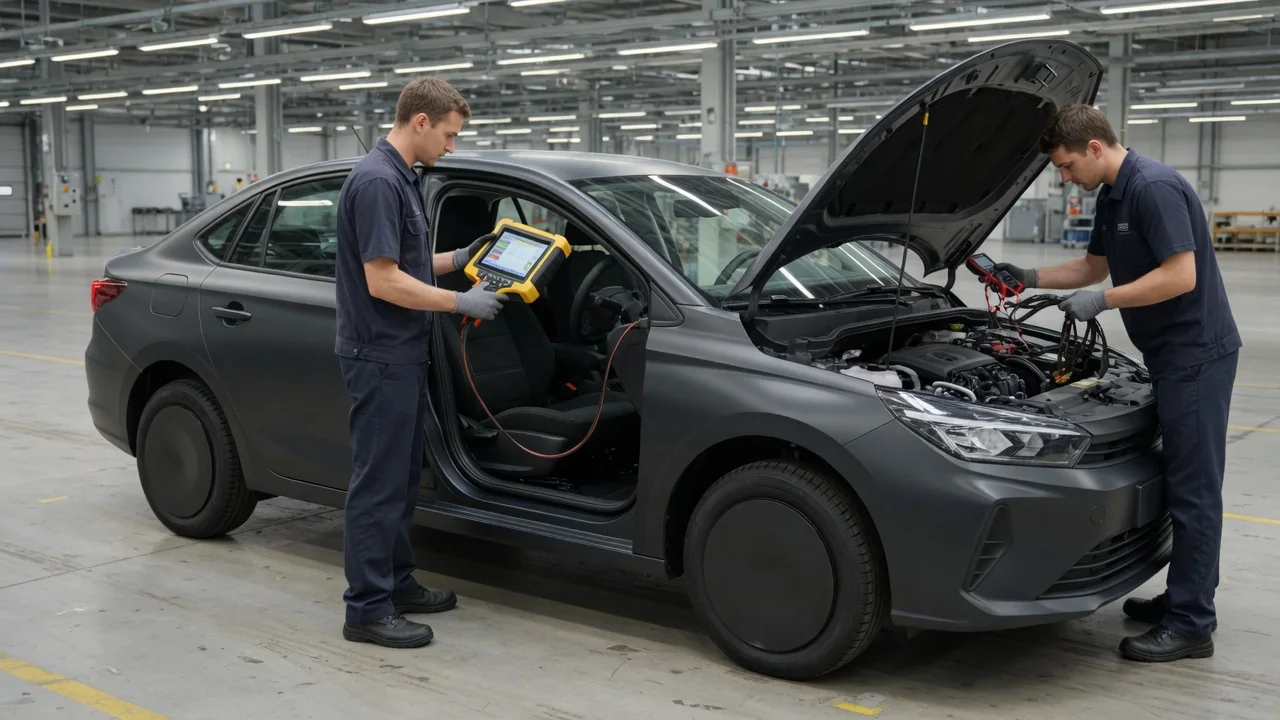
A modern vehicle relies on wiring harnesses, connectors, control modules and data networks that must all work together the first time the ignition is switched on. Manufacturers therefore check electrical systems at several points, from harness production to the final end of line car electrical test. Exact procedures vary by manufacturer, plant and model, but the general approach is consistent: verify circuits, record the results against the vehicle, and repair and re-test anything that fails before the car leaves the factory.
Circuit checks from harness to end of line
Electrical checking typically starts before a harness reaches the assembly line. Suppliers commonly build and test wiring harnesses on test boards that plug into every connector. These boards check each circuit for continuity, for shorts between wires and for correct pin positions. Some test setups also confirm that terminals are fully seated and that locking features are engaged. A terminal that backs out of its cavity can pass a quick check and still lose contact later. Catching these problems at the harness stage costs less than finding them inside a finished car.
During assembly, the focus shifts to the connections made on the line. Workers and automated systems connect harnesses to modules, sensors, lamps and the battery. Many connectors have secondary locks and give an audible or tactile click to show full engagement. Ground points and battery terminals are usually tightened with controlled tools so the fastening torque can be verified, because a loose ground can cause faults that are hard to trace. Some plants also use cameras or sensors to confirm that specific connectors are present and seated.
The end of line car electrical test brings these checks together. A tester is typically connected to the vehicle's diagnostic port. The station may program or update control modules, apply configuration (coding) that matches the vehicle's equipment, and confirm that every expected module communicates on the vehicle networks. Functional checks then exercise lights, wipers, horn, windows, locks, displays and warning lamps. An operator may follow prompts, or diagnostic commands may switch outputs on and off directly. Many plants also check charging behavior, read stored fault codes and measure current draw while the vehicle is asleep, which catches circuits that do not shut down. Where driver-assistance cameras or radar sensors are fitted, they may be calibrated at this stage. A water-leak test may be followed by another electrical check, since moisture can affect connectors.
Diagnostic records and traceability
Factory electrical checks generate data, and that data is usually tied to the vehicle identification number (VIN). Typical records can include: • which test stations the vehicle passed through; • pass or fail results for each step; • measured values; • the software and calibration versions loaded into each control module; • configuration data; • any fault codes read during testing; Part identifiers and supplier batch information for key electrical components may also be linked to the same vehicle record.
These records serve several purposes. In the plant, they act as a release gate: a vehicle with missing or failed test steps is normally held rather than shipped. Quality engineers use aggregated results to spot patterns, such as one connector that fails repeatedly or a supplier batch that causes faults, and then correct the process upstream. Later, the records support traceability. If a defect is found in the field, manufacturers can use build and software data to narrow down which vehicles might be affected. This is one reason software versions and component batches are recorded at all.
How much of this record is visible after delivery varies. Dealer and manufacturer service systems can often show a vehicle's build configuration and module software levels. Detailed plant test logs, however, generally stay internal to the manufacturer. An owner usually cannot request them or read them with a generic scan tool.
Repair and re-testing before release
When a vehicle fails an electrical check, it is typically moved off the main line to a repair or rework area so it does not hold up production. Technicians start from the failure record, which shows which step failed and often which fault codes or measured values were involved. Troubleshooting then follows familiar workshop methods. Technicians consult wiring diagrams, check connectors for incomplete seating or damaged terminals, and measure voltage and resistance. They also confirm whether a module is receiving power, ground and network signals.
Repairs range from reseating a connector or tightening a ground to replacing a damaged harness section, a faulty module, or a component such as a lamp or switch. Software-related failures may be fixed by reprogramming a module or correcting its configuration. After repair, the vehicle is normally re-tested on the steps that failed and often on related steps, because disturbing a harness to fix one fault can create another. The repair action and the new results are added to the vehicle's record. This lets the plant confirm that the car passed and analyze why the failure happened.
Practical implications and limits
For owners, factory electrical testing means a new car should leave the plant with its modules communicating, its software configured for its equipment and its basic functions confirmed. It does not mean every possible fault has been ruled out. End-of-line tests take a short time and run on a new vehicle in a controlled environment. They cannot reproduce years of vibration, temperature cycling, road salt or moisture. Intermittent faults, connectors that loosen over time and components that wear with age can appear long after a vehicle passed every factory check.
There are also steps between the factory and the driveway. Vehicles are often shipped in a transport or low-power mode to protect the battery. Dealers typically perform a pre-delivery inspection that returns the car to normal operation and checks basic functions. Problems that arise in transit or storage, such as a discharged battery, are handled at that stage rather than at the plant.
When an electrical problem appears in a new or nearly new car, the practical route is the manufacturer's warranty process at an authorized service facility. These facilities have the brand's diagnostic tools, software updates and service information. A generic code reader can show standard fault codes, but it may not reach every module or display the configuration data set at the factory. The owner's manual remains the best source for vehicle-specific details such as fuse locations and warning lamp meanings, because factory test methods and electrical layouts differ between manufacturers and models.