Why Do Some Car Modules Need Coding After Replacement?
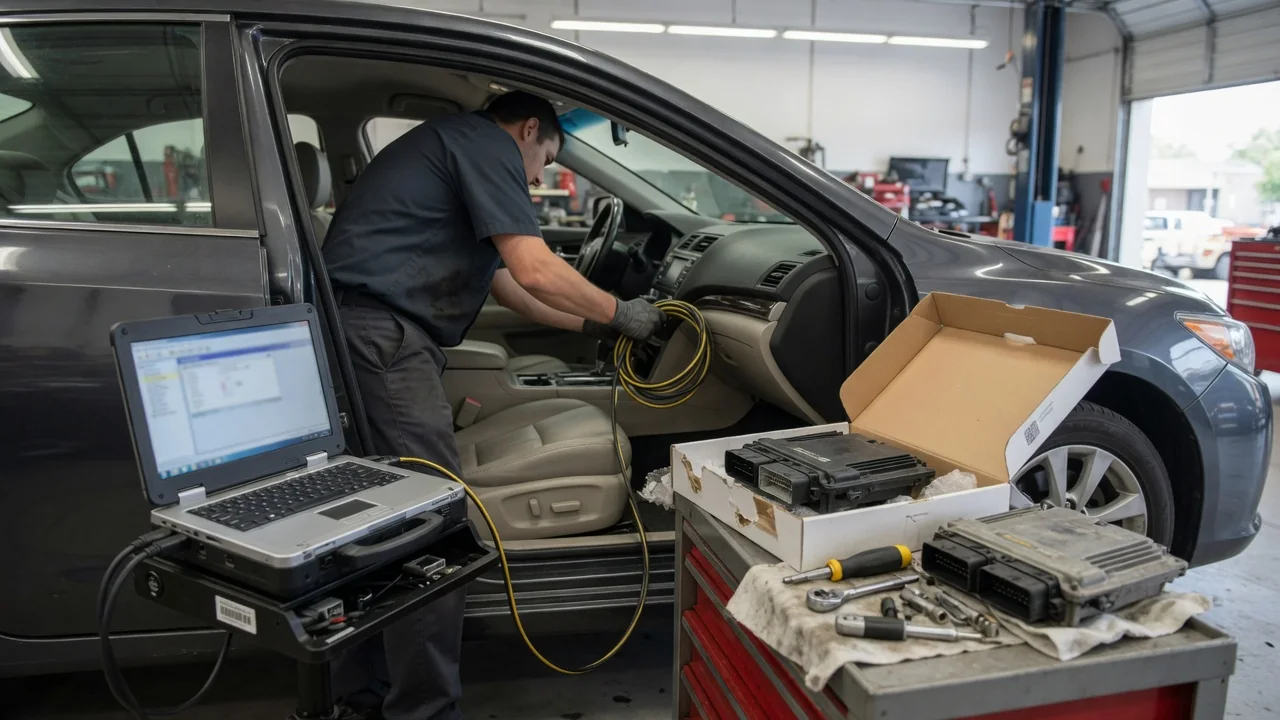
When a control module fails and is replaced, many owners expect the new part to work as soon as it is plugged in. On many modern vehicles that is not the case. A replacement unit may need coding, programming, or an adaptation procedure before it behaves correctly. The reasons fall into three groups. The module must learn how this particular vehicle is configured. It must be accepted by the vehicle's security systems. And the result must be verified so that hidden faults do not remain.
Vehicle configuration
A single part number for a body control module, instrument cluster, or gateway is often designed to serve many versions of a vehicle line. The same hardware may be installed in cars with different engines, transmissions, lighting packages, driver assistance features, and comfort options. Instead of manufacturing a separate module for every combination, manufacturers commonly ship a generic unit. They then rely on configuration data, often called coding or variant coding, to tell it which equipment is actually present. That data can define whether the car has fog lamps, which tire size the speedometer should assume, whether a trailer hitch is fitted, which language the display uses, or which networked modules the unit should expect to hear from. Without it, a module may run on default settings that do not match the vehicle, or it may not operate at all.
It helps to separate three terms that are often used loosely. Programming, sometimes called flashing, writes the operating software into the module's memory. Coding sets parameters within that software to match the vehicle's equipment. Adaptation or calibration teaches the module values that depend on the individual car, such as the end stops of a throttle body, the zero position of a steering angle sensor, or the learned shift behavior of a transmission. Depending on the manufacturer and the module, a replacement may need one, two, or all three steps. The exact sequence is defined by the manufacturer's service information, not by a general rule.
Configuration also matters because modules do not work in isolation. On a networked vehicle, controllers exchange messages over buses such as CAN, LIN, or automotive Ethernet. Each module may expect certain messages from certain partners and may log a fault if a message is missing or formatted differently. Many vehicles also store the vehicle identification number and equipment data in more than one controller, and some compare those records during startup. A new module that carries no vehicle data, or data from another car, can create mismatches. These can show up as warning lights, disabled functions, or communication fault codes in modules that were never touched.
Security
Security is the second major vehicle module coding reason. Immobilizer systems are designed so that the engine will only run when the engine control unit, the immobilizer or body controller, and an authorized key recognize one another. This is usually achieved by storing matching secret values or identifiers in the participating modules and keys. A new replacement unit has not been paired with the car, so it cannot complete that authentication. If modules were accepted automatically when swapped in, a thief could try to defeat the immobilizer by installing a controller that does not ask for a valid key. The pairing procedure is the barrier that prevents this.
Many manufacturers also restrict who can perform the pairing. Access to security-relevant functions often requires a diagnostic tool that can complete a challenge-response exchange with the module, and in many cases an online connection to the manufacturer's server so the request can be authorized and logged. Some vehicles protect components such as infotainment units, instrument clusters, or other controllers so that a part taken from another vehicle stays locked or limited until it is released for the new car. Which modules are covered, and whether a used part can be reassigned, varies widely between manufacturers and model years.
Security in this sense also covers software integrity. Controllers involved in braking, steering, airbags, and emissions control may only accept software that has been digitally signed by the manufacturer and may reject altered files. This guards against tampering and helps ensure the module runs a validated release that fits the rest of the vehicle. It is one reason a replacement may need to be updated to a particular software level rather than used with whatever version it shipped with.
Verification
Coding and programming are only complete once the result has been checked. A typical verification routine starts with reading fault codes from all modules on the vehicle, not just the replaced one, because configuration errors often surface elsewhere on the network. Codes stored during the repair itself, such as communication faults logged while the module was disconnected, are usually cleared, and the system is then checked again. A fault that returns after clearing points to a remaining problem rather than a leftover record from the work.
Beyond fault codes, the functions controlled by the module need to be exercised. For a body controller, that might mean checking lighting, locks, wipers, and windows. For a module tied to driver assistance, a separate calibration of cameras or radar may be specified after replacement, and some calibrations require a defined target setup or a road drive under particular conditions. Steering angle sensors, ride height sensors, and transmission adaptations may also need resetting or relearning. Service information usually lists these follow-up tasks, and some diagnostic tools guide the technician through them.
A useful part of verification is recording the module's identification data, software version, and coding before and after the work. When the original unit can still communicate, saving its coding provides a reference that can be transferred or compared, which makes later diagnosis easier.
Practical implications and limits
For owners, the main consequence is that replacing a module is often a two-part job: fitting the hardware and completing the software work. Whether a part is plug-and-play depends on the vehicle, the module, and its role. Some simpler components need nothing at all, while immobilizer-related or safety-related controllers may not work without manufacturer-level access. Before buying a part, it is worth confirming what the service information requires and whether the installing shop has a tool and access capable of performing those steps on that specific vehicle.
Used and remanufactured modules deserve particular care. A unit removed from another car may carry that car's identity, security pairing, or protection lock, and not every unit can be reset or reassigned. Some suppliers offer cloning or pre-coding services, but availability depends on the module and the provider. General-purpose scan tools can perform coding on some vehicles and not others. When a procedure is incomplete, symptoms can range from a single warning light to a car that will not start, so a module that seems defective after installation may simply be uncoded. Following the manufacturer's procedure remains the most reliable path.