How Do Car Modules Know Vehicle Speed?
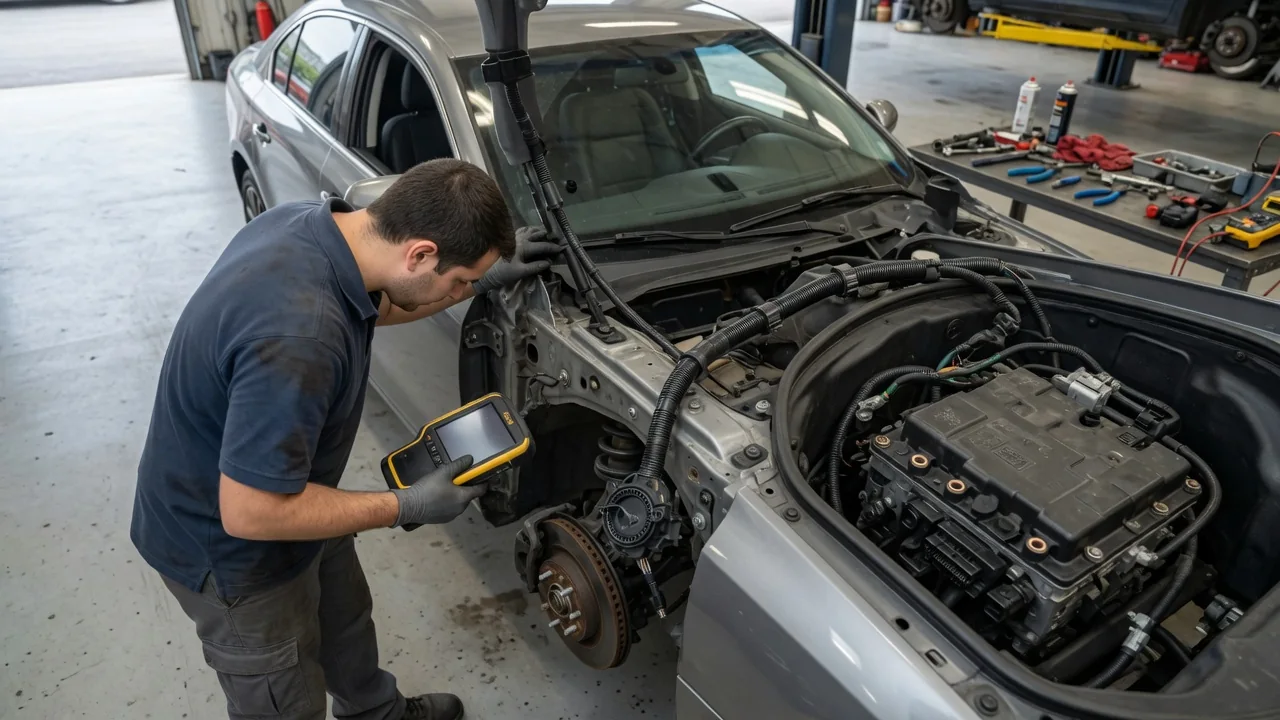
Modern cars contain many control modules that need to know how fast the vehicle is moving, from the instrument cluster to the transmission and steering controls. In most current vehicles, the modules do not each measure speed on their own. Sensors at the wheels or in the drivetrain generate raw pulses, and one module turns those pulses into a speed value. The vehicle speed data network then shares that value with every other module. Understanding this chain explains many puzzling symptoms when something fails.
Wheel Sensors: Where Speed Data Begins
On vehicles with anti-lock brakes, each wheel normally has its own wheel speed sensor. The sensor sits close to a target that rotates with the wheel or axle. On many designs that target is a toothed tone ring, also called a reluctor ring. On others it is a magnetic encoder ring with alternating north and south poles, often built into the wheel bearing seal. As the wheel turns, each tooth or magnetic pole passes the sensor tip and produces a pulse. The faster the wheel spins, the more pulses arrive each second. That pulse frequency is the basic measurement of wheel speed.
Two broad sensor types are common. Passive sensors, also called variable reluctance sensors, contain a magnet and a coil and generate their own alternating voltage. Their output grows weaker as speed falls, which makes very slow movement harder to read. Active sensors are typically based on Hall effect or magnetoresistive elements. They receive power from the control module and send back a switching signal whose strength does not depend on speed. Active sensors can detect wheel rotation down to nearly zero speed. Some versions also report the direction of rotation, which supports low-speed features such as hill hold.
Wheel sensors are not the only possible source. Many vehicles, particularly older designs, use a dedicated vehicle speed sensor on the transmission or transfer case output shaft. Automatic transmissions also commonly carry their own input and output speed sensors for shift control. Which sensor serves as the main vehicle speed reference depends on the vehicle's architecture. Factory service information is the reliable guide for a specific model.
Shared Signal: How One Speed Value Reaches Many Modules
Raw pulses are only the starting point. The module that reads the wheel sensors is usually the ABS or stability control module. It converts each pulse stream into an individual wheel speed, using the known number of teeth or poles on the target and a programmed tire rolling circumference. From those four values it calculates a single vehicle speed. Exact methods vary by manufacturer. In general, the calculation has to reject distortions from wheel spin, wheel lockup, and the different distances wheels travel in a turn, so it is more than a simple average.
That calculated value is then placed in a message on the vehicle's data network, most often a Controller Area Network, or CAN bus. The source module does not send the speed to each module individually. It broadcasts the value repeatedly, and any module that needs it reads the same message. A gateway module may pass the value between separate networks, for example from a chassis network to a body or infotainment network. Messages commonly include status information as well. Receiving modules can therefore tell whether the value is valid and notice when fresh messages stop arriving.
Many systems rely on that shared number. The instrument cluster uses it for the speedometer and odometer. The engine control module needs it for cruise control and, on some vehicles, speed limiting. The transmission controller uses it in shift decisions. Other common examples include speed-sensitive power steering, automatic door locking, wiper timing and audio volume adjustment, although these features vary widely between vehicles. Older designs often distributed speed as a hardwired pulse signal instead of a network message, and some vehicles combine both approaches.
Faults: What Happens When the Speed Chain Breaks
Problems at the sensor end are usually physical. Wiring near the wheels is exposed to water, road salt, heat and suspension movement, so chafed or corroded wires and connectors are frequent causes. Other common causes include: • Metal debris collecting on a magnetic sensor tip. • A cracked or rusted tone ring. • Too much clearance between the sensor and its target, which weakens the signal. • A worn or incorrectly installed wheel bearing, when the encoder ring is part of the bearing. The ABS module typically detects a missing or implausible wheel signal and stores a chassis fault code. It then turns on the ABS warning light, and often the traction or stability warning light.
Failures further along the chain look different. If the source module stops working, or the network carrying its messages is disrupted, receiving modules lose the speed value altogether. They may store communication fault codes, commonly in the U-code group, and fall back to default behavior. Depending on the design, symptoms can include: • A speedometer that drops to zero. • Cruise control that stops working. • Harsh or delayed shifting, or a transmission held in a protective mode. • Changed steering effort. The engine controller may also log a powertrain code related to vehicle speed, such as P0500, when the expected value is missing or does not match other inputs.
Intermittent faults are especially confusing. A sensor may drop out only over bumps, in wet weather or above a certain speed. That can cause a flickering speedometer, ABS activation at low speed when no wheel is locking, or warning lights that come and go. Because several modules share one value, a single weak link can create symptoms that seem unrelated.
Practical Implications and Limits
For owners, the main lesson is to consider the whole chain before replacing parts. A dead speedometer together with ABS warnings points toward the wheel sensor side. A group of communication codes alongside several unrelated warnings suggests a module or network issue. A scan tool that displays live data lets you compare the four wheel speeds while driving slowly. One wheel reading zero, or reading very differently from the others, is a strong clue. Basic code readers that show only generic powertrain codes may miss chassis and network codes entirely.
Tire size matters because the speed calculation assumes a particular rolling circumference. Fitting noticeably larger or smaller tires than the vehicle is configured for shifts the reported speed and odometer reading. On some vehicles it can also affect shift timing. Mixing tires of different diameters on one vehicle can make wheel speeds disagree enough for stability systems to react or log faults. A compact spare or unevenly worn tires can have this effect. Some vehicles allow the stored tire size to be updated with suitable diagnostic tools, while others do not.
General explanations have limits. Several details are vehicle-specific: the number of sensors, which module calculates speed, how messages are routed and how each system responds to a missing signal. The speed shown by a phone or navigation unit usually comes from satellite positioning and is separate from the vehicle's own calculation, so a mismatch is only a rough check. For wiring diagrams, connector locations, sensor clearance specifications and test procedures, use the service manual for the exact vehicle.