What Is a Bare-Metal Repaint? Stripping, Metal Assessment, and Coating Explained
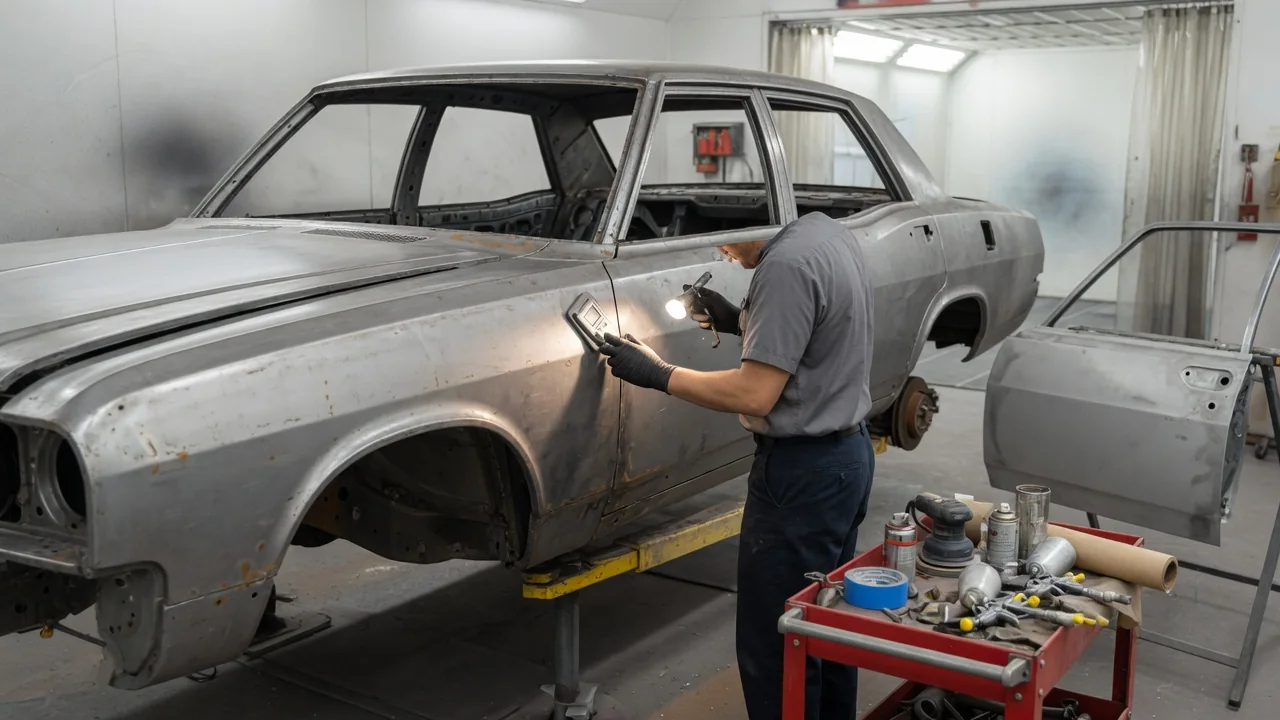
A bare-metal repaint is a refinish in which all existing paint, primer, and body filler are removed down to clean steel or aluminum before any new coating goes on. Unlike a scuff-and-spray job that lays fresh color over the old finish, it rebuilds the entire paint system from the substrate up. On a classic car, the process breaks into three linked stages: stripping the old finish, assessing the exposed metal, and coating it properly before corrosion can return.
Stripping
The point of stripping is to remove everything that could compromise the new finish. An older car may carry the factory coating plus one or more later resprays, each with its own primer, filler, and possibly incompatible chemistry. A paint system is only as sound as its weakest layer, so cracking, crazing, lifting, or blistering anywhere in that stack can eventually show through new paint. Taking the panels to bare metal eliminates the unknowns and gives the new primer a direct, clean surface to bond to.
Shops use several stripping methods, often in combination. Mechanical removal with dual-action sanders, abrasive discs, and hand tools gives close control and suits smaller areas or individual panels. Chemical strippers soften paint so it can be scraped and washed off, which avoids heat and abrasion but requires careful neutralizing and cleanup. Media blasting propels an abrasive or softer material such as plastic, glass bead, walnut shell, soda, or harder mineral grit at the surface, and the choice of media and pressure determines how aggressive it is. For a fully disassembled body shell, some restorers use immersion stripping in chemical tanks, which can reach inner cavities that other methods cannot.
Each method carries risks. Aggressive blasting can heat and stretch large, flat, thin panels such as hoods, roofs, and trunk lids, leaving distortion that must be corrected later. Blast media can lodge in seams, pinch welds, and box sections and work its way out after painting. Chemical residue left in overlapping joints can cause bubbling or adhesion failure. Heavy grinding can thin the metal or create heat marks. The right approach depends on the panel material, its thickness and shape, and whether the car is apart or still assembled.
Metal assessment
Once the finish is gone, the metal tells its own history. Stripping commonly exposes rust in several forms: light surface oxidation, pitting that has eaten into the surface, flaking scale, and perforation where the metal has rusted through. It also reveals earlier repair work that paint had concealed, including thick filler over damaged areas, patch panels overlapped rather than butt-welded, brazed joints, and evidence of accident damage. On some older vehicles, lead body solder may appear at seams, either from the factory or from a later repair, and should be identified before anyone grinds into it.
Assessment means judging whether each area can be cleaned and kept, needs a section repaired, or should be replaced. Pitted metal must be cleaned until no active corrosion remains in the pits, because rust left at the bottom of a pit can continue under new coatings. Thin, cracked, or perforated metal usually calls for cutting out the weak area and welding in new material. Panels are also checked for dents, waves, and distortion, and doors, hood, and trunk lid are typically test-fitted so gaps and alignment can be corrected while the metal is still bare. Photographing what stripping reveals creates a useful record of the car's condition and the repairs made.
Construction varies by vehicle, so the assessment should follow how that specific body was built, including which panels are structural and what material each part uses. Aluminum panels, for example, need tools and procedures kept separate from steel work to avoid contamination and galvanic corrosion problems.
Coating
Bare steel begins to oxidize quickly when exposed to humidity, so stripped and repaired metal should be protected without long delays. A thin haze of flash rust can form on freshly exposed steel and must be removed before priming. Before the first coat, the surface is cleaned with a wax and grease remover, and some product systems call for a specific metal preparation step. Fingerprints, sanding dust, and leftover stripper or media all interfere with adhesion.
The first coat is the foundation for everything above it. Many restorers use an epoxy primer for its adhesion and its ability to seal bare metal against moisture; self-etching primers are another option in certain systems. Body filler and further repairs are then applied according to the product manufacturer's directions about whether filler goes over primer or bare metal. High-build primer surfacer follows and is block sanded, often with a guide coat, to make panels straight. A sealer may be used before the color coat, which is either single-stage paint or a base coat with clear coat over it. Staying within one manufacturer's compatible system and following its technical data sheets for film thickness, flash times, and recoat windows helps avoid adhesion and solvent problems.
Coating is not limited to visible exterior surfaces. Seams are sealed to keep water out of joints, inner panels and the underside receive protective coatings, and enclosed box sections may be treated with cavity wax. These hidden areas are frequently where corrosion restarts on a classic car bare metal paint job that looked flawless on the outside.
Practical implications and limits
A bare-metal repaint is labor intensive, and most of that labor goes into preparation rather than spraying color. It makes the most sense when the existing finish is failing, when the car's repair history is unknown, when significant rust or body damage is suspected, or as part of a full restoration where the body is already disassembled. For a car whose paint is generally sound, a more limited refinish over properly prepared existing paint may be a reasonable alternative, and some shops strip only the panels that genuinely need it.
There are limits to what the process achieves. It does not automatically solve structural corrosion in frames, floors, or hidden members unless those areas are actually reached and repaired. The durability of the result depends on workmanship and on whether every stage was done thoroughly, not on the label bare metal itself. Stripping also permanently removes original factory paint, which some owners and collectors value as evidence of originality, so that trade-off is worth weighing before work begins on an unrestored car.
When discussing a bare-metal job with a shop, useful questions include which stripping method will be used on each panel, how seams and cavities will be cleared of media or chemicals, how soon bare metal will be primed, which product system will be used, and whether the condition of the stripped body will be documented with photos. Clear answers give a good indication of how carefully the work will be done.