What Is Paint Stripping in a Restoration?
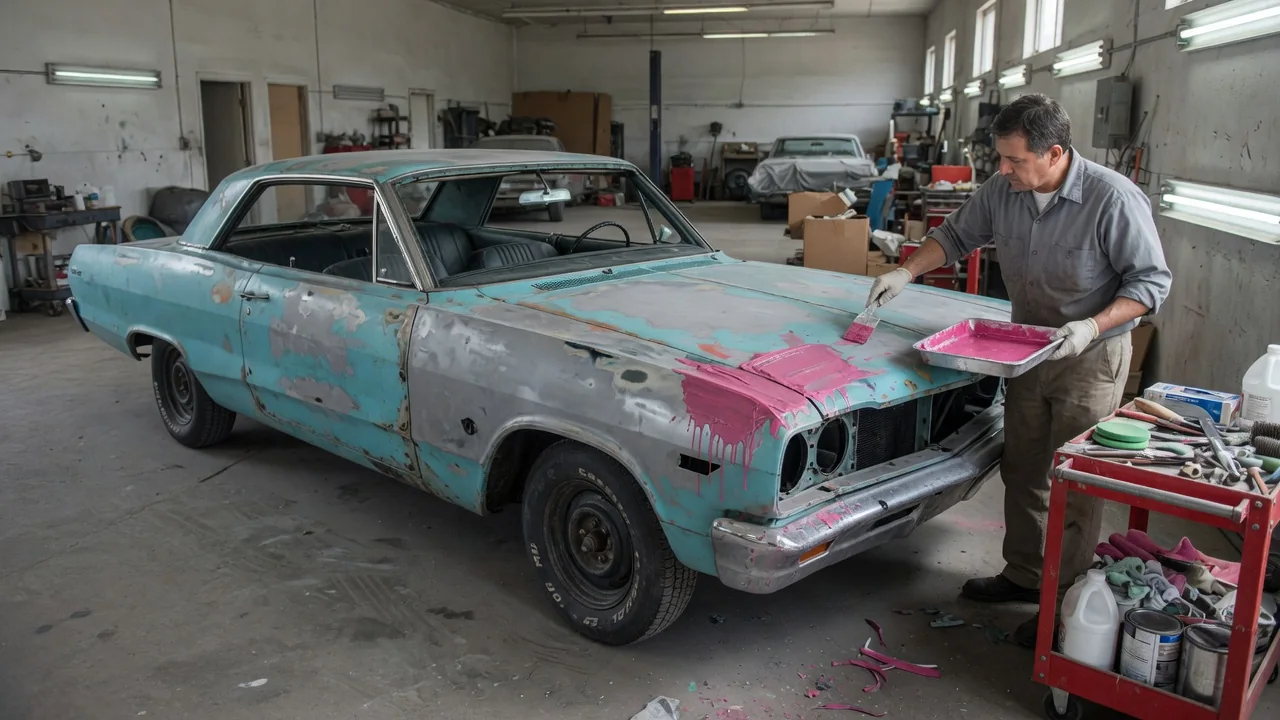
Paint stripping in a restoration is the process of removing a classic car's existing coatings, from topcoat down to primer, filler and sometimes factory sealers, so the bare body can be inspected and refinished on a sound foundation. It sounds simple. But how the layers come off, how the exposed metal is protected afterward, and what happens to the removed material all affect the quality and durability of the finished job. This guide explains each stage in practical terms.
Layer removal
A body that has been on the road for decades rarely carries a single coat of paint. Under the visible color there may be several earlier refinishes, primers of different chemistries, body filler over old repairs, and seam sealer or undercoating in hidden areas. Stripping removes this stack so the restorer can see what the metal actually looks like. Rust bubbles, previous patch panels, filler hiding dents and uneven welds are often invisible until the coatings are gone. That is why many restorers treat stripping as part of the diagnosis rather than just surface preparation.
Classic car paint removal methods fall into a few broad groups. Mechanical removal uses sanders, abrasive discs, strip wheels or scrapers. It gives close control on small areas, but it generates heat and dust and can thin the metal if used aggressively. Media blasting propels an abrasive such as plastic media, crushed glass, walnut shell, garnet or sodium bicarbonate against the surface. Softer media remove coatings with less effect on the metal, while harder media cut faster and also attack rust and mill scale. Chemical strippers soften the paint so it can be scraped or washed off, and they reach curved surfaces without abrading the steel. Some shops also immerse complete shells in chemical or electrolytic baths, which can reach inside box sections that other methods cannot touch.
No single method suits every panel. Large flat skins such as hoods, roofs and doors can distort if they are blasted too aggressively or allowed to build up heat. For that reason they are often stripped chemically or with careful sanding, while heavier structural parts tolerate more aggressive blasting. Aluminum, fiberglass and thin trim pieces each need gentler approaches than steel. Combining methods is common practice because it matches the tool to the material. A typical example is chemical stripping on outer skins and blasting on floors and brackets.
Metal protection
Once paint is gone, bare steel begins reacting with moisture in the air. Flash rust can form quickly in humid conditions. It is especially likely after any process that leaves the surface damp, such as washing off chemical stripper or soda residue. For that reason, stripping is usually planned so that each area is protected soon after it is cleaned. Leaving an entire shell exposed for weeks while other work continues invites new corrosion.
Protection starts with cleaning. Chemical strippers often require neutralizing or thorough rinsing as the product manufacturer directs, because residue left in pores or seams can interfere with primer adhesion or keep working under the new finish. Blasted surfaces need loose media blown out of crevices and any embedded particles removed, and soda blasting residue is generally washed off before priming. After cleaning and degreasing, a primer suited to bare metal seals the surface. Depending on the refinish system, this is commonly an epoxy primer or an etching primer. Following one manufacturer's system from primer to topcoat reduces the risk of incompatible layers.
Hidden areas deserve the same attention as visible panels. Seams, pinch welds, the inside of rockers and the backs of panels can trap stripper, water or blast media that later causes rust from the inside out. Restorers often treat these cavities with cavity wax or other rust-inhibiting coatings once the structure is finished. The key point during stripping is to avoid driving moisture or chemicals into places that cannot be dried or cleaned afterward.
Waste
Stripping produces more waste than many owners expect. Depending on the method, it may include paint chips and sludge mixed with chemical stripper, contaminated rinse water, spent blast media carrying paint particles, used abrasive discs and solvent-soaked rags. Older finishes can contain lead or chromate pigments, and some traditional stripper formulations contain hazardous solvents. The debris therefore should not be treated as ordinary trash by default. Testing older paint for lead before removal is a reasonable precaution, especially when sanding or blasting will create airborne dust.
Good waste handling begins before work starts. The following steps make disposal easier and limit contamination of the work area: laying down plastic sheeting, containing blasting inside a booth or enclosure, collecting sludge in sealed containers and keeping rinse water out of storm drains. Disposal rules differ by state and locality. For home projects, check local household hazardous waste programs; shop operations should check applicable environmental regulations. Personal protection belongs here too. Respirators rated for the hazard, chemical-resistant gloves, eye protection and good ventilation protect the person doing the work as well as the environment.
Practical implications and limits
The choice of stripping method has consequences well beyond the first weekend of work. A shell stripped to bare metal everywhere commits the owner to a full refinish, including priming, bodywork and paint on every surface. That commitment carries time, space and budget implications. Partial stripping, limited to damaged or suspect panels, can make sense on a car whose original finish is largely sound or historically significant, though it leaves some unknowns under the remaining paint.
Professional services such as dip stripping or controlled media blasting reduce the labor and mess at home. They also hand over decisions about media type, pressure and chemistry. Ask a shop how it handles thin panels, how it removes residue from enclosed sections and how quickly parts are primed after stripping. An owner working alone faces different limits: available space, air supply, ventilation and the ability to keep stripped metal dry. These limits often determine which method is realistic.
Finally, stripping reveals condition but does not fix it. Once the coatings are off, the body may need rust repair, panel replacement or straightening before any primer goes on, and the painted surface is not a reliable guide to how much. How a specific car responds depends on its construction, previous repairs and storage history. General guidance about methods is a starting framework, not a guarantee of outcome for any particular vehicle.