What Is Panel Beating in Car Restoration?
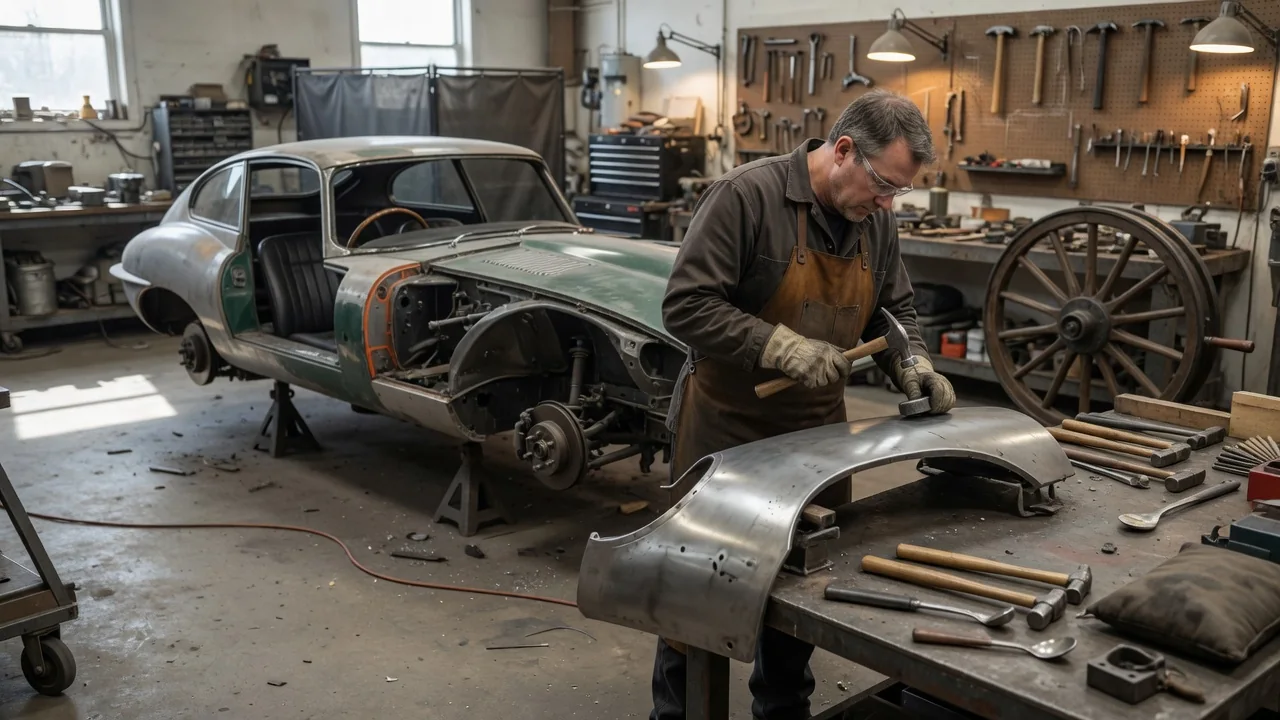
Panel beating is the hand craft of reshaping sheet metal body panels back to their correct form. In classic car panel beating, it often means saving original steel or aluminum rather than replacing it. The term covers straightening dents, restoring crowns and edges, and preparing metal so that paint lies flat with minimal filler. This guide explains what panel beating in car restoration involves, how metal is shaped and finished, and where the method reaches its limits.
Metal shaping
Panel beating relies on the fact that sheet metal can be moved, not just pushed. A dent is rarely a simple depression. The impact usually stretches some areas and leaves others compressed or buckled, so the panel beater reads these areas before striking anything. Damage is generally worked out in roughly the reverse order it went in, starting with the last folds and ridges created. This tends to release stress so the panel can return toward its original contour without being forced. Hammering at random on the lowest point often adds stretch and makes the repair harder.
The basic tools are hammers and dollies. A dolly is a shaped steel block held behind the panel. Striking directly over it, known as hammer-on-dolly, squeezes the metal between two hard surfaces and can thin and stretch it slightly. Striking beside the dolly, known as hammer-off-dolly, pushes a high spot down while the dolly lifts a nearby low spot, which moves metal with little stretching. Spoons and slappers spread blows over a wider area for gentle work on large, gently curved surfaces. Where there is access from behind, body picks can raise small low spots.
Other methods add or remove curvature when a panel is made or reshaped from flat stock. Shrinking, done with heat or with shrinking tools, gathers metal to tighten an area or to form a curve such as a wheel arch flange. Stretching thins the metal to create a crown, using a planishing hammer, a mallet over a sandbag or a stretching tool. An English wheel rolls the panel between an upper and a lower wheel to raise and smooth compound curves. Skilled shaping depends on frequent checking against templates, bucks or the matching panel on the opposite side of the car.
Surface finish
Shaping gets the overall contour right, and finishing makes the surface true enough to paint. After the main work, a panel typically still has small highs and lows that are hard to see on bare metal. Panel beaters find them by running a flat hand or gloved hand across the surface, and with tools that reveal unevenness. A body file is drawn lightly across the metal. It cuts the high spots and leaves the lows untouched, which shows exactly where more hammer work is needed.
The cycle of filing, tapping lows up and highs down, and filing again is often called metal finishing. Done well, it can bring a panel close enough to its final shape that only a thin skim of filler is needed before primer, and some restorations use none at all. Guide coat does a similar job later in the process. It is a light dusting of contrasting color sprayed over primer and then block sanded, which shows where the surface is still uneven. Planishing with a light hammer and a smooth dolly can also refine the texture left by heavier shaping tools.
Finish quality matters because paint magnifies defects instead of hiding them. Gloss finishes and dark colors reflect light in a way that exposes ripples, low spots and file marks. Overworked areas can also leave metal thin or hardened. This affects how the metal responds to further shaping and how it behaves when heated during nearby welding.
Limits of panel beating
Panel beating can do a great deal, but not everything. Metal that has been thinned by rust cannot be hammered back to strength. Pitting and perforation call for cutting out the damaged section and welding in new or fabricated metal. Hammering on weak, rusty steel tends to stretch it further and can open holes. Sharp creases and tears can also leave metal so stretched or work hardened that the original contour can only be restored by shrinking, sectioning or replacement, not by straightening alone.
Structural damage is a separate matter. Bent chassis rails, sills, pillars, floors and suspension mounting points affect alignment and crash behavior. Correcting them normally involves measuring against reference dimensions, using pulling or straightening equipment, and then repairing or replacing sections. Outer panel work does not address these problems, and a smooth exterior can hide misalignment underneath. Body-on-frame and unibody cars carry structural loads in different places, so where cosmetic work ends and structural work begins depends on the specific vehicle design.
Materials also set limits. Aluminum panels can be shaped with the same general methods, but aluminum behaves differently from steel. It work hardens, can crack if overworked, and is often annealed to restore workability. Some classic cars use composite panels such as fiberglass. These are repaired with entirely different techniques and are not candidates for panel beating.
Practical implications and limits
For an owner, the practical question is usually whether to repair an original panel or replace it. Panel beating preserves original metal, factory seams and markings. That can matter for authenticity, and for cars where reproduction panels are unavailable or fit poorly. It also tends to take considerable skilled labor, so the trade-off depends on the condition of the panel, parts availability and the goals of the restoration. An assessment after media blasting or paint stripping often reveals more than an inspection of a painted car can.
When reviewing work or discussing it with a shop, it helps to ask how much filler is planned, whether structural areas have been checked and measured, and how rust repairs will be handled. Thick filler over poorly shaped metal may look acceptable at first but can crack, shrink or trap moisture over time. Owners who want to try panel beating themselves can learn basic dent work on scrap panels before touching a car, because mistakes such as overstretching are easier to make than to undo. Procedures and panel construction vary by make and model, so work on a particular vehicle should be guided by factory service information or a qualified specialist.