What Does Freezing Rain Do to Car Door Seals?
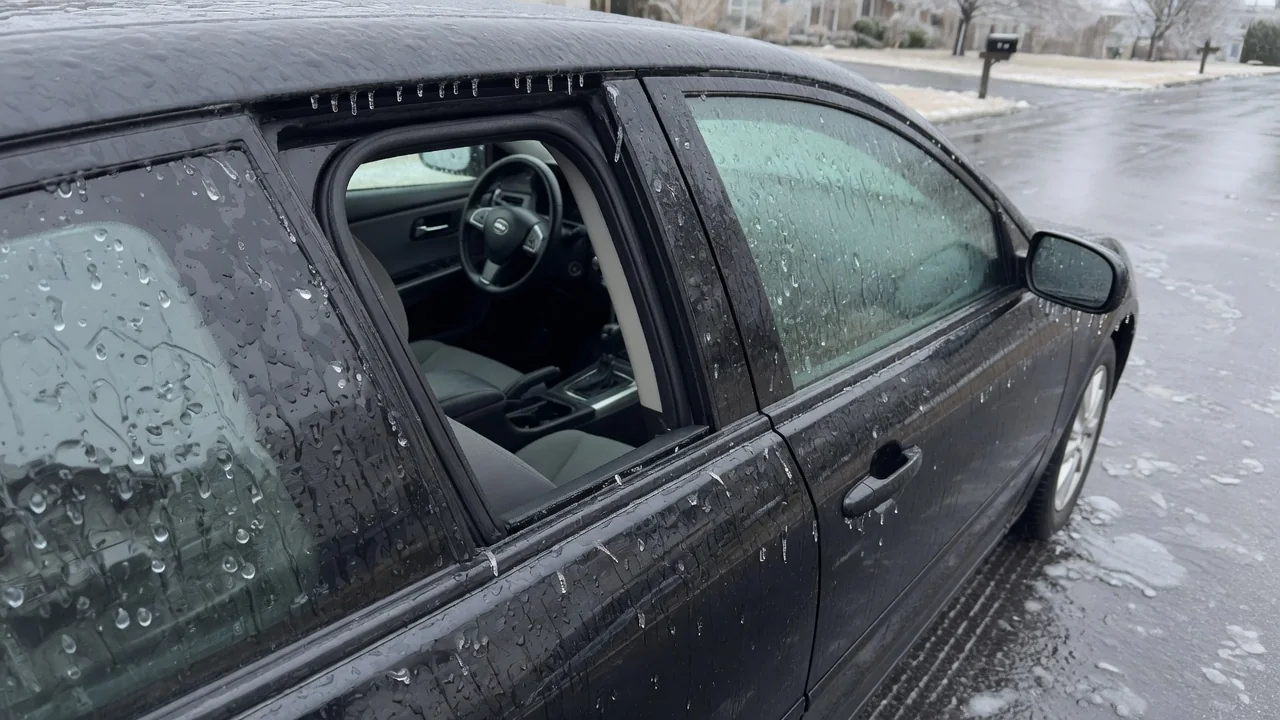
Freezing rain is one of the harder winter conditions for car door seals. Unlike dry snow, it arrives as liquid water that freezes on contact, so it can run into the narrow gap between a door and its frame before turning solid. The result can be a door that will not open, a seal stuck to the body, and rubber that may tear if forced. This guide explains how that bond forms, how to release it gently, and why drying matters afterward.
Ice bonding: how freezing rain locks seals in place
Freezing rain forms when rain falls through a shallow layer of below-freezing air near the ground. The droplets stay liquid but become supercooled, and they freeze when they touch a surface that is below freezing. On a car, that water does not simply bead and roll off. It spreads across the door skin, follows gravity into panel gaps, and is drawn into the tight contact line where the rubber weatherstrip presses against painted metal. Once there, it freezes in place, filling tiny irregularities on both surfaces and acting like glue between them.
Door seals are typically made from soft, elastic rubber compounds designed to compress and spring back. In cold weather that rubber becomes stiffer and less forgiving, while the ice holding it is hard and brittle. Many doors have more than one seal, often one mounted on the door and another around the body opening, so a single door can be held at several points along its perimeter. Ice also tends to build up along the bottom edge, where water collects, and around the latch area. Repeated freeze and thaw cycles let more water creep in each time, which is why a door that opened easily in the morning may be firmly stuck by evening.
The ice alone does not usually harm the seal. The risk comes when force is applied while the rubber is cold and bonded: the lip can tear, the seal can be pulled away from its retaining flange or adhesive, or its surface can be scuffed. That is why the method used to open the door matters as much as the ice itself.
Gentle release: opening a frozen door without damage
The first goal is to break the ice without stretching the rubber. A simple approach is to push firmly inward on the door near its edge, or give a few gentle bumps with the flat of the palm along the seam. Pressing inward compresses the seal and can crack the thin ice layer holding it, after which the door may open normally. Pulling repeatedly on the outside handle tends to stress the handle mechanism and the seal rather than the ice.
If one door is stuck, another may not be. Getting in through any door that opens lets you start the engine and run the heater, warming the car from the inside. Warmth gradually reaches the door edges and softens the bond. This takes patience, and the time required depends on the outside temperature, the thickness of the ice and the vehicle itself. A de-icer spray intended for automotive use can help along visible seams; check the product label and the owner's manual for anything that should not contact rubber or paint.
Some common shortcuts carry real risk. Pouring hot water over the car can crack cold glass, and the water that runs into the gaps may refreeze even harder. Metal tools such as screwdrivers or keys used to pry at the gap can cut the seal and chip paint. If the window glass is frozen to its seal as well, avoid running a power window against the ice, since the motor or regulator can be strained; leave it closed until the glass is free.
Drying: keeping the bond from re-forming
Once the door is open, the water that caused the problem is often still there, now partly melted. If the door is closed on a wet seal and the car sits overnight in freezing temperatures, the bond can form again. Wiping the seal and the matching surface on the door frame with a dry, absorbent cloth removes much of that moisture. Pay particular attention to the lower edge of the door opening and the bottom of the door, where meltwater gathers.
Running the heater for a while during and after driving helps evaporate remaining moisture inside the cabin and along the inner seal edges. Doors also have drain openings at the bottom that let water escape from inside the door shell. If these are blocked by debris or ice, water can collect inside the door and freeze around internal parts. Keeping those drains clear, where they are accessible, supports drying beyond the visible seal.
After the seals are clean and dry, many owners apply a rubber seal conditioner or silicone-based protectant. A thin coat can reduce how strongly ice adheres to the rubber and helps keep the material supple. Some petroleum-based products can degrade certain rubber compounds, so it is sensible to follow the vehicle manufacturer's guidance on what to use.
Practical implications and limits
When it comes to freezing rain and door seals, the usual outcome is an inconvenience rather than a failure, as long as the rubber is released without force. The longer-term concerns are wear from repeated forced openings and the slow accumulation of small tears. After a winter with frequent icing, it is worth looking along each seal for split lips, flattened sections or pieces that have pulled loose, and noticing new wind noise or damp carpets, which can point to a seal that no longer closes tightly.
Prevention has limits. Conditioners and covers reduce sticking but do not guarantee that a door will open after a heavy ice storm, and parking in a garage or under solid cover is the most dependable way to keep freezing rain off the car. Vehicles also differ: seal layout, frameless windows, door shape and drain placement vary by design, so the general mechanism described here can play out differently from one car to another. The owner's manual remains the best source for model-specific cautions about seals, windows and approved products.
If a door still will not open after reasonable warming, or a seal is visibly torn or detached, a repair shop or dealer can assess whether the weatherstrip can be refitted or needs replacement. Trying to glue or force a damaged seal back into place in freezing conditions often works poorly, because both rubber and many adhesives behave differently at low temperatures.