Wastegate Actuator Clip: Inspecting Linkage Retention
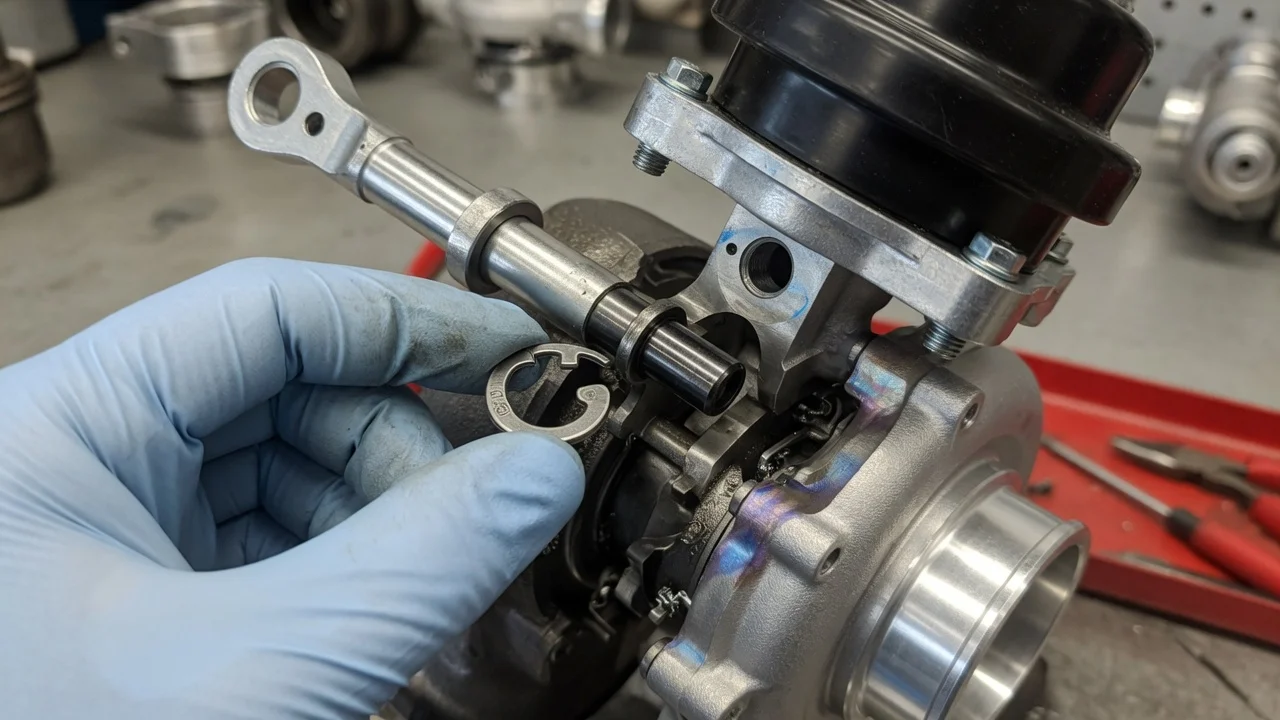
The wastegate actuator clip is a small retaining part with an important job. It holds the actuator rod to the wastegate lever, and if it loosens or falls off, the turbocharger loses controlled boost regulation. This guide explains how to connect symptoms to linkage retention, tell a missing or worn clip apart from other boost faults, and order your checks so you gather useful evidence before buying parts. Designs differ by engine and turbocharger, so confirm details against the manufacturer specifications for your vehicle configuration.
Establish the symptoms
Start by writing down when the problem appears instead of describing it only as low power. Note whether it happens at cold start, idle, light cruise, hard acceleration or when lifting off the throttle. A loose or missing clip often shows up as a metallic rattle or tick from the turbo area. It is usually most noticeable at idle or on deceleration, and it may change with engine temperature. If the rod has fully separated from the lever, the actuator no longer controls the wastegate, so boost behavior becomes unpredictable. Many owners notice weak acceleration, a turbo that seems unable to build pressure, or a reduced-power mode.
Record associated signs as well: a check engine light, a boost-related warning message, a new whistle or flutter, or a change in fuel consumption. Recent changes matter just as much. Turbo, exhaust manifold, heat shield or downpipe work can disturb the linkage, and a clip that was reused or not fully seated during an earlier repair is a common suspect. Check the service history for that kind of work and for any tuning or boost-related modifications.
Distinguish plausible causes
A missing or loose clip is only one explanation. Worn linkage parts can produce the same rattle even with the clip in place: the pin on the lever, the hole in the rod end and the wastegate flap pivot inside the turbine housing all wear over time. A rattle that continues with the clip seated, along with play you can feel at the pivot rather than at the clip, points away from the clip itself. Loose heat shields and exhaust clamps are another frequent source of metallic buzzing. They tend to rattle at particular engine speeds or over bumps, and tapping them with the engine off and cold often reproduces the sound.
For boost complaints, competing causes include a leaking intake hose or intercooler connection, a split line to the actuator, a faulty boost control solenoid, a torn actuator diaphragm, or an electronic actuator fault on engines that use one. A clean, intact clip with the rod firmly attached to the lever weakens the retention theory. A clip found loose behind a heat shield, a shiny worn ring on the pin, or a rod that moves without moving the lever strongly supports it. Stored fault codes and live data help separate an actuator control problem from a mechanical disconnection.
Checks in a useful order
Begin with safe observations. Let the engine cool completely, because turbocharger and exhaust components stay hot long after shutdown. With the engine off, locate the actuator and follow its rod to the wastegate lever. On some engines this requires removing a cover or heat shield, and access from above may be limited. Confirm the clip is present, fully seated in its groove and not cracked, spread or corroded. Look for wear marks on the pin, a rod end sitting at an angle, and a clip or fragments lying nearby. Photograph what you find before touching anything.
Next, check movement gently by hand only where the design allows it. On many pneumatic actuators you can feel whether the lever moves with the rod and whether there is obvious free play at the pin. Do not bend the rod, change its length or loosen the adjuster nut, because rod length sets actuator preload and altering it changes boost behavior. Electronic actuators can be damaged by forcing them, and some need calibration with a scan tool after being disturbed, so leave them alone unless the service information says otherwise.
Tests beyond this need tools, specifications or a qualified technician: reading fault codes and live boost data, applying pressure or vacuum to the actuator with a hand pump to check diaphragm integrity and rod travel, smoke testing the intake for leaks, and comparing rod travel with manufacturer specifications. Never run the engine with covers removed while working near belts and fans.
Interpret the findings
A missing clip with a rod that has dropped off the lever confirms a retention failure, but it does not prove the clip is the whole story. Work out why it came off. An elongated rod hole, a worn pin or a damaged groove can let a new clip fail again, and on some designs those parts are not sold separately from the actuator or turbocharger. A clip that is present and secure largely rules out retention as the cause of an underboost complaint, shifting attention to hoses, boost controls, the actuator itself or the wastegate pivot.
Play you can feel at the clip suggests linkage wear, but how much play is acceptable depends on the design and cannot be judged reliably by eye. A rattle that stops when you hold the lever during an inspection only identifies a probable source; confirm it by correcting the fault and checking whether the noise is gone. If fault codes remain after the linkage is restored, or live boost readings still look wrong, further diagnosis is needed before replacing a turbocharger or actuator.
Urgency and next action
Stop driving and arrange an inspection if the check engine light flashes, the engine repeatedly enters reduced-power mode, you hear grinding or scraping from the turbo, or you notice surging or a sudden power spike that could indicate overboost. A disconnected wastegate leaves boost control to chance, and continued hard driving risks damage far more costly than a clip. No safe remaining mileage can be promised with a linkage fault, so limit driving to what is needed to reach a workshop and use gentle throttle.
When booking the repair, give the shop the exact vehicle configuration, including model year, engine and whether the actuator is pneumatic or electronic, plus the service history for any turbo or exhaust work. Bring your notes on when symptoms occur and under what operating conditions, any fault codes, and your photos of the clip and linkage. That information helps the technician confirm the cause, order the correct retaining parts or assembly, and perform any required calibration instead of replacing components on suspicion.