Wastegate Actuator Rod and Arm: Inspecting the Linkage
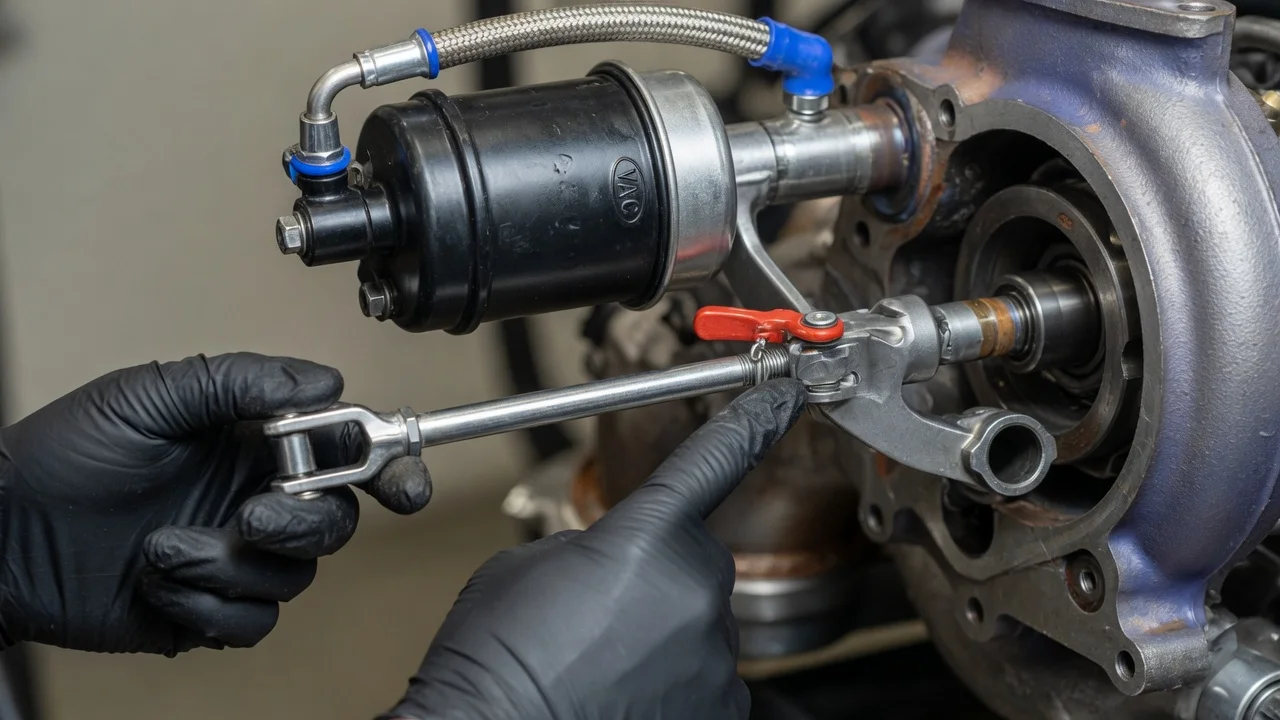
On a turbocharged engine, the wastegate actuator rod is the short link that turns actuator movement into wastegate opening. If the rod, its retaining clip or the wastegate actuator arm binds, wears or comes loose, boost control suffers. The engine may rattle, lose power or set warning lights. This guide covers how to narrow down a linkage problem, which checks an owner can safely make, and when the job needs a technician with the manufacturer specifications for your vehicle configuration.
Establish the symptoms
Start by writing down exactly when the problem appears. Note whether it happens on a cold start, at warm idle, under light throttle, during hard acceleration or when you lift off the throttle. Operating conditions matter here. A metallic rattle from the turbo area at idle or on deceleration that fades under load often points toward play in the linkage. A lack of pulling power that builds as boost should rise points toward the wastegate staying open or toward a leak elsewhere in the boost system. Sudden surges, or power that cuts out abruptly, suggest boost is overshooting and the engine computer is stepping in.
Record the associated signs as well: a check engine light, a reduced-power mode, stored trouble codes such as underboost or overboost, unusual exhaust smoke, or a change in fuel economy. Then list recent changes. Work near the turbocharger, removed or refitted heat shields, an impact underneath the car, engine tuning, an aftermarket boost controller or intake parts can all affect the linkage or the boost readings. Your service history may also show earlier turbo or actuator work, which helps a technician judge what has already been ruled out.
Distinguish plausible causes
Several faults sit within the linkage itself. A missing or broken retaining clip can let the rod slip off the arm's pin. A bent rod can bind or change the effective rod length. A worn bushing at the wastegate pivot creates slack, which is a common source of rattle. Carbon or corrosion can seize the pivot so the arm sticks open or closed. A rod-end adjuster that has been moved changes the preload and therefore boost behavior. Rattle at idle that disappears under boost fits pivot wear. Boost that is consistently low or high under all conditions fits an arm stuck in one position.
Other faults can produce the same complaints. On pneumatic actuators, a torn diaphragm or a cracked, split or disconnected vacuum or pressure hose stops the rod from moving correctly even when the linkage is healthy. A faulty boost control solenoid, an electronic actuator with a failing motor or position sensor, a leaking intercooler pipe, or an inaccurate boost sensor can also cause underboost or overboost. A loose heat shield can mimic linkage rattle. Evidence that weakens the linkage theory includes a rod and arm that move freely through their full travel, codes pointing to an electrical circuit, and noise that persists after the heat shields are secured.
Checks in a useful order
Work only with the engine off and fully cooled, because the turbocharger and exhaust stay hot long after shutdown. If access requires raising the vehicle, support it properly on stands. Begin the inspection by looking. Confirm the rod is attached to the arm and the retaining clip is present and seated. Check that the rod is straight and the adjuster locknut is tight. Look for factory paint or witness marks on the adjuster to see whether they appear undisturbed. Make sure hoses to a pneumatic actuator are connected and free of cracks. Soot or oil around the turbo is worth photographing for the technician.
Next, check movement. On many pneumatic designs, you can push the rod against its spring by hand to feel whether the wastegate arm swings smoothly and returns fully. Grinding, sticking or noticeable slack before the arm begins to move are all useful findings. Do not force an electronic actuator by hand, as its internal gearing can be damaged. Do not loosen the locknut or alter the rod length either. That adjustment sets preload, and it can only be corrected against the manufacturer specifications.
Tool-based tests usually belong to a qualified technician. A hand vacuum or pressure pump with a gauge shows whether a pneumatic diaphragm holds and at what point the rod starts to move, which is then compared with the published value for that turbo. A scan tool can compare requested boost with actual boost and display electronic actuator position. On some vehicles it can also run actuator tests or a position relearn. Logging data during a road test shows how the system behaves under real load.
Interpret the findings
A detached rod or missing clip explains a disconnect, but find out why it happened. A worn pin hole or the wrong clip will let it fail again, and the arm must move freely before the rod is refitted. A seized arm establishes binding at the pivot. Because the pivot is part of the turbocharger, the repair may involve turbo service rather than a separate part, so confirm the binding under applied vacuum or pressure first. Slack that matches the rattle points to a worn bushing. Confirm the noise source before assuming it, since a heat shield can sound similar.
If the linkage moves freely but the diaphragm will not hold, the actuator is the likely fault. If the linkage is free and the actuator holds, look upstream at hoses, the control solenoid, boost leaks and sensors. On an electronic actuator, a position mismatch could come from either the actuator or a binding linkage, so mechanical freedom should be confirmed first. On many engines the actuator is calibrated to the turbo and supplied as an assembly, so check service information before ordering parts. After any repair, data should show boost tracking the requested value; one quiet drive is not proof of a fix.
Urgency and next action
Stop driving and arrange inspection if you notice any of these: • uncontrolled boost surges or repeated overboost warnings; • a flashing check engine light; • heavy smoke or oil leaking from the turbo area; • grinding or scraping from the turbocharger; • a rod hanging loose near hot exhaust parts; When a rod detaches, the wastegate may stay open or closed depending on the design and actuator type, so the outcome cannot be predicted safely. A rattle with normal power is less urgent but still warrants inspection. No distance can be promised as safe until the cause is known.
Give the repairer your VIN and exact vehicle configuration, including the engine and turbo type. Bring the stored codes with their freeze-frame data, notes on when the symptoms occur, and any photos or a video of the noise. Include your service history, any modifications and the checks you have already made. Ask whether manufacturer bulletins apply and whether the repair needs adjustment or calibration afterward. For routine inspection, follow the manufacturer's maintenance schedule rather than assuming a universal interval for linkage checks.