Vehicle fire: what to do at the roadside
The short answer
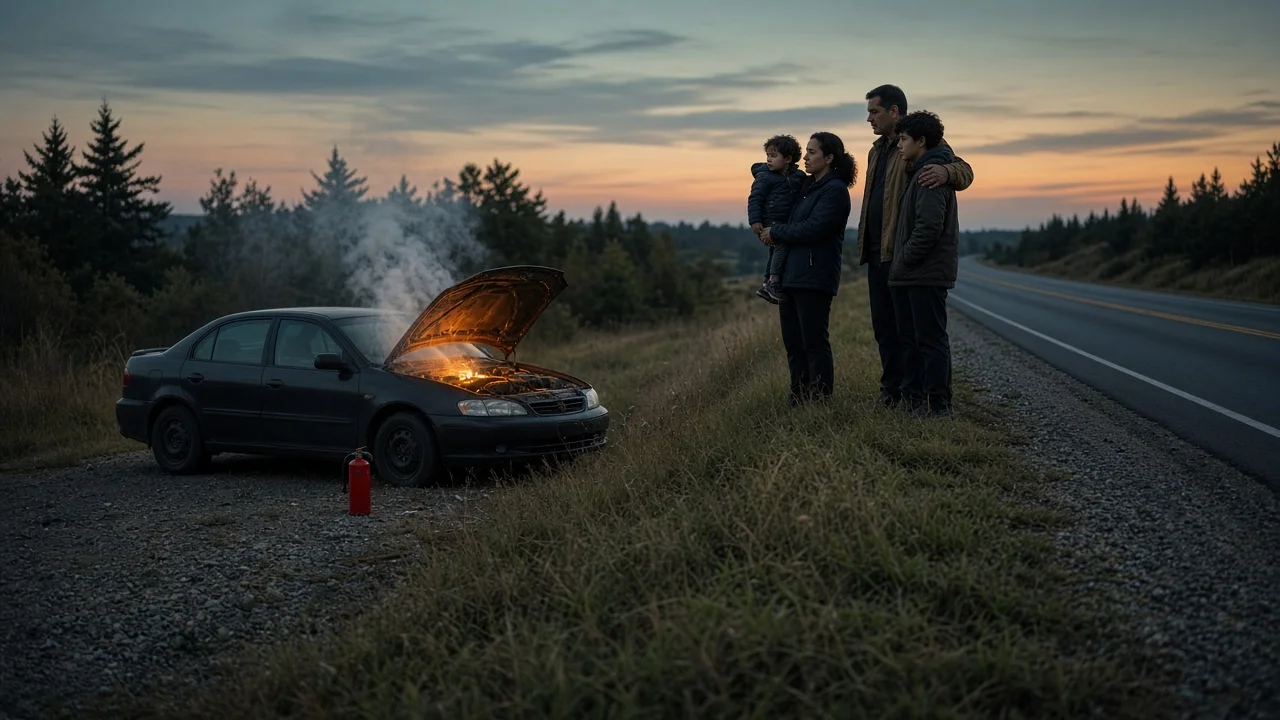
If your vehicle shows signs of fire, your priority is to protect people, not the vehicle. Signal, pull over as soon as it is safe, switch off the engine, get everyone out, move well away from the vehicle and traffic, and call 911. Do not go back for belongings, and do not open the hood. Fight the fire yourself only if it is small, you have a suitable extinguisher, you know how to use it, and you have a clear escape route. If the vehicle is electric or a hybrid, do not try to fight a fire involving the battery, and tell the dispatcher what kind of vehicle it is.
This guide covers how to respond at the roadside to visible flames, smoke or other warning signs, and what to do afterward. It does not replace instructions from emergency responders or your vehicle manufacturer, which take priority wherever they differ.
Warning signs that a fire may be starting
Not every vehicle fire begins with visible flames. Treat any of these signs as a reason to stop promptly and check from a safe position:
Smoke coming from under the hood, the dashboard, the wheels or underneath the vehicle. A smell of burning plastic, rubber or electrical insulation. A strong fuel smell, especially with fluid dripping or pooling under the vehicle. Sparks, crackling sounds or flickering light from the engine bay or underside. Fuses that blow repeatedly, or electrical features that fail suddenly. Gauges behaving abnormally, such as a sudden spike in engine temperature or a rapid drop in fuel level. On electric or hybrid vehicles, battery warnings, unusual hissing or popping, or smoke from the battery area.
These signs can have causes other than fire, such as coolant hitting a hot engine or a brake that is dragging. You cannot reliably tell the difference from the driver's seat, so the safe response is the same: stop, switch off and get out. Diagnosis comes later, and it should be done by a qualified technician, not at the roadside.
Step by step: responding to a vehicle fire
1) Signal and pull over safely
Turn on your hazard lights and move to the shoulder, a breakdown lane or an exit as soon as it is safe. Avoid stopping next to dry grass, buildings, fuel pumps or other vehicles where possible. If you are in a tunnel or garage, follow posted emergency instructions and get out of the enclosed space on foot if the vehicle cannot be moved out safely.
2) Turn off the engine
Shutting off the ignition stops the engine and, on many vehicles, the fuel pump, which can reduce the fuel feeding a fire. Put the vehicle in park or apply the parking brake so it cannot roll.
3) Get everyone out
Help passengers out, starting with children and anyone who needs assistance. Exit on the side away from traffic if you can. Leave belongings behind. A fire can grow quickly, and returning to the vehicle is one of the most dangerous things you can do.
4) Move well away and stay away from traffic
Move a good distance from the vehicle, ideally upwind and uphill, and behind a barrier such as a guardrail if one is available. Keep off the roadway itself. Vehicle fires produce toxic smoke, and parts such as tires, bumper struts, gas-filled hood or trunk supports and fuel components can burst. This guide does not give a specific safe distance because none was available from verified sources here; follow any distance given by the 911 dispatcher or responders on scene.
5) Call 911
Call from a safe position. Give your location as precisely as you can, using mile markers, exits, cross streets or landmarks. Say how many people are involved, whether anyone is hurt, and what kind of vehicle it is, especially if it is electric, a hybrid, or carrying fuel or hazardous cargo. Warn other drivers only if you can do so without entering traffic.
6) Do not open the hood
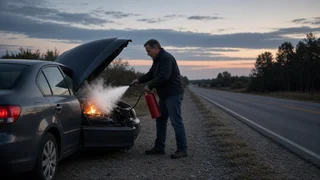
Opening the hood lets more air reach a fire in the engine bay, which can make it flare up suddenly toward your face and hands. Leave the hood closed and let firefighters deal with it.
Should you use a fire extinguisher?
An extinguisher is an option only for a small fire in its early stage, and only after everyone is out and 911 has been called. All of the following should be true before you try:
The fire is small and not spreading quickly. You have an extinguisher rated for vehicle fires. In the US, a multipurpose ABC unit covers ordinary combustibles, flammable liquids and electrical fires; confirm the label on your own extinguisher. You know how to use it, and you can keep a clear path away from the vehicle behind you. The fire does not involve the high-voltage battery of an electric or hybrid vehicle. The fire is not in the engine bay with the hood closed, since you would have to open the hood to reach it.
If you do use one, stand back, aim at the base of the flames rather than the smoke, and sweep from side to side. If the fire does not go out quickly, or it grows, stop and move away. Your safety matters more than the vehicle.
Electric and hybrid vehicles
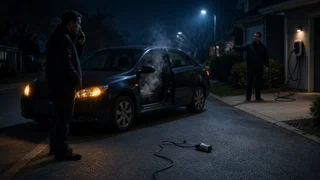
Fires involving high-voltage lithium-ion batteries behave differently from fuel fires. They can be hard to extinguish, can give off especially hazardous gases, and can reignite after appearing to be out, sometimes much later. The roadside response for occupants is the same: stop, switch off, get out, move away and call 911. Do not try to fight a battery fire yourself, and make sure responders know the vehicle has a high-voltage battery. Check your owner's manual for any manufacturer-specific emergency guidance for your model.
If there is smoke but no visible flames
Follow the same first steps: pull over, turn off the engine and get everyone out. Do not restart the vehicle to see whether the smoke stops, and do not open the hood to look. White, sweet-smelling vapor may point to a coolant leak, while acrid or dark smoke may point to burning oil, rubber or wiring, but these are only possibilities and not something to test at the roadside. If you are unsure whether it is fire, call 911.
Even if the smoke stops, have the vehicle towed rather than driven. Whatever caused it, such as a fuel or oil leak, an electrical fault or an overheating component, can start again. A qualified technician should inspect it before it is used again.
After the fire is out
Stay away from the vehicle until responders say it is safe, particularly with electric and hybrid vehicles because of the risk of reignition. Get medical attention for anyone who breathed in smoke or has burns, even if the symptoms seem minor. Do not drive the vehicle. Arrange a tow, and tell the tow operator if it is an electric or hybrid vehicle. Photograph the scene from a safe distance if that helps, and contact your insurer. Check whether your vehicle is affected by a safety recall, as some recalls concern fire risk. Your dealer or the manufacturer can confirm this for your VIN.
Limits of this guide
No model-specific data, statistics or measured distances were available for this article, so it gives no figures for safe distances, how fast fires spread or how often they happen. The steps above reflect general fire-safety principles. Instructions from 911 dispatchers, firefighters and your vehicle manufacturer take priority, especially for electric, hybrid, commercial or specialty vehicles.