Choosing Replacement Turbo Blanket Springs
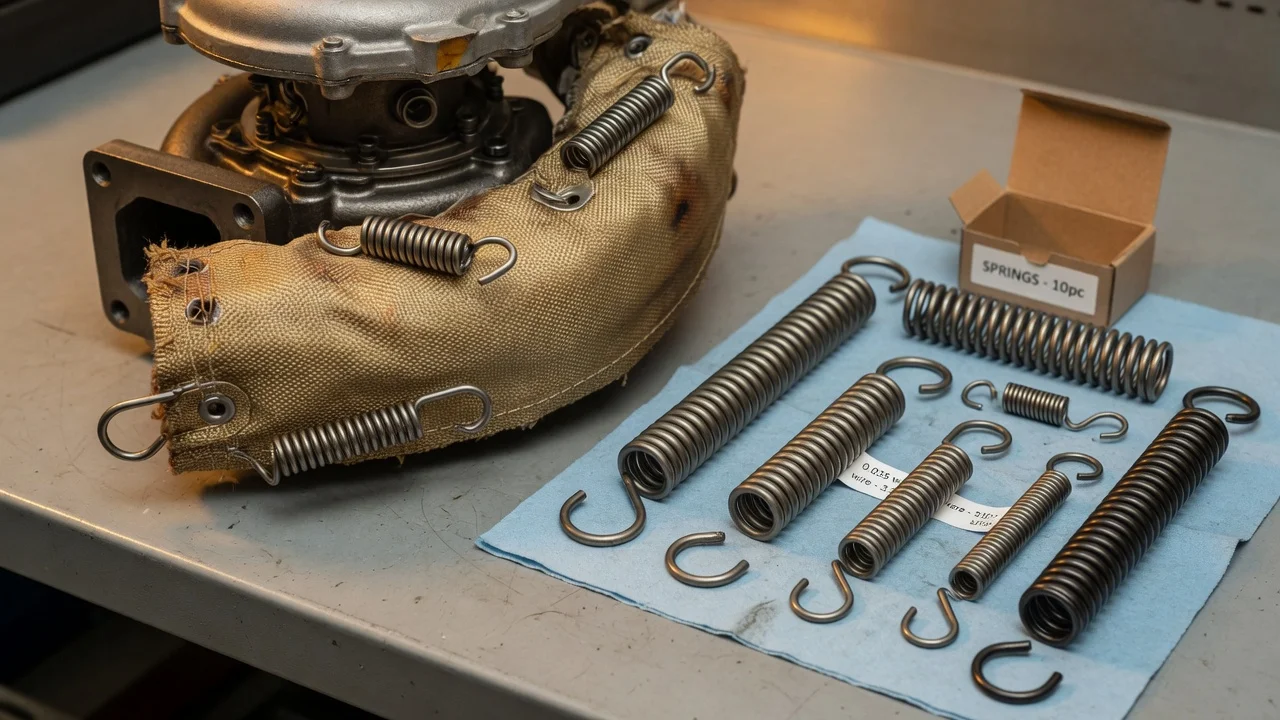
Turbo blanket springs are the small tension springs that hold a heat blanket closed around a turbine housing. They look like trivial hardware, yet a weak or mismatched spring lets the blanket shift, chafe and sit unevenly against hot metal. This guide explains how to choose replacements that suit your blanket, your turbo and your engine bay. It also shows how to tell a genuine hardware failure from a vague noise report before you spend money on parts.
Define the job the product must do
Start by confirming what the springs actually have to do on your setup. Most aftermarket blankets wrap around the turbine housing and close with springs hooked between metal eyelets or tabs along the seam. The springs keep those seams together while the housing expands and contracts through heat cycles, so they must hold tension at operating temperature, not only when fitted cold. A daily driver making short trips, a towing rig spending long periods under load and a track car facing repeated heat soak all stress this hardware differently, and that use profile should guide how robust the replacement needs to be.
Next, separate symptom reports from verified failures. A rattle at idle, a blanket that looks slightly out of place or an unusual smell from the engine bay are symptoms with several possible causes, including a loose factory heat shield, wastegate rattle or an exhaust leak at a flange. A verified spring failure is something you can see during a cold-engine inspection: a broken spring, coils stretched so they no longer close, a missing hook or a spring rusted through. Note which positions failed and record them in the service history so a recurring problem at the same location becomes obvious.
Practical constraints matter as well. Access around the turbo varies widely between engine configurations, and on some vehicles the blanket can only be reached after removing a heat shield, intake pipe or downpipe. When the job needs that much disassembly, replacing every spring at once is usually more sensible than chasing failures one at a time.
Check compatibility
Fit is determined by the blanket rather than by the vehicle alone. Turbine housings differ between turbo families, and the same model can use different turbochargers depending on model year and engine variant, so a blanket and spring layout that suit one version may not match another. Identify the blanket brand and the housing it was made for, then measure an intact original spring instead of relying only on a vehicle listing.
The specifications worth recording are free length between hook ends, outer coil diameter, wire thickness, hook style and orientation, and the total number of springs the blanket uses. Hooks should pass through the eyelets cleanly and seat without being bent open; a hook forced wider to fit loses grip and can release under vibration. Also check how far each spring stretches once installed. A spring that is too short gets overstretched and takes a permanent set, while one that is too long will not pull the seam closed.
Where the blanket maker or turbo manufacturer publishes specifications for retention hardware, follow them over generic kits. If your blanket uses a locking wire, clip or tie in addition to springs, plan to renew that too, because pairing new springs with fatigued backup hardware undermines the repair.
Features that affect the choice
Material is the main decision. Stainless steel is the usual choice for blanket springs because plain carbon steel loses temper and corrodes quickly near exhaust heat. Stainless grades differ in heat and corrosion resistance, however, and sellers do not always state which one they use. A listing that says only high temp or heavy duty, with no material grade or temperature rating, is offering a marketing label rather than evidence. Higher-alloy springs exist for very hot applications, but they cost more and are harder to find in small sizes.
Spring rate is a genuine trade-off. A stiffer spring holds the seam tighter but is harder to install in cramped spaces and puts more load on the eyelets, which can tear grommets on an older blanket. A lighter spring is easier to fit and gentler on the fabric but may relax sooner. Matching the original rate is usually the safest option unless you have a documented reason to change it.
Packaging details count too. Kits with a few extra springs are useful because hooks are easily dropped during installation, and a kit with mixed lengths helps when a blanket has seams of different sizes. Avoid assortments without listed dimensions, since you end up measuring every piece yourself.
Limitations and ownership costs
Springs only retain the blanket. They cannot rescue a blanket that has frayed, no longer matches the housing shape or has soaked up oil, and an oil-saturated blanket should be replaced because it can become a fire hazard. New springs also do nothing about the underlying cause of a heat or boost complaint. A loose blanket does not normally set diagnostic codes on its own, so if a code is stored, diagnose it on its own merits rather than assuming the springs are involved.
Installation is fiddly. Work with the engine cold, wear gloves and use a spring hook tool or long-nose pliers. Stretch each spring only enough to seat the hook, then confirm that no spring body or hook end touches a moving part, wiring harness or fluid line. Some owners add stainless safety wire as a backup retainer; if you do, tuck the tail ends so they cannot chafe nearby components.
Running costs are modest but recurring. Heat cycling and vibration gradually relax springs, so include the blanket and its hardware in routine inspection, particularly after any work that disturbed the turbo area. Replace springs as a set when several show open coils, and log the date and positions.
Build a practical shortlist
A compact checklist keeps the decision grounded in fit rather than packaging claims. For each candidate, confirm the stated material and grade, dimensions that match your measured original, a hook style that seats in your eyelets without modification, enough springs for every position plus a few spares, and compatibility with any backup wire or clip your blanket relies on.
Then weigh the remaining differences against how the vehicle is used. Sustained high exhaust temperatures justify a better-documented material, while a lightly used daily driver may be well served by a correctly sized stainless kit. When two options look equal, choose the seller that publishes dimensions and material, because that information lets you confirm fit before installation rather than after it.
After fitting, bring the engine to operating temperature, let it cool fully and inspect again. A spring that has already stretched or a seam that has opened points to the wrong size or rate, and it is far better to find that in the driveway than after the blanket has worked loose on the road.