Top-Post Battery Disconnect Switch: Types, Uses and Fitment Guide
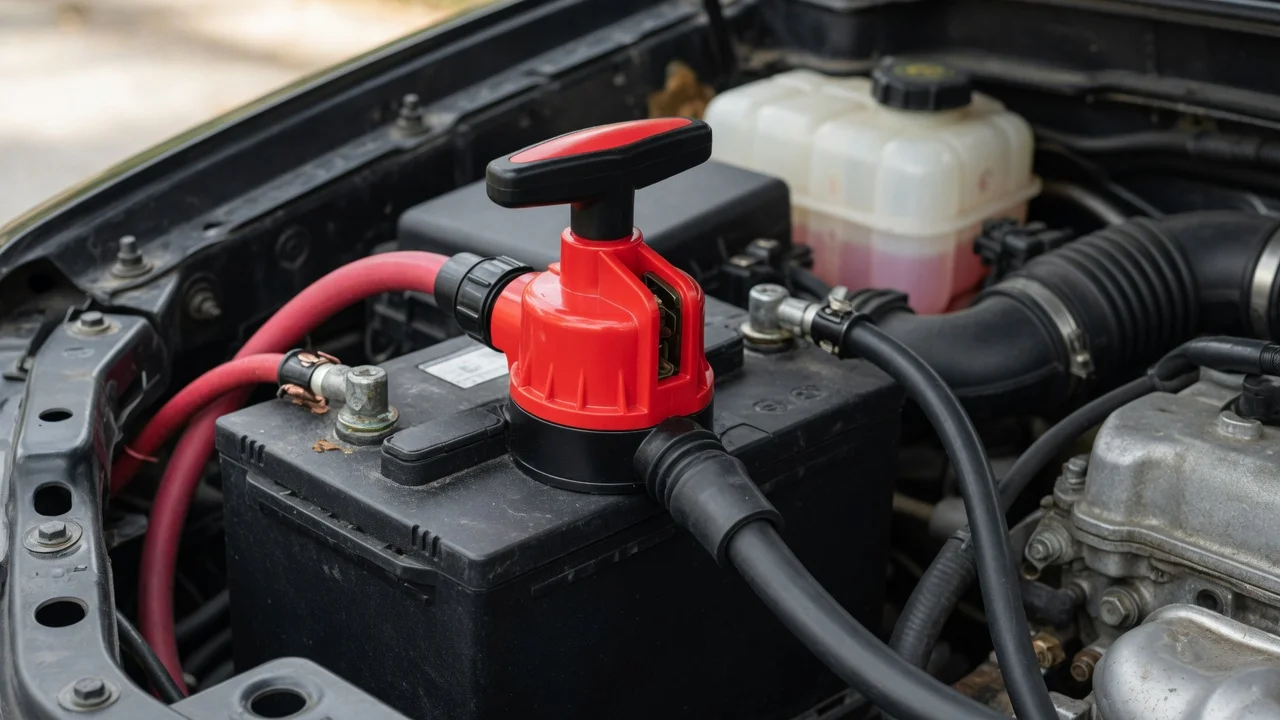
A battery disconnect switch lets you cut the electrical connection between a vehicle's battery and the rest of its electrical system without removing a battery cable with a wrench. Owners fit them to stop slow battery drain during storage, to make electrical work safer, as a basic theft deterrent, or to meet rules in some motorsport classes. This guide covers the switch styles that work with top-post batteries and explains what each one is suited to.
What "top-post" means and why it matters
A top-post battery has its terminals as round posts on the top of the case. That differs from a side-post battery, where threaded terminals sit on the side of the case, and from stud-terminal batteries, which have threaded studs and are common in marine and some commercial uses. A switch designed for one terminal style generally will not fit another without an adapter, so knowing your battery type is the first step.
Top posts are not all the same size. The common SAE-style post is tapered, and the positive post is slightly larger than the negative so that cables are harder to reverse. Some batteries fitted to Asian-market and Japanese-brand vehicles use smaller JIS-style posts instead. A terminal-mounted switch sized for SAE posts may not clamp securely on a JIS post. Check the post type on your specific battery before buying.
Names and related terms
Retailers and owners use several names for the same device: battery disconnect switch, battery kill switch, battery cutoff switch, master switch and isolator switch. These generally refer to a switch that breaks the battery circuit.
A battery isolator is a different device. It manages charging between two or more batteries, such as a starting battery and an auxiliary battery in a camper or off-road vehicle, and is not designed to shut off the whole electrical system. Because the names overlap, read the product description rather than relying on the label alone.
How this list was put together
This list covers the main design styles of disconnect switch that can be used with a top-post battery. It is a selection of switch types, not a list of every product on the market, and it does not name specific brands. Entries are ordered from the simplest designs that clamp directly onto the battery post to more involved designs that are mounted elsewhere and wired into the cable. The order reflects installation complexity, not quality. No comparable performance or durability test data was available, so the switches are not ranked against one another.
Types of top-post battery disconnect switch
1) Rotary knob terminal switch
This is one of the most widely sold styles for top-post batteries. The switch body clamps onto the battery post, the existing cable clamp attaches to the switch, and a threaded knob on the side is turned to separate or join the internal contacts. Many versions use a colored knob, often green, that is fully removed or backed off to break the circuit.
Relevance: it installs with basic hand tools, needs no extra wiring, and suits owners who mainly want to stop drain on a stored vehicle. The trade-off is that it adds height above the post, so check that it clears the hood, the battery hold-down and nearby components. You also need to open the hood to use it.
2) Knife-blade terminal switch
A knife-blade switch also mounts directly on the post, but it uses a hinged metal blade that you lift to break the circuit and press down into a slot to reconnect it. The open or closed position is easy to see at a glance.
Relevance: it offers quick, tool-free operation and a clear visual check of whether the battery is connected. Because the blade is exposed metal, keep tools and other conductive objects away from it, and confirm it will not contact the hood or a body panel when lifted. It suits occasional use, such as storing a classic car, a project vehicle or a seasonal vehicle.
3) Remote-mounted rotary master switch
This style is mounted away from the battery, for example on a firewall, in the trunk or on a panel, and is wired into the battery cable. It is typically operated by a rotating handle or a removable key. A removable key adds a small theft-deterrent benefit, because the vehicle cannot be powered without it.
Relevance: it lets you cut power without reaching the battery, which is useful when the battery is hard to access or is relocated. It is the general type used where motorsport rules call for an externally reachable cutoff, but requirements differ by sanctioning body and class, so check the current rulebook before choosing a switch. Installation involves cutting or making new cable runs and is more involved than a terminal-mounted switch.
4) Remote-control or solenoid disconnect
These units use an electrically operated relay or solenoid to open and close the circuit. They are controlled by a key fob, a dash-mounted button or another trigger, and some mount directly on or near the battery terminal.
Relevance: they offer convenience and can be operated without opening the hood, which appeals to owners who disconnect often or want a discreet anti-theft cutoff. They are more complex than mechanical switches, and the control circuit itself may draw a small amount of power. Behavior varies between products, so read the manufacturer's information on standby draw and on what happens if the remote or control unit fails.
Quick comparison
Type | Mounting | Operation | Typical use; Rotary knob terminal switch | On the battery post | Turn knob by hand | Storage, simple drain prevention; Knife-blade terminal switch | On the battery post | Lift or lower blade | Storage, visible on/off check; Remote-mounted rotary master switch | Wired into cable away from battery | Handle or removable key | Relocated batteries, motorsport, theft deterrence; Remote-control or solenoid disconnect | On or near battery, electrically controlled | Fob or button | Frequent use, convenience, anti-theft
What to check before buying and installing
Post type and size: confirm whether your battery uses SAE-style or JIS-style top posts and that the switch fits it. Current rating: the switch must handle the vehicle's electrical load, including engine cranking. Compare the manufacturer's rating with your vehicle's needs; larger engines and diesels generally demand more current. Clearance: terminal-mounted switches add height and width, so make sure the hood closes without touching the switch. Which terminal: these switches are commonly fitted to the negative terminal, which reduces the risk of a short circuit if a tool touches the switch and a grounded metal part at the same time. Follow the switch maker's instructions for your setup. Use with the engine off: unless the product states otherwise, disconnect only with the engine off. Cutting the battery while the engine runs can cause voltage spikes that may damage electronics.
Effects on modern vehicles
Cutting battery power on a vehicle with modern electronics can reset the clock, radio presets and some learned settings in the engine or transmission control modules. Some vehicles may idle or shift differently until those settings relearn. Some radios need a security code after power loss, and some vehicles have specific procedures after reconnection, such as resetting power windows or the steering angle sensor. These effects vary widely by make, model and model year, so check your owner's manual or a dealer before relying on a disconnect switch for routine use.
Some vehicles also keep modules active for a period after the ignition is switched off. Where the manufacturer recommends waiting before disconnecting the battery, follow that guidance.
Information gaps
No independent test data, product specifications or vehicle-specific compatibility information was available for this guide. As a result, it does not give current ratings, measurements or brand recommendations, and it does not rank the switch types. Use the manufacturer's specifications and your vehicle's documentation to confirm fit and suitability.