Top-Post vs Side-Post Car Battery Terminals
The short answer
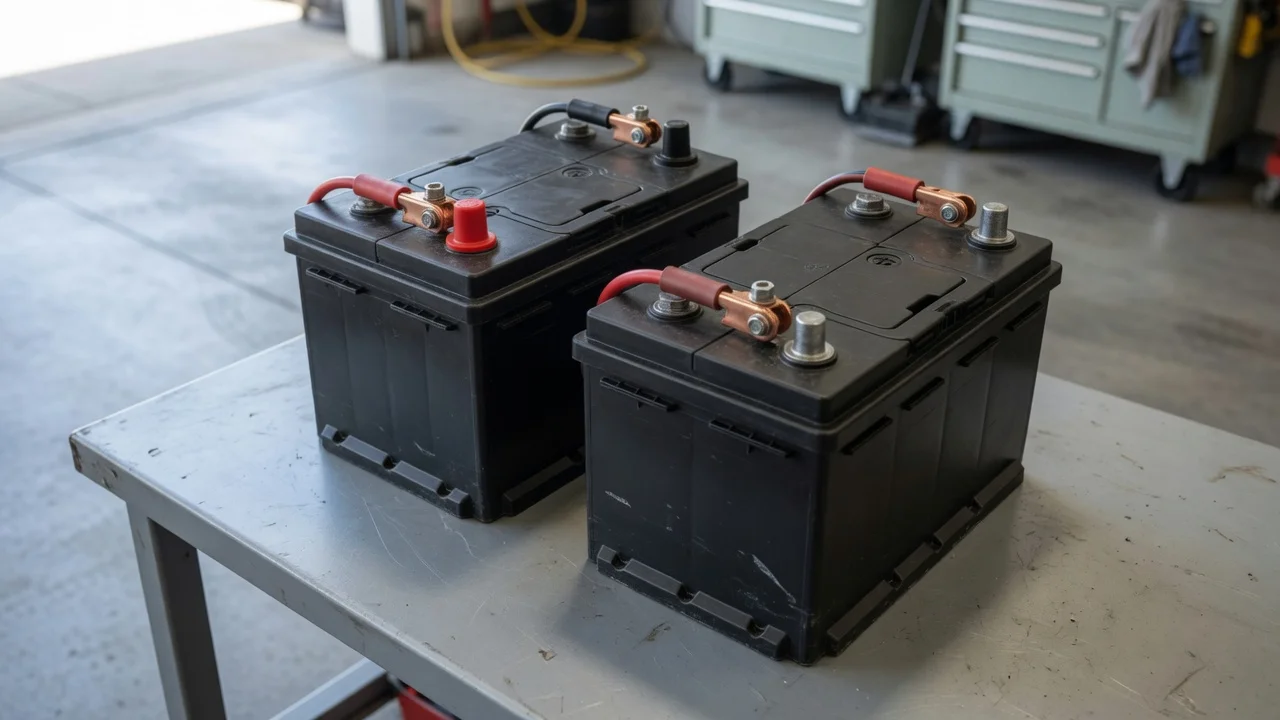
Top-post and side-post batteries differ mainly in where the terminals sit and how the cables attach. A top-post battery has two raised lead posts on its lid, and the cable clamps slip over them and tighten around them. A side-post battery has two threaded sockets set into the front face of the case, and the cable ends bolt directly into them. Neither design is universally better. The right one is whatever your vehicle's cables, tray and hold-down were built for. A battery with the wrong terminal layout may not connect properly, may leave cables strained or too short, or may put terminals close to metal parts they should not touch.
How to tell which type you have
Look at where the cables meet the battery. If the clamps sit on top of the case and wrap around round posts, it is a top-post battery. If the cables run to the side of the case and end in flat terminals held by bolts, it is a side-post battery. Some batteries, often called dual-terminal batteries, have both top posts and side sockets so they can be fitted to either type of vehicle.
Top-post terminals explained
Top posts are the most common layout across many makes and markets. The posts are slightly tapered so the clamp tightens as it is pushed down and clamped. On standard automotive top posts, the positive post is a little larger in diameter than the negative post. This helps prevent a clamp from being fitted to the wrong terminal by mistake.
Easy to see and reach for inspection, cleaning, testing and jump-starting. Many clamp styles and replacement cable ends are available. Exposed posts and clamps can collect visible corrosion, which usually shows up as white, blue or green buildup. The raised posts need enough clearance above the battery, which matters in tight engine bays or under hoods with little room.
Side-post terminals explained
Side-post batteries have long been associated with many General Motors vehicles, though they are not limited to one manufacturer. The cable end is a flat lug bolted into a threaded socket on the side of the battery. Because the bolted joint is more enclosed than a clamp on an open post, side terminals are often described as less prone to visible corrosion at the connection. That does not make them maintenance-free, and corrosion can still form.
A compact, low-profile connection that needs less vertical clearance. Often harder to reach for testing or jump-starting. Many vehicles with side-post batteries provide separate jump-start points under the hood for this reason. The threaded sockets can be damaged by overtightening or by using a bolt of the wrong length or thread. Follow the vehicle or battery maker's tightening guidance. Fewer aftermarket clamp options than top posts, though adapters exist.
Choosing a replacement battery
The safest approach is to match the battery your vehicle specifies, rather than choosing a terminal style by preference. Terminal type is only one part of fit. Case dimensions, terminal position, and which side the positive terminal sits on all have to suit your cables and hold-down.
Check the owner's manual, the label on the current battery, or a retailer's fitment lookup for your exact model year, engine and market. Note the battery group size. This is a standard size code, such as a BCI group number in North America, that describes case dimensions and terminal layout. Confirm the terminal type and where the positive terminal sits, so the cables reach without stretching. Match or exceed the required electrical ratings, such as cold cranking amps (CCA), which measures how well a battery starts an engine in cold conditions. If you are considering a dual-terminal battery, make sure the unused terminals are capped or covered so they cannot contact metal parts.
Can you use adapters to switch between types?
Adapters can convert side terminals to top-style posts, which some people use for jump-starting or charging. They add an extra connection that can loosen or corrode, and they can change clearances around the battery. A battery that matches your vehicle's original terminal type is generally the simpler and more reliable choice. If an adapter is used, it should be the correct type for the terminal and fitted securely.
Safety when working with either type
Disconnect the negative cable first and reconnect it last. This lowers the risk of a short if a tool touches the positive terminal and a metal part of the vehicle at the same time. Wear eye protection, keep sparks and flames away from the battery, and make sure all connections are clean and tight before starting the engine. Some modern vehicles may need settings relearned or systems reset after the battery is disconnected. Check your vehicle's documentation for any specific procedure.
What this guide does not cover
No vehicle-specific data was available for this article. It does not list which models use which terminal type, exact group sizes, bolt thread sizes, or tightening torques. Confirm those details for your specific vehicle using the owner's manual, the existing battery label, or a parts retailer's fitment information.