Test brake fluid for moisture
What a moisture test tells you
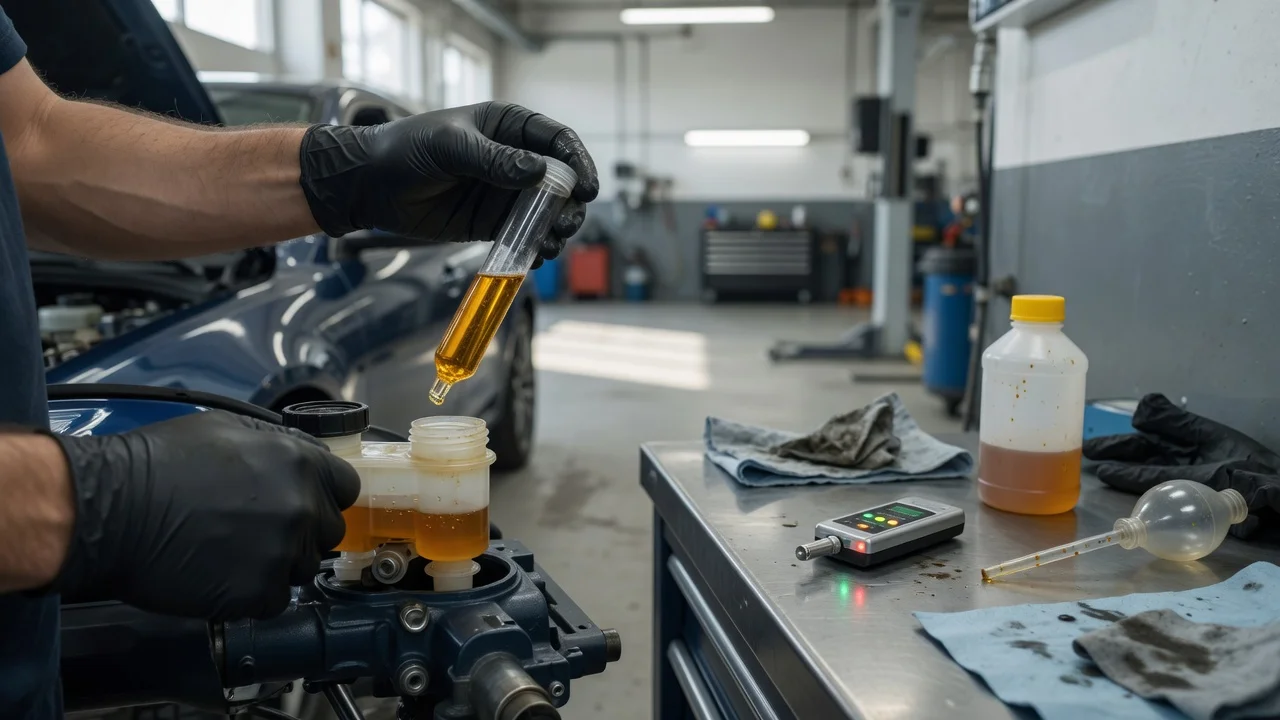
A brake fluid tester is a workshop or DIY tool used to estimate water content in glycol-based hydraulic brake fluid. Moisture matters because DOT 3, DOT 4 and DOT 5.1 fluids are hygroscopic: they absorb water from the air through reservoir vents, microscopic hose permeability and service openings. Dissolved water lowers the fluid’s boiling point, which can allow vapour to form under hard or repeated braking and can contribute to internal corrosion in the hydraulic circuit.
The essential answer is that you can screen for moisture with an electronic tester pen, chemical test strips, or a boiling-point tester, then use the result together with the vehicle maker’s service interval and a visual inspection. None of these tools, used alone, prove the entire brake system is healthy. They estimate water in a sample, usually taken from the master-cylinder reservoir, and they do not replace a full hydraulic inspection or a manufacturer-specified fluid change.
Scope: which fluids a tester is for
Moisture testers are intended for glycol-ether fluids specified as DOT 3, DOT 4 or DOT 5.1 under FMVSS 116. Those grades share a hygroscopic chemistry even though their minimum dry and wet boiling points differ. DOT 5 silicone fluid is a different chemistry: it does not absorb water in the same way, it is not compatible with glycol fluids, and conductivity-style pens and moisture strips made for glycol fluid are the wrong tool for it. Confirm the cap, reservoir marking or owner’s manual before testing or topping up.
Wet boiling point in the DOT standard is defined after a controlled moisture load (commonly cited as about 3.7 percent water by volume in SAE J1703/J1704 practice). That laboratory wet rating is a specification floor for new fluid after humidity exposure, not a pass/fail number your handheld tester is calibrated to reprint. Handheld readings are estimates of in-service water, not a certified laboratory assay.
Types of brake fluid moisture testers
Electronic tester pens
A brake fluid tester pen is a handheld probe with metal electrodes and LED or digital readout. You dip the electrodes into the reservoir fluid and the tool infers water from electrical conductivity: more dissolved water generally raises conductivity. Many consumer pens display stepped bands (often labelled around 1, 2, 3 and 4 percent water) rather than a continuous laboratory measurement. Accuracy depends on clean electrodes, the fluid chemistry the unit was designed for, temperature, and contamination other than water. Dirt, metallic wear debris and mixed fluid grades can shift a conductivity reading even when water content has not changed by the same amount.
Test strips
Brake fluid test strips are paper or polymer strips with a chemical pad that changes colour after a short dip. You compare the pad with a printed chart that typically maps colour to an approximate moisture band. Strips are cheap, need no battery and work without inserting electronics into the reservoir. They are also qualitative: lighting, strip age, pad wetting time and the chart’s colour steps all affect how you read them. Use them before the expiry date on the pack, keep unused strips dry, and treat the result as a screening band, not a precise percentage.
Boiling-point testers
A brake fluid boiling-point tester heats a small sample and reports the temperature at which the fluid boils. That measurement is closer to the property that matters in a panic stop than a conductivity estimate, because vapour lock is a boiling-point problem. These units are more common in workshops than in home toolkits, need a representative sample, and still do not describe corrosion, sludge or fluid that has been mixed with the wrong grade. Compare the reading with the minimum wet boiling point for the DOT grade in the vehicle, not with the much higher dry boiling point printed for unused fluid.
How to take a useful sample
Park on level ground, apply the parking brake and let the system cool. Hot fluid and a hot reservoir can distort both conductivity and boiling-point readings. Clean the reservoir cap and the surrounding paint so dirt does not fall in when you open it. Moisture testing is wasted if you contaminate the fluid while checking it. Read the fluid type on the cap or in the owner’s manual. Do not test or add fluid if the marking is DOT 5 silicone unless the tool and replacement fluid are specified for that chemistry. For a pen, wipe the electrodes, dip them fully into the fluid, wait for a stable indication, then wipe them again before storage so residue does not corrode the probe. For strips, dip only the pad for the time the pack states, then match colour immediately under decent light. Do not drop the strip back into the reservoir. For a boiling-point tester, follow the tool’s sample volume and heating procedure. A few millilitres from the top of the reservoir is still only a reservoir sample.
Reservoir fluid is the easiest place to test and the first place atmospheric moisture collects. It is not always the wettest or most degraded fluid in the system. Calipers, wheel cylinders and ABS hydraulic units sit lower, run hotter and can hold older fluid after a reservoir-only top-up. A clean, dry reading at the cap therefore does not guarantee dry fluid at the corners. If the vehicle has never had a full bleed, treat a reservoir test as a screening step and plan a complete exchange if the fluid is old, dark, or overdue by the maintenance schedule.
How to read the result
There is no single universal “fail” percentage published for every vehicle. FMVSS 116 and SAE wet-boiling-point figures describe new fluid after a standard humidity procedure; they are not a field condemnation threshold. Tool makers often mark the upper LED or the darkest strip colour as a change-now band, commonly around the region where water content approaches the wet-spec humidity load. Treat those marks as the tester manufacturer’s guidance for that instrument, and confirm against the vehicle maker’s replacement interval.
Low moisture band plus fluid that is still clear or light amber, within the maker’s change interval: note the date and retest at the next service. Do not ignore a scheduled change solely because a pen showed a low band. Mid or high moisture band, dark brown or black fluid, particles, or a neglected interval: plan a complete fluid exchange and bleed, not a reservoir top-up with fresh fluid. Topping up dilutes the sample you just tested and leaves wet fluid in the lines. Wrong DOT grade, milky appearance, or a suspected mix of silicone and glycol: stop testing as a DIY moisture check and have the system inspected. Mixed chemistries and emulsified water are outside what a simple pen or strip is built to interpret. Soft pedal, fading on a long descent, a warning lamp, or a leak: those are brake-performance faults. A moisture tester does not diagnose them, and the vehicle should not be driven as if a colour chart has cleared the hydraulic system.
What the test does not cover
A moisture tester does not measure boiling point unless it is a boiling-point instrument. It does not measure viscosity, lubricity, pH, copper or other corrosion products, or whether ABS valves are gummed. Copper test strips exist as a separate chemical check for corrosion by-products; they answer a different question from a water tester. Electronic pens can also disagree with strips on the same reservoir because they use different physical principles. When two cheap methods conflict, prefer a full fluid change on an aged system over trying to average the gadgets.
Service intervals still come from the vehicle manufacturer and vary by model year, market and duty cycle. Many passenger-car schedules fall in a two- to three-year window, but that is a pattern in owner literature, not a substitute for the book that belongs to the car. Severe humidity, frequent short trips, a damaged reservoir cap seal, or an open cap left after DIY work all accelerate water uptake beyond a calendar guess.
Choosing a tester and the next action
Choose a pen if you want a fast reservoir screen and will replace the fluid when the indication leaves the low band or when the schedule is due, whichever comes first. Choose strips if you want a low-cost, no-battery check and accept a colour-chart result. Choose a boiling-point tester if you need a number you can compare with the DOT wet minimum for the grade in the car. In all three cases, buy a tool labelled for the DOT family you actually run, keep probes and unused strips clean and dry, and record the date, fluid type and reading.
The practical next action after a high moisture indication is a complete bleed with the specified fluid until fresh fluid appears at every caliper or cylinder, then a firm pedal check and a leak inspection. Dispose of used glycol fluid as hazardous waste according to local rules. If the pedal is already long, the fluid is opaque, or you cannot identify the grade, skip further home testing and have the hydraulic system inspected before relying on the brakes.