Brake Fluid Testers: How to Check Brake Fluid for Moisture
The Short Answer
A brake fluid tester estimates how much the fluid in your brake system has degraded, usually by detecting absorbed water. Most glycol-based brake fluids (DOT 3, DOT 4 and DOT 5.1) are hygroscopic, which means they pull moisture from the air over time through hoses, seals and the reservoir vent. Water lowers the fluid's boiling point, and that is what matters for braking. The three common tools are electronic tester pens, chemical test strips and boiling point testers. They do not measure the same thing, so a reading from one is not directly comparable to a reading from another. A quick tester is useful for deciding whether fluid needs a closer look, but if the result is borderline or the vehicle's service interval has passed, a fluid flush is the usual next step.
One qualification changes the answer entirely: DOT 5 silicone-based fluid is not hygroscopic and is not compatible with most moisture testers designed for glycol fluids. Confirm which fluid your vehicle uses, typically marked on the reservoir cap or in the owner's manual, before testing.
Why Moisture in Brake Fluid Matters
Brakes convert motion into heat, and some of that heat reaches the fluid at the calipers. Fresh fluid has a high boiling point. As it absorbs water, the boiling point drops. If fluid at the caliper boils during hard or prolonged braking, such as on a long downhill grade or when towing, it forms vapor bubbles. Vapor compresses where liquid does not, so the pedal can go soft or sink toward the floor. This is often called brake fade from fluid boil, as distinct from fade caused by overheated pads.
Moisture also contributes to internal corrosion of steel lines, caliper bores, ABS components and master cylinder parts. Brake fluid contains corrosion inhibitors that are gradually consumed, so aged fluid can be harmful even before its boiling point becomes a safety concern.
US federal standards (FMVSS 116) set minimum boiling points for each fluid grade in two states: dry, meaning fresh fluid, and wet, meaning fluid that has absorbed a defined amount of moisture in a lab test. These are minimums; many retail fluids exceed them.
Fluid grade | Base | Minimum dry boiling point | Minimum wet boiling point | Hygroscopic; DOT 3 | Glycol ether | 205 °C (401 °F) | 140 °C (284 °F) | Yes; DOT 4 | Glycol ether / borate ester | 230 °C (446 °F) | 155 °C (311 °F) | Yes; DOT 5.1 | Glycol ether / borate ester | 260 °C (500 °F) | 180 °C (356 °F) | Yes; DOT 5 | Silicone | 260 °C (500 °F) | 180 °C (356 °F) | No
Types of Brake Fluid Testers and How They Differ
Electronic Tester Pens
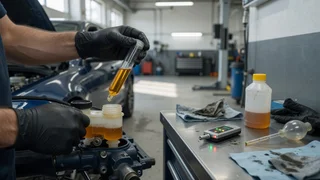
A brake fluid tester pen is a small battery-powered device with two metal probes at the tip. You dip the probes into the reservoir and the pen measures electrical conductivity between them. Water raises conductivity, so the pen translates the reading into an estimated moisture level, usually shown as a row of colored LEDs or a simple pass, caution or replace indication.
Pens are inexpensive, fast and easy to use, which makes them popular for quick checks. Their limitation is that conductivity is an indirect measure. Different fluid brands and grades have different additive packages, which can shift the baseline reading. A pen calibrated around typical DOT 3 or DOT 4 fluid may read differently in DOT 5.1 or a fluid with an unusual formulation. Pens also cannot account for contamination other than water. Treat a pen as a screening tool rather than a precise measurement.
Chemical Test Strips
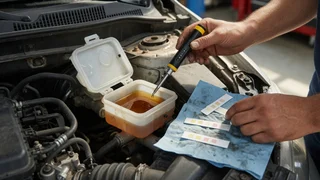
Brake fluid test strips are dipped into the fluid and change color after a short wait; you compare the color against a chart. Many popular strips do not detect water directly. Instead they measure dissolved copper, which builds up as corrosion inhibitors are depleted and the fluid begins attacking metal brake components. A high copper reading indicates the fluid's protective additives are worn out, which tends to correlate with age and moisture exposure, but it is a different measurement from water content.
Strips are cheap and widely used in shops. They are best understood as a corrosion-protection indicator. Check the packaging to see what a given strip actually tests for, keep them sealed and dry, and note any expiration date, since strips themselves can degrade.
Boiling Point Testers
A boiling point tester draws a small fluid sample into a heated chamber and measures the temperature at which it actually boils. Because the boiling point is the property that determines fade resistance, this is the most direct way to assess whether fluid is still fit for use. The result can be compared against the dry and wet minimums for the fluid's DOT grade.
These testers are more expensive and more involved to use, so they are found mainly in professional shops and among enthusiasts who track or tow. If you need a definitive answer, for example to settle a disagreement between a pen reading and a strip reading, a boiling point test is the stronger evidence.
Comparison at a Glance
Tester type | What it measures | Strengths | Limitations | Best use; Electronic pen | Electrical conductivity, used to estimate water content | Fast, cheap, reusable | Indirect; readings vary with fluid formulation; not for DOT 5 | Quick home screening; Test strips | Usually dissolved copper (inhibitor depletion); some types target moisture | Cheap, simple, no battery | Single use; may not measure water at all; color reading is subjective | Corrosion-protection check; Boiling point tester | Actual boiling temperature of a sample | Directly measures the property that matters | Higher cost; slower; requires sampling | Definitive assessment
How to Test Brake Fluid for Moisture
Identify the fluid grade from the reservoir cap or owner's manual, and confirm your tester is suitable for it. Park on level ground with the engine off. Clean the reservoir cap and surrounding area before opening so dirt does not fall in. Open the reservoir only as long as needed; brake fluid absorbs moisture from humid air. Follow the tester's instructions for immersion depth and wait time. Keep pen probes clear of the reservoir walls and screen. Read the result promptly. For strips, compare under good light against the chart within the stated time window. Clean the tester, close the reservoir securely, and wipe up any drips. Brake fluid damages paint, so rinse spills with water right away.
Reservoir Readings Have a Blind Spot
Most quick tests sample fluid at the master cylinder reservoir, but the fluid that boils is in the calipers or wheel cylinders. Fluid at the wheels sees more heat cycling and moves little during normal driving, so it can be in worse condition than fluid in the reservoir. A good reservoir reading does not guarantee the fluid at the wheels is equally healthy. This is one reason many service schedules call for replacing brake fluid on a time interval regardless of test results. Intervals vary by manufacturer, model and fluid type, so check the maintenance schedule for your specific vehicle.
What to Do With the Result
Pass or low reading, within service interval: no action needed; recheck at the next routine service. Caution or borderline reading: plan a fluid flush soon, especially before towing, mountain driving or track use. Replace or high reading: have the system flushed and bled. Topping off the reservoir does not fix degraded fluid because the old fluid stays in the lines and calipers. Service interval exceeded with a good reading: follow the manufacturer's interval anyway, given the reservoir sampling limitation. Dark, cloudy or gritty fluid, or a soft or sinking pedal: have the brake system inspected rather than relying on a tester.
A flush replaces the fluid throughout the system, not just in the reservoir. On vehicles with ABS or electronic stability control, some bleeding procedures require a scan tool to cycle the hydraulic unit. Use only the fluid grade specified for your vehicle, and never mix silicone DOT 5 with glycol-based fluids.
Which Tester Makes Sense for You
For an owner who wants an occasional check between services, an electronic pen or a pack of test strips is a reasonable, low-cost choice, provided you treat the result as a screening signal. Strips are particularly useful if your concern is internal corrosion; pens give a fast moisture estimate. If you tow heavy loads, drive in hilly terrain or do performance driving, a boiling point test, whether your own tester or a shop's, gives the most meaningful answer. Whatever tool you use, the manufacturer's fluid replacement interval remains the baseline, and the tester helps you decide whether to act sooner.