Symptoms of Fuel Injector Problems
The short answer
A fuel injector is an electrically controlled valve that sprays a metered amount of fuel into the engine. When one starts to fail, it usually delivers too little fuel, too much fuel, or fuel in a poor spray pattern. The most common signs are a rough or shaky idle, misfires, hesitation or stumbling when accelerating, reduced power, worse fuel economy, hard starting, a raw fuel smell, and a lit check engine light.
None of these symptoms is unique to injectors. Ignition faults, vacuum leaks, low fuel pressure, sensor faults and mechanical engine problems can produce the same complaints. Treat the symptoms as a reason to test the fuel system, not as proof that an injector needs replacing.
Scope: which injection system you have matters
Most modern gasoline engines use either port fuel injection, where injectors spray into the intake port just ahead of the valve, or gasoline direct injection (GDI), where injectors spray straight into the combustion chamber at much higher pressure. Some engines use both. Diesel engines use their own high-pressure injection systems. The broad symptoms overlap, but test methods, pressures and safe service procedures differ by engine, model year and market, so confirm which system your vehicle uses before acting on any test.
Common symptoms and what they suggest
Symptom | How an injector could cause it | Other common causes; Rough idle or shaking | One cylinder receives too little or too much fuel, so it fires unevenly | Worn spark plugs, failing ignition coil, vacuum leak, low compression; Misfire, often with a flashing or steady check engine light | Clogged, stuck or electrically failed injector starves or floods a cylinder | Ignition faults, valve or compression problems, wiring faults; Hesitation, stumbling or weak acceleration | Restricted injector cannot supply enough fuel under load | Weak fuel pump, clogged fuel filter, faulty airflow sensor, ignition breakdown under load; Poor fuel economy | Leaking or dripping injector adds unmetered fuel | Dragging brakes, tire pressure, faulty oxygen or temperature sensor, driving conditions; Hard starting, especially after the car sits | Leaking injector lets fuel pressure bleed off or floods a cylinder | Weak fuel pump check valve, leaking pressure regulator, battery or starter issues; Raw fuel smell | External leak at the injector seal or body, or a rich-running cylinder | Leaking fuel line, evaporative system fault, overfilled tank; Black smoke from the exhaust | Injector delivering too much fuel or spraying poorly | Clogged air filter, sensor faults; on diesels, turbo or calibration issues; Failed emissions test | Rich or lean running raises pollutant levels | Catalytic converter, oxygen sensors, misfires from other causes
An external fuel leak or strong fuel smell is a fire risk. If you see fuel dripping or smell it strongly around the engine, avoid driving the vehicle and have it inspected promptly.
Fault codes that often point toward the fuel system
On vehicles with OBD-II (on-board diagnostics, second generation), a scan tool can read diagnostic trouble codes (DTCs). Several standardized codes commonly appear alongside injector problems, though manufacturers may add their own codes and exact definitions can vary by vehicle.
P0300: random or multiple cylinder misfire detected; P0301 to P0312: misfire detected in a specific cylinder (the last digits indicate the cylinder number); P0201 to P0212: injector circuit fault for a specific cylinder, which indicates an electrical problem in the injector, its wiring or its driver, not necessarily a clogged injector; P0171 and P0174: system too lean, bank 1 and bank 2; P0172 and P0175: system too rich, bank 1 and bank 2
A code describes what the engine computer detected, not which part failed. A misfire code for cylinder 3, for example, says cylinder 3 is not firing properly; the cause could be the injector, the spark plug, the coil, a vacuum leak at that cylinder or low compression. Use codes to decide where to test, not what to buy.
How to tell an injector problem from other causes
The goal is to separate what you observe from what might be causing it, then run checks that rule causes in or out. A sensible order moves from simple, low-cost checks toward more specialized tests. The interpretation of each result depends on the operating conditions the test requires, such as engine temperature, idle versus load, and key-on versus running, so follow the service information for your specific engine.
1) Read codes and freeze-frame data
Record all stored and pending codes plus the freeze-frame data, which shows conditions such as engine speed, temperature and load when the fault was set. This helps you reproduce the problem. Supports: narrowing the fault to a cylinder, a bank or a circuit. Leaves unresolved: which component is responsible.
2) Look and smell
Inspect visible injectors, connectors and fuel rails for wetness, fuel odor, damaged wiring or loose connectors. Supports: an external leak or connection fault if found. Leaves unresolved: internal clogging or internal leaking, which are not visible from outside.
3) Check fuel trims
Short-term and long-term fuel trim (STFT and LTFT) are scan-tool values showing how much the engine computer is adding or removing fuel to keep the mixture correct. Large positive trims suggest a lean condition; large negative trims suggest a rich one. Trims that are off on only one bank of a V-type engine point toward something specific to that bank, while trims that are off on both banks point toward a shared cause such as fuel pressure or airflow measurement. What counts as abnormal varies by vehicle and condition, so compare against the manufacturer's guidance. Supports: whether the problem is lean or rich and how widespread it is. Leaves unresolved: whether an injector, a vacuum leak or a sensor is to blame.
4) Swap test for a cylinder-specific misfire
Where accessible, swap the ignition coil, and separately the spark plug, from the misfiring cylinder to another cylinder, clear codes and drive. If the misfire moves with the part, that part is the likely cause. If it stays in the original cylinder, the injector, wiring or engine mechanics become more likely. On port-injected engines, injectors can sometimes be swapped the same way; this is often impractical or not recommended on direct-injection engines because of high pressure and single-use seals. Supports: isolating ignition versus fuel versus mechanical causes. Leaves unresolved: whether a remaining fault is electrical or mechanical.
5) Check the injector's electrical circuit
An injector circuit code, or a misfire that stays in one cylinder, justifies checking whether the injector is receiving a pulse and whether its coil is electrically sound. A noid light plugged into the injector connector shows whether the engine computer is pulsing the injector. A resistance check of the injector coil can reveal an open or shorted winding, but acceptable resistance depends on the injector type and vehicle, so use the manufacturer's specification rather than a general number. Supports: whether the fault is electrical. Leaves unresolved: a clogged nozzle or poor spray pattern, which can pass electrical tests.
6) Test fuel pressure and pressure hold
Measuring fuel pressure checks whether the pump and regulator supply what the system needs. Watching whether pressure holds after the engine is shut off can reveal leakage; a steady drop may come from a leaking injector, a pump check valve or a pressure regulator, and further isolation is needed to tell them apart. Required pressures and hold times are specific to each system and are not supplied here. Direct-injection and diesel systems operate at very high pressure and should be tested only with the proper equipment and procedures. Supports: ruling the whole fuel supply in or out. Leaves unresolved: which individual injector is at fault if one is.
7) Injector balance or flow testing
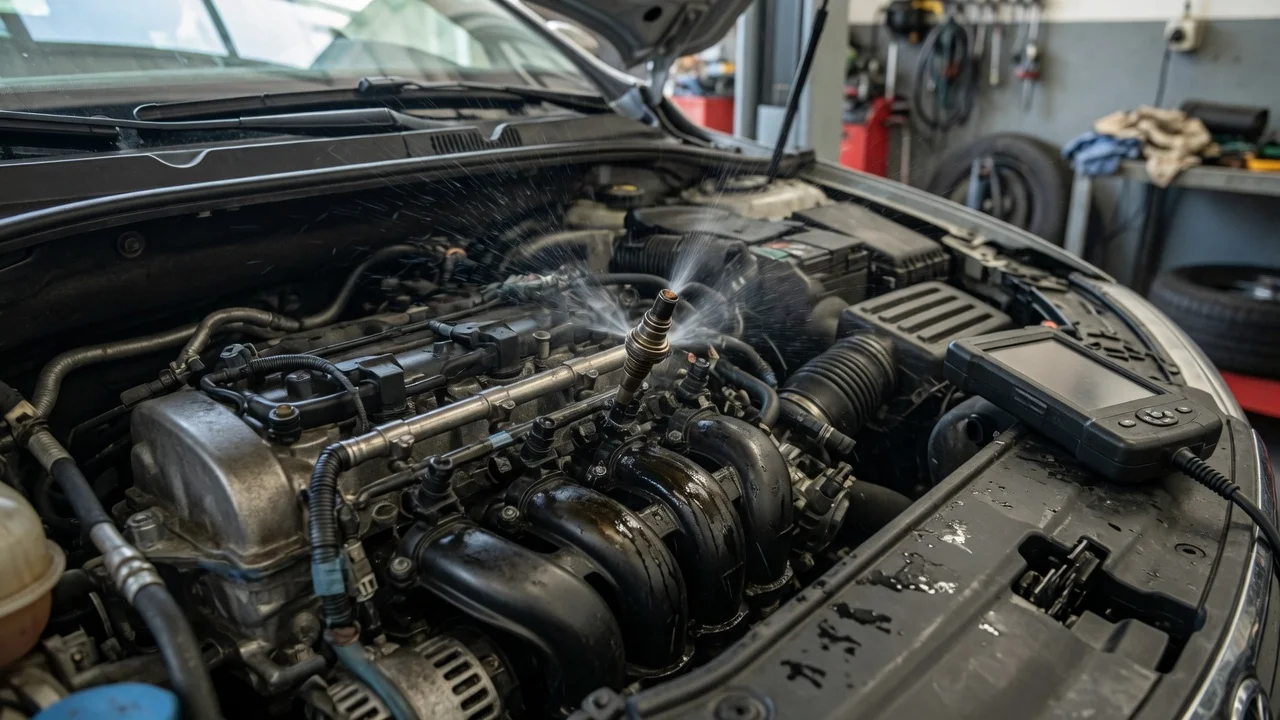
A balance test pulses each injector in turn and compares pressure drop, showing which injector flows noticeably more or less than the others. Shops may also bench-test removed injectors for flow and spray pattern, and some scan tools can run cylinder contribution tests. Supports: identifying a specific restricted or leaking injector. Leaves unresolved: little, but results must be compared against the procedure's own criteria.
8) Rule out mechanical causes
If fuel and ignition tests pass but a cylinder still misfires, a compression or leak-down test checks the valves, rings and head gasket. Replacing an injector will not fix a mechanical fault, so this step prevents unnecessary parts spending.
Clogged, leaking or electrically failed: why the type matters
Clogged or restricted injector: tends to cause lean running, hesitation and misfire under load. Cleaning may help in some cases; heavily restricted injectors may need replacement. Leaking or dripping injector: tends to cause rich running, fuel smell, hard starting after sitting and poor economy. Internal leaks usually mean replacement or professional service. Electrically failed injector or circuit: tends to cause a dead cylinder and injector circuit codes. The fault may be in the injector, the connector, the wiring or the engine computer's driver, so test before replacing.
What to do next
If the check engine light is flashing, reduce load and get the vehicle checked soon, because a severe misfire can overheat and damage the catalytic converter. For a steady light or mild symptoms, start by reading the codes and noting when the problem occurs. Fuel additives marketed as injector cleaners may help with light deposits on some engines, but they will not repair an electrical fault, an internal leak or a mechanical problem, and their effect varies. Because fuel systems carry fire and high-pressure injury risks, especially on direct-injection and diesel engines, leave pressure testing and injector removal to someone with the right tools and service information if you are not equipped for it.
Information gaps to keep in mind
This guide does not provide resistance values, fuel pressures, pressure-hold limits or fuel-trim thresholds, because these depend on the specific engine, model year and market and no vehicle-specific data was supplied. Use the manufacturer's service information or a reputable repair database for your exact vehicle to interpret test results.