Rules for Using Shared EV Charging Stations at Home Communities
Shared EV charging in apartment buildings, condominiums and HOA communities works on a simple principle: a limited number of chargers and a limited electrical supply have to serve several drivers fairly. The rules that make this work are set locally, by the property owner, the association board or the charging network operator, so there is no single national rulebook. Most communities, however, address the same issues: who may use the chargers, how long a session can last, how energy is paid for, and what happens when a car stays plugged in after it has finished charging.
The short answer
If you charge at a shared residential station, expect to follow your community's written policy on access, scheduling, session length, billing and moving your vehicle once charging ends. Where no policy exists, the reasonable default is to charge only what you need, move promptly when finished, never unplug another vehicle unless the rules explicitly allow it, and report faults rather than trying to fix equipment yourself. The details that most change the answer are whether the chargers are assigned to individual spaces or shared from a common pool, whether they are networked with an app and payment system, and how much electrical capacity the building can supply.
What counts as shared residential charging
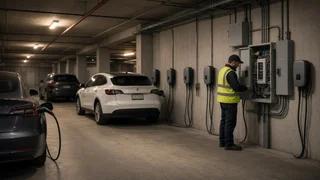
Shared residential charging covers chargers installed in common parking areas that several residents can use, as opposed to a private charger wired to one owner's space and meter. Typical setups include a bank of Level 2 chargers in a garage, a few chargers in a surface lot available on a first-come or reservation basis, and managed systems where every space has a charger but all of them draw from a shared electrical circuit.
This differs from public charging in an important way. Public stations are open to anyone and governed mainly by the network operator's terms. Residential stations serve a defined group of neighbors, so rules lean on community governance: lease terms, HOA covenants, house rules and board decisions. Enforcement is often gentler but more personal, since the person waiting for the charger may live down the hall.
Common rules and why they exist
Access and eligibility
Many communities limit chargers to registered residents, sometimes requiring drivers to register their vehicle, accept a usage agreement or create an account with the charging network. Guest access varies widely: some properties allow it with resident sponsorship, others prohibit it entirely. Registration helps with billing, contacting owners whose cars are blocking a charger, and keeping the system from being used by non-residents.
Scheduling, reservations and time limits
When there are fewer chargers than EV drivers, communities usually choose one of three approaches: first come, first served; a reservation calendar or app booking; or fixed time blocks assigned to residents. Session time limits are common, as are overnight rules that either reserve chargers for overnight use or require vehicles to move by a set morning hour so others can charge during the day. The specific limits are a local decision and should be stated in the community's policy rather than assumed.
Idle time and moving your vehicle
The most frequent source of conflict is a fully charged car left occupying a charger. Networked chargers can often notify drivers when a session ends, and some operators let the property apply idle fees after a grace period. Even without fees, most policies expect drivers to move within a reasonable time after charging finishes. Setting a charge limit in the vehicle and using a phone notification makes this easier to follow.
Unplugging other vehicles
Unplugging someone else's car is a sensitive issue. Some communities explicitly permit residents to unplug a vehicle that has finished charging so the next person can use the cable, while others forbid touching another resident's car or connector under any circumstances. Many vehicles lock the connector in place during a session, so unplugging may not even be possible. Unless your policy clearly allows it, contact the owner or management instead.
Billing and payment
Communities recover electricity and equipment costs in different ways. Common models include per-kilowatt-hour billing through a network app, per-hour or per-session fees, a flat monthly charge for registered EV owners, or charges added to rent or HOA dues. Billing by energy consumption, measured in kilowatt-hours, generally tracks actual electricity use most closely, while time-based billing also discourages long idle sessions. Rates and fees are set by the property or operator, so check the posted terms or app before you plug in.
Equipment care and fault reporting
Standard rules ask users to return cables to their holsters, avoid leaving connectors on the ground where they can be driven over, and report damage or malfunctions to management or the network operator. Residents are usually prohibited from repairing, modifying or resetting equipment themselves, both for safety and because the chargers are shared property.
How shared residential charging compares with public charging
Aspect | Shared residential charging | Public charging; Who can use it | Residents and sometimes registered guests | Generally anyone with a compatible vehicle and payment method; Who sets the rules | Property owner, HOA board or building manager, often with a network operator | Network operator and site host; Typical charger type | Mostly Level 2 AC | Level 2 AC and DC fast charging; Scheduling | First come, reservations or assigned blocks | Mostly first come, first served; Enforcement | House rules, lease or covenant terms, notices, idle fees where enabled | Network fees, idle fees, parking enforcement; Typical use pattern | Longer sessions, often overnight | Shorter top-ups or travel stops
Vehicle compatibility and connector standards
Before relying on a shared charger, confirm that its connector standard matches your vehicle or that a suitable adapter is permitted. In the US, most Level 2 chargers have historically used the J1772 connector, while Tesla's connector, now standardized as SAE J3400 and often called NACS, is being adopted by a growing number of automakers and charger manufacturers. Compatibility depends on the specific vehicle model and model year as well as the charger, so check both.
Some communities address adapters directly, for example by allowing personal adapters but prohibiting leaving them attached to the charger. If your car needs an adapter, keep it with you and check whether the policy says anything about its use.
Charging power and shared supply capacity
Charging power, measured in kilowatts, determines how fast a car gains range. In a shared setting, the power you actually receive depends on three things: the charger's rating, your vehicle's onboard charger limit, and the building's available electrical supply capacity. A car can only accept as much AC power as its onboard charger allows, so a higher-rated station will not speed up a vehicle that cannot use it.
Many buildings use load management, also called power sharing, to install more chargers than the electrical service could support at full output simultaneously. The system divides available capacity among active sessions, so charging speed may drop when several cars are plugged in at once. This is normal behavior, not a fault. It also explains why some communities schedule charging windows or limit session length: the constraint is often the building's electrical capacity rather than the number of plugs.
Networked chargers and charging protocols
Networked chargers connect to a management platform that handles user authorization, session tracking, billing and notifications. Many use the Open Charge Point Protocol (OCPP), an open communication standard between chargers and management software, which lets a property change software providers without replacing hardware in many cases. For residents, the practical effect is that rules such as access restrictions, idle fees and time limits can be enforced automatically through the app. Non-networked chargers rely on posted rules and manual tracking, which typically makes billing and enforcement less precise.
Right-to-charge laws and resident requests
Several US states have right-to-charge laws that limit how condominium associations, HOAs or landlords can prohibit residents from installing chargers, usually subject to conditions such as resident-paid installation, insurance and compliance with reasonable association rules. Coverage and conditions differ by state, and these laws generally concern installing chargers rather than the day-to-day rules for using shared stations. If you are considering asking for a charger or challenging a restriction, check the current law in your state and your governing documents.
A practical baseline policy
Communities drafting or updating rules often cover the following points. Residents can also use this list to understand what to look for in an existing policy:
Eligibility: who may use the chargers, whether registration is required and whether guests are allowed. Scheduling: first come, reservations or assigned time blocks, and any overnight rules. Session limits: maximum session length and expectations for moving after charging completes. Idle policy: grace period, notifications and any idle fees. Unplugging: whether residents may unplug finished vehicles, and under what conditions. Billing: how energy or time is charged, how payment works and how disputes are handled. Compatibility: supported connectors and rules on personal adapters. Equipment care: cable handling, prohibited modifications and how to report faults. Parking: whether charger spaces are reserved for actively charging EVs only. Enforcement: notices, fees or other consequences for repeated violations.
What to do next
Start by reading your building's posted rules, lease addendum or HOA documents, and check the charging network's app if the stations are networked. Confirm that your vehicle's connector is supported, note how billing works, and set up session notifications so you can move your car promptly. If the rules are unclear or missing, raise it with management or the board; clear written policy prevents most of the disputes that shared charging tends to create.