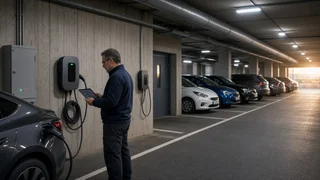
Do shared residential EV chargers need load management?
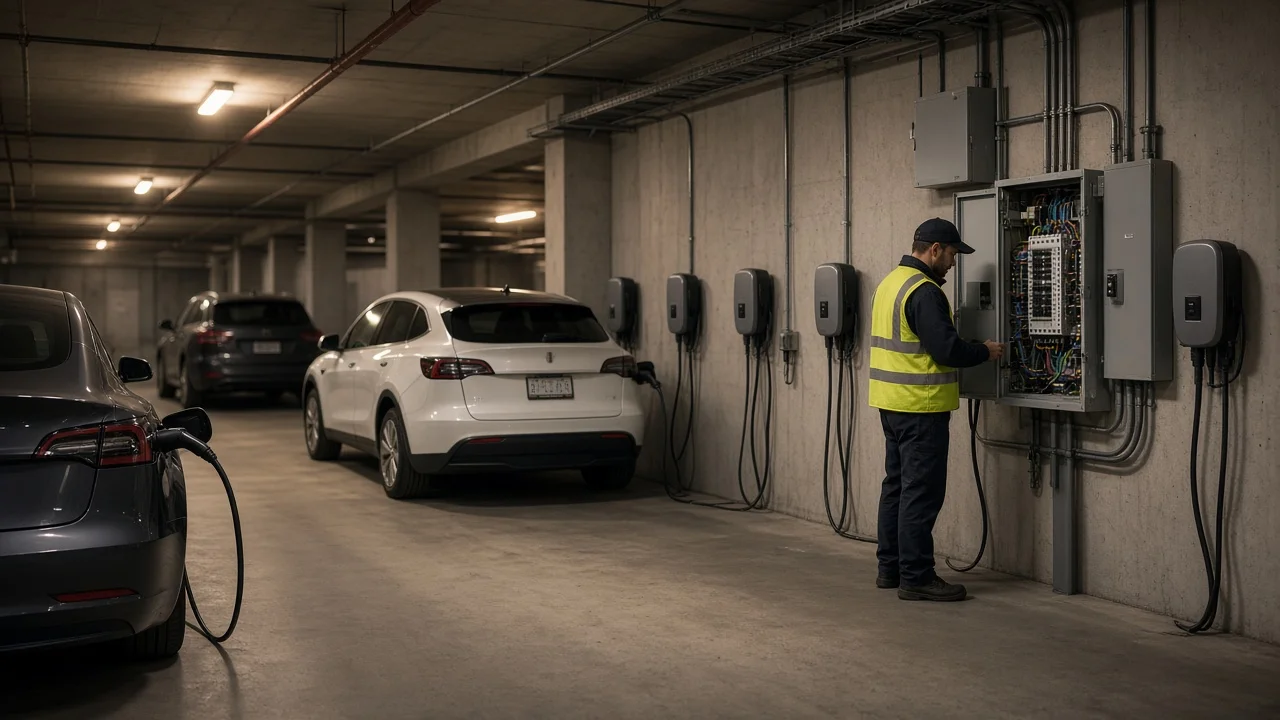
The short answer
Shared residential EV chargers do not always need load management, but many installations end up depending on it. It is needed when the building's electrical service, or the feeder supplying the parking area, cannot safely carry every charger running at full power at the same time. If that capacity exists, chargers can be installed without it. If it does not, the choices are usually to add load management, upgrade the electrical service, or install fewer or lower-powered chargers.
Load management is therefore an engineering and cost decision, not a feature every shared charger must have. A licensed electrician, working under the electrical code adopted in your area, determines whether it is required for a specific building.
What counts as shared residential charging
This guide covers chargers that several households draw power from through common electrical infrastructure. Typical examples include apartment buildings, condominiums, townhome communities managed by a homeowners association, and multi-unit properties with a shared garage or parking lot. A charger at a single-family home on its own electrical service is a different case, although the same capacity principles apply on a smaller scale.
What load management does
Load management, also called energy management or power sharing, controls how much electricity chargers draw so that the combined demand stays within a set limit. Instead of sizing the electrical system for every charger at maximum output simultaneously, the system divides the available capacity among the vehicles that are plugged in.
Static power sharing: a group of chargers shares a fixed capacity limit, and the system divides that limit among the vehicles currently charging. Dynamic load management: the system monitors the building's actual electrical use and gives chargers more or less power as other demand rises and falls. Scheduling and prioritization: some systems shift charging to times of lower building demand or let a property manager set rules for how power is allocated.
The tradeoff is charging speed. When many vehicles charge at once, each may receive less power than its charger's maximum. For overnight residential charging, where cars are often parked for many hours, this reduction may be acceptable, but it depends on how residents drive and how many vehicles share the system.
Why shared buildings are more likely to need it
EV charging places a sustained demand on electrical circuits, and electrical codes in the US treat it as a continuous load, which increases the capacity a circuit must be designed to handle. In a single home that may involve one or two chargers. In a multi-unit building, the demand multiplies with each parking space that gets a charger, while the building's service was often sized long before EV charging was considered.
Recent editions of the National Electrical Code recognize energy management systems as a way to limit the load used in electrical calculations. In practice, this can allow a building to add more chargers on existing service than an unmanaged design would permit. Whether this applies depends on which code edition your jurisdiction has adopted and on any local amendments.
When it is likely needed and when it may not be
Situation | Load management likely? | Why; Building service has ample spare capacity and only a few chargers are planned | Possibly not | The system may support every charger at full power simultaneously; Many chargers planned on an existing service with limited spare capacity | Likely | Managed load can keep demand within what the service can supply; Planning to add chargers over time | Often useful | Shared capacity can be divided as more spaces are electrified; Service upgrade is practical and affordable | Optional | Added capacity may remove the need, though management can still reduce peak demand; Service upgrade is costly or requires extensive utility work | Likely | Management can be an alternative to or a way to delay an upgrade
These are general patterns, not rules. The actual answer comes from a load calculation for the specific building.
What to check before deciding
A load calculation by a licensed electrician showing the spare capacity of the building service and of the feeder serving the parking area. The number of chargers planned now and the number likely to be added later. The electrical code edition and any local EV charging requirements in your jurisdiction. Whether the local utility needs to be involved for a service upgrade. Whether the chargers being considered support power sharing or connection to an energy management system. How charging costs will be measured and billed to individual residents, since some management platforms also handle this. Rules set by the property owner, condominium board or homeowners association for installing and using shared chargers.
Information gaps
No verified figures were available for this article on equipment prices, installation costs, typical charging speeds under shared loads, or specific product capabilities. Local code requirements, utility rules and any state or municipal incentives or mandates also vary and should be confirmed with an electrician, the local permitting office and the utility before planning a project.
Bottom line
Shared residential chargers need load management when the building cannot supply every charger at full power at the same time and an electrical upgrade is not the preferred solution. For many apartments, condos and HOA communities, it is a practical way to add charging within existing capacity, at the cost of slower charging when demand is high. Start with a professional load calculation, then compare load management, a service upgrade or a combination of both.