Replace brake caliper pins, bolts, and brackets
The short answer
On most cars and light trucks with floating disc brake calipers, the caliper bolts, slide pins and mounting bracket are separate parts. Each can be replaced without replacing the whole caliper, and the job is usually done with the wheel off and the brake hose still connected. Two conditions change this answer. First, some manufacturers specify certain caliper or bracket bolts as single-use, so they must be replaced whenever they are removed. Second, these parts are specific to the vehicle, so they must match the exact model year, axle position and brake package. If the brakes use fixed calipers, usually multi-piston units that do not slide, there are no slide pins to replace and most of this guide does not apply.
What each part does
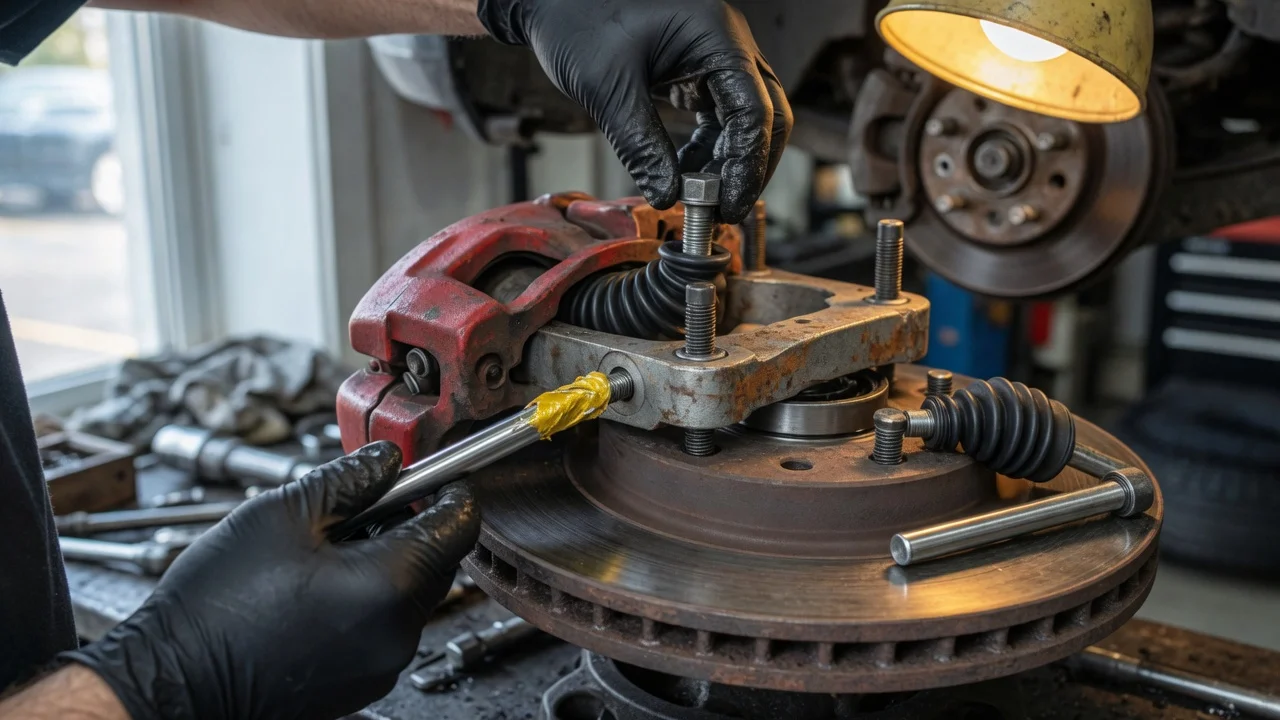
The caliper mounting bracket, also called a carrier, bolts to the steering knuckle or axle and holds the brake pads in position around the rotor. The caliper body sits over the bracket and slides on two slide pins, also called guide pins. The pins let the caliper center itself as the pads wear, so both pads press on the rotor evenly. Rubber boots seal the pins against water and dirt.
"Caliper bolt" can mean two different fasteners, so it helps to know which one you need. Caliper guide bolts are the smaller bolts that attach the caliper body to the slide pins or bracket, and they are removed during a routine pad change. Bracket bolts are usually larger and hold the bracket to the knuckle or axle. They carry braking loads and are usually tightened to a higher torque. On some designs the guide bolt and slide pin are a single part.
Signs each part needs replacing
Part | Common signs of a problem | Usual action; Slide pins | Pin sticks or will not move by hand; corrosion, pitting or a bent pin; inner and outer pads wearing unevenly or tapered; brake drag or pull; rattle or clunk | Clean and re-lubricate if the pin is smooth and straight; replace the pins and boots if they are damaged; Pin boots | Torn, swollen, cracked or missing boots | Replace them, usually as part of a pin and boot kit; Caliper guide bolts | Damaged threads, corrosion, rounded heads, or a manufacturer single-use instruction | Replace them with the correct bolts for the vehicle; Bracket bolts | Damaged threads, heavy corrosion, a bolt that was overtightened or stretched, or a single-use specification | Replace them with the correct grade and length; do not substitute generic hardware; Mounting bracket | Cracks or bending; deep grooves or heavy rust where the pad ears sit; pin bores that are damaged or out of round; stripped threads | Replace the bracket
Uneven pad wear is often the first visible sign of a slide pin problem. If the inner pad is much thinner than the outer pad, or a pad is worn into a wedge shape, check the pins before installing new pads. However, a piston that is seized or leaking fluid points to a caliper fault, and new pins will not fix it.
Matching parts to your vehicle
Pins, bolts and brackets differ between front and rear axles. They can also differ between trims, brake packages such as heavy-duty, towing or performance options, and production periods within the same model year. Some vehicles also have different parts for different markets. Identify the part using the model year, make, model, trim, engine and drivetrain, and the axle position. Where a parts catalog asks for a production date or VIN, provide it. If a catalog lists more than one option for your vehicle, compare the old part with the new one, or confirm the part with a dealer parts department, before buying.
On some calipers the upper and lower slide pins are different. One pin may have a rubber bushing or sleeve, or the two pins may be different lengths. Keep track of which pin came from which bore, and install replacements in the same positions. Replacement calipers are sold either with or without a bracket, and some come with new pins and bolts. Check what is included before ordering.
General replacement steps
These steps describe the usual sequence on a floating caliper. Your vehicle's service information takes priority for its specific steps, torque values and any single-use fasteners.
Park on level ground, loosen the wheel nuts, lift the vehicle and support it on stands rated for its weight, then remove the wheel. Remove the caliper guide bolts and lift the caliper off the bracket. Support it with a hook or wire. Do not let it hang from the brake hose, and do not press the brake pedal while it is off. Remove the pads and any abutment clips. To replace the bracket, remove the bracket bolts. These are often tight and may be corroded. Pull out the slide pins and inspect them, along with the boots and the pin bores. Clean the bores and the pad contact areas on the bracket. Install new abutment clips if the old ones are worn or a new set came with the pads. Lubricate the slide pins with a high-temperature brake lubricant that is safe for rubber. Petroleum-based greases can make rubber boots and bushings swell, which can cause the pins to stick. Install the pins and boots in their correct positions, then fit the bracket, pads and caliper. Tighten the bracket bolts and caliper guide bolts to the specified torque with a torque wrench. If the manufacturer specifies threadlocker, apply it, or use new bolts that have it pre-applied. Refit the wheel, tighten the wheel nuts to specification, and pump the brake pedal until it feels firm before moving the vehicle. If you installed new pads, follow the pad manufacturer's bedding-in procedure.
What this guide does not cover
No vehicle was specified, so this guide does not give torque values, part numbers, prices or single-use fastener lists. These vary by vehicle and should come from the manufacturer's service information for your model year, market and trim. Brake fasteners are safety-critical, so do not estimate a torque value.
When to get professional help
A professional repair makes sense in several situations: a bracket bolt will not come out or snaps, the threads in the knuckle are damaged, the caliper is leaking fluid, or you are unsure the brakes are working properly after the job. A repair shop can also confirm whether a dragging brake comes from the pins, the caliper piston or a hydraulic problem, which helps you avoid buying parts that will not solve it.