Off-road go-karts for adults
The short answer
An off-road go-kart is a good fit for an adult if the manufacturer rates it for adult riders, it has real off-road hardware such as a protective frame, suspension, knobby tires and adequate brakes, and you have a legal place to ride it. Three things can change that answer. If the kart's rider height or weight limit doesn't cover you and any passenger, it isn't suitable at any price. If you want to ride on public roads or certain public trails, most go-karts won't qualify, so a registered off-highway vehicle such as a UTV may be the better choice. And if you live in California, check whether the engine is certified for sale there before you buy.
What makes a go-kart "adult" and "off-road"
Many go-karts sold for off-road use are sized and rated for children or teenagers, even when they look similar to adult models. The difference is in the manufacturer's ratings and construction, not the styling. An adult off-road kart is built for adult body size and load, usually with a larger frame, a more capable engine or motor, and suspension meant for uneven ground. Karts built for paved tracks have little or no suspension and very low ground clearance, which makes them a poor match for dirt, grass or trails.
Some products marketed as off-road go-karts overlap with dune buggies and small side-by-sides. Labels vary between sellers, so judge a vehicle by its specifications and ratings rather than its category name.
What to check before you buy
Area | What to confirm | Why it matters; Rider fit | Manufacturer's age rating, maximum rider weight and rider height range | Exceeding these limits strains the frame, suspension and brakes and can leave you poorly protected by the cage and belts; Seating | One or two seats, and the combined load rating for two riders | A two-seat kart's capacity has to cover both occupants, not just the driver; Frame and protection | Roll cage or roll bar, seat belt or harness, and nets or guards near the occupants | Off-road riding raises the risk of rollovers and contact with branches or debris; Suspension and clearance | Front and rear suspension type and stated ground clearance | Determines how well the kart handles ruts, roots and rocks without bottoming out; Tires | Tread pattern and size suited to your terrain | Knobby tires grip dirt and grass; smooth tires do not; Brakes | Brake type (disc or drum) and whether braking acts on one or more wheels | Off-road surfaces lengthen stopping distances, so brake capability matters more than top speed; Drivetrain | Transmission type, whether there is a reverse gear | Reverse makes getting unstuck or turning around on narrow trails much easier; Speed controls | Adjustable speed limiter or governor | Useful if less experienced riders will share the kart; Power source | Gas engine or electric motor, plus range or fuel capacity | Affects noise, maintenance, run time and where you can ride
Gas or electric
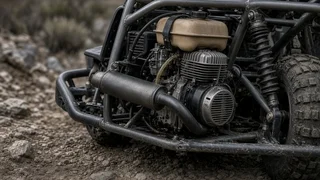
Gas-powered karts typically use a small single-cylinder engine paired with a CVT (continuously variable transmission), which changes gear ratio automatically so there is no clutch or shifting. They refuel quickly and suit long sessions, but they need routine engine maintenance and they are louder, which can matter with neighbors or noise-restricted riding areas.
Electric karts are quieter and need less routine mechanical upkeep, but run time depends on the battery and how hard you ride, and recharging takes far longer than refueling. When comparing electric models, look at the stated battery capacity, the charger included, the expected charge time and whether replacement batteries are available. Treat manufacturer range figures as estimates, since terrain, rider weight and speed all affect them.
Where you can legally ride
In the US, off-road go-karts are generally not street legal. Whether you can ride on public land, trail systems or private property depends on state and local rules, which may cover off-highway vehicle registration or stickers, spark arrestors, noise limits, and minimum age or supervision requirements. Check with your state's off-highway vehicle program or land management agency and any local ordinances before you buy, especially if you don't own land suitable for riding.
California has its own emissions certification for off-road engines. A gas kart sold elsewhere in the US may not be legal to sell or register there, so California buyers should confirm the specific model is approved for that state.
Ownership considerations
Off-road riding wears suspension parts, bushings, belts, chains, brakes and tires faster than paved use. Before committing to a model, find out whether replacement parts are sold by the brand or a domestic distributor, whether a dealer or repair shop near you will work on it, and what the warranty covers and for how long. Some karts are shipped in a crate and need partial assembly, so ask how much assembly is required and whether a dealer will do it and perform a pre-delivery inspection.
Specifications can differ between model years and versions of the same kart, including engine size, suspension and seating. Confirm the spec sheet matches the exact model year and version you are buying rather than relying on a general product page or an older review.
Questions to ask the seller
What are the maximum rider weight, rider height range and age rating for this exact model year? Is the load rating for one rider or for two riders combined? What type of brakes does it have, and on which wheels? Does it have a reverse gear and an adjustable speed limiter? What is the warranty, and who handles warranty claims? Where do replacement parts come from, and are common wear parts in stock? How much assembly is required, and is a pre-delivery inspection included? Is the engine certified for sale in my state? For electric models: what is the battery capacity, charge time and replacement battery availability?
Safety gear
A roll cage and belts don't replace personal protective gear. Plan for a properly fitted helmet, eye protection, gloves, long sleeves and pants, and closed footwear for every rider, and wear the belt or harness every time. Read the owner's manual before the first ride, since it lists the manufacturer's operating limits and maintenance intervals.
What this guide does not cover
No verified data on specific brands, models, prices, performance figures or reliability was available for this article, so it does not recommend particular karts or quote numbers. Use the checklist above to compare the manufacturer specifications, warranty terms and legal requirements that apply to the models and location you are considering.