Mazda CX-90 "Engine Malfunction – Have the Vehicle Inspected": What It Means and What to Do Next
The Short Answer
An engine malfunction message telling you to have the vehicle inspected means the CX-90's engine management system has detected a fault and stored information about it. It does not identify which part has failed, and it does not by itself say how urgent the problem is. How serious it is depends on what else the vehicle is doing: a steady warning with normal driving behavior usually allows a careful trip to a dealer or repair shop, while a flashing warning, loss of power, overheating, or an oil pressure warning means you should stop driving as soon as it is safe.
The exact wording, warning icons and on-screen guidance can differ by model year, market and powertrain. The CX-90 has been sold with more than one electrified powertrain depending on the market, and a plug-in hybrid can show warnings that relate to its hybrid system rather than the gasoline engine alone. Your owner's manual for your specific model year and market is the authoritative reference for what each message means on your vehicle. No model-specific fault data, recall details or service bulletin information was available for this guide, so the advice below follows general diagnostic practice rather than documented CX-90-specific failure patterns.
First, Decide Whether It Is Safe to Keep Driving
Before thinking about causes, look at how the vehicle is behaving. These conditions call for stopping somewhere safe and arranging professional help or towing rather than continuing to drive:
The check engine light is flashing rather than steady. On most modern vehicles this indicates an active misfire severe enough to damage the catalytic converter. The engine shakes, stumbles or runs roughly, especially at idle or under acceleration. The vehicle loses significant power or enters a limited-power mode. The temperature gauge or a coolant warning shows overheating. An oil pressure warning appears alongside the engine message. You smell fuel, see smoke, or hear new knocking or grinding from the engine. Several unrelated warnings appear at once together with the engine message, which can point to an electrical or control-system problem.
If the warning is steady, the engine sounds and feels normal, and no other critical warnings are present, it is generally reasonable to drive gently to a qualified shop soon. Avoid heavy loads, towing and hard acceleration until the vehicle has been checked.
Simple Checks You Can Do Yourself
A few observations can help a technician and may reveal a minor cause. None of these replaces a proper diagnosis.
Check | What to look for | What it may indicate; Fuel cap | Whether it is missing, loose or has a damaged seal | A poorly sealed cap is a common cause of evaporative emissions faults. Tightening it may clear the warning after several drive cycles, but not immediately. Recent fueling | Whether the warning appeared shortly after filling up | Could relate to the cap, or occasionally to fuel quality. Note the station and timing. Warning behavior | Steady or flashing; constant or intermittent | Flashing suggests an active misfire. Intermittent warnings are still worth recording for the technician. Driving symptoms | Rough idle, hesitation, reduced power, unusual noises or smells | Helps narrow the problem to ignition, fuel delivery, air intake, or mechanical causes. Other warnings | Battery, charging, coolant, oil or hybrid system messages | Multiple warnings can point to a low 12-volt battery voltage, a charging problem or a wider electrical issue. Fluid levels | Engine oil and coolant on level ground with the engine cool | Low levels can contribute to faults and are important to report. Do not open a hot cooling system. Recent work | Battery replacement, jump-starting, accessories installed, or recent servicing | A disturbed connector, sensor or electrical supply can trigger a warning.
Reading the Fault Code
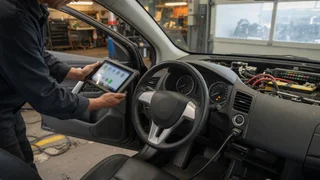
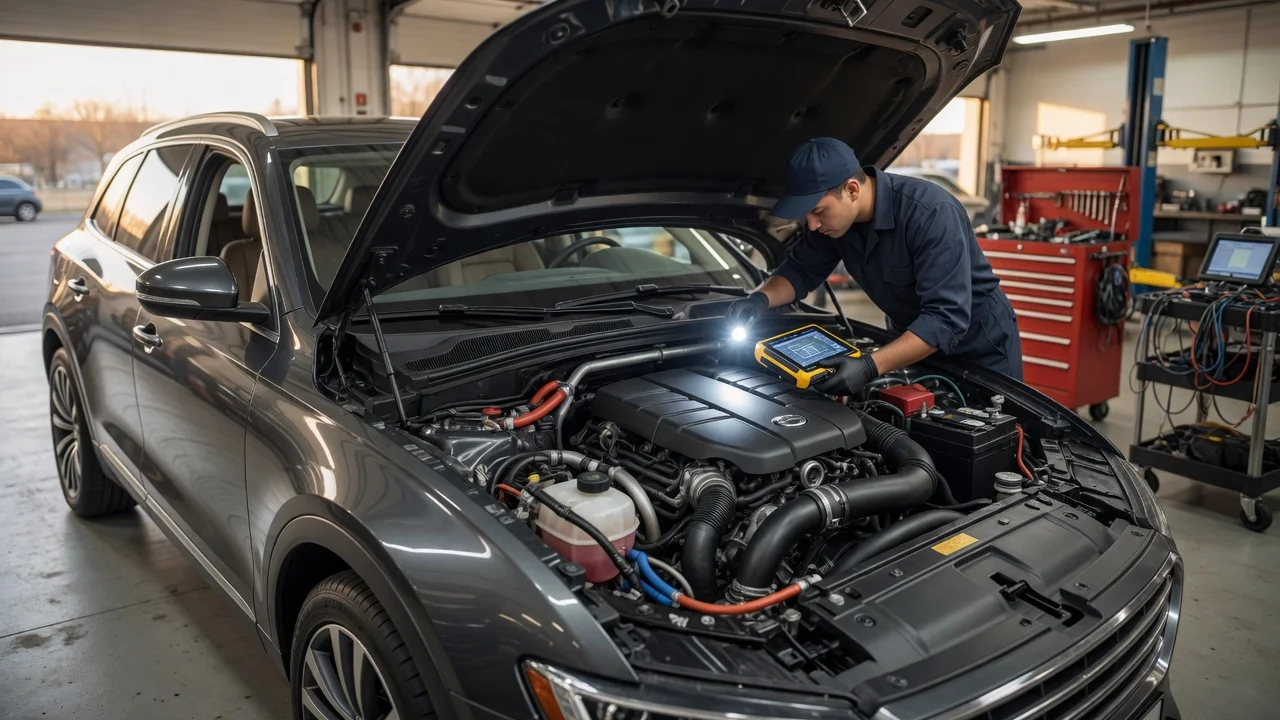
Gasoline vehicles sold in many markets support standardized on-board diagnostics, often called OBD-II, through a port under the dashboard. A basic scan tool can read diagnostic trouble codes (DTCs), which are short alphanumeric codes describing what the engine computer detected. Many parts stores and repair shops can read these codes, and inexpensive scanners are widely available.
Treat a fault code as a starting point for investigation, not proof that a specific part has failed. A code describes a condition the system detected, such as a sensor reading outside its expected range, and several different causes can produce the same code. For example, a code pointing to a sensor may be caused by the sensor itself, its wiring or connector, a vacuum or air leak, or a problem in the system the sensor is monitoring. Replacing parts based only on a code can waste money without fixing the problem.
Generic scanners also have limits. They typically read standardized engine codes but may not access manufacturer-specific codes, freeze-frame details or hybrid-system data. On a CX-90, particularly a plug-in hybrid, a dealer or a shop with manufacturer-level diagnostic equipment may be needed to see the full picture. Clearing a code without fixing the cause only hides the warning temporarily, and it can erase data a technician would find useful.
Plausible Causes, Grouped by What You Notice
Without a code and inspection, it is not possible to say what caused the message on a particular vehicle. The groupings below reflect general engine diagnostic categories and are not a list of known CX-90 problems.
Warning with no driving symptoms: often emissions-related faults, such as an evaporative system leak or a sensor reporting an out-of-range value. Usually not an emergency, but still needs inspection. Rough running, shaking or a flashing light: commonly ignition or fuel delivery problems causing misfires. Stop driving and seek diagnosis. Hesitation or reduced power without misfire: may involve air intake, boost control on a turbocharged engine, sensors, or the engine computer limiting output to protect components. Warning together with electrical or charging messages: may involve the 12-volt battery, charging system, or, on electrified powertrains, the hybrid system. Professional diagnosis is needed. Warning with overheating, low oil pressure or unusual mechanical noise: potentially serious mechanical issues. Stop the engine and arrange towing.
Recalls, Warranty and What to Tell the Technician
Before paying for repairs, check whether open recalls or service campaigns apply to your vehicle by searching your vehicle identification number (VIN) with Mazda or your country's vehicle safety authority. Specific recall or bulletin information for the CX-90 was not available for this guide, so a VIN lookup or a call to a dealer is the reliable way to confirm. Depending on the vehicle's age and mileage, the repair may also be covered by the factory warranty or by emissions-related coverage, which varies by market; your warranty booklet sets out the terms.
When you book the inspection, give the technician a clear record: when the message first appeared, whether the light was steady or flashing, what the vehicle was doing at the time, any symptoms, other warnings shown, recent fueling or servicing, and any codes you have already read. This helps separate the triggering condition from its underlying cause.
Bottom Line
The engine malfunction message on a Mazda CX-90 is a request to have the vehicle diagnosed, not a diagnosis in itself. Stop driving if the warning flashes or comes with rough running, power loss, overheating, oil pressure warnings or unusual smells and noises. If the vehicle drives normally, check the fuel cap, note any symptoms, consider reading the code, and have a qualified technician confirm the cause before parts are replaced.