Mazda CX-90 Engine Malfunction Warning: What It Means and How to Diagnose It
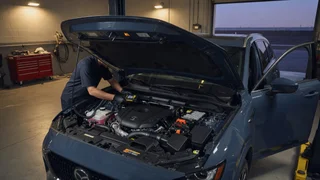
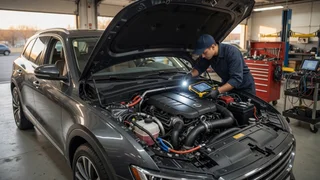
A Mazda CX-90 engine malfunction warning means the engine control system has detected a fault it cannot correct on its own. The fault could be in the engine, the emissions system, or a related powertrain component. The warning names a system, not a failed part. It can be triggered by something as minor as a poorly sealed fuel filler or by a serious misfire. The most important first distinction is whether the light is steady or flashing and whether the vehicle drives normally. That tells you how urgent the problem is. The stored diagnostic codes then point you toward the cause. The advice below applies to the CX-90 sold in the US since its launch as a 2024 model. It covers both main powertrain families: the turbocharged 3.3-liter inline-six with a 48-volt mild-hybrid system, offered in standard Turbo and higher-output Turbo S form, and the plug-in hybrid (PHEV), which pairs a 2.5-liter four-cylinder with an electric motor and a high-voltage battery. Some causes and warnings differ between these two, so know which one you have before you interpret any result.
What the warning light actually indicates
The amber engine-outline symbol is the malfunction indicator lamp, often called the check engine light. It is required on all modern US vehicles as part of the OBD-II (on-board diagnostics, second generation) system. The engine computer continuously monitors sensors, ignition, fuel delivery and emissions components. When a reading falls outside its expected range under certain conditions, often across more than one drive cycle, the computer stores a diagnostic trouble code and turns on the lamp.
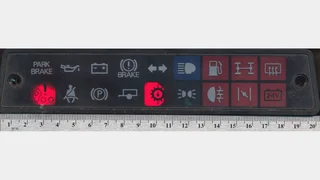
Depending on model year and software, the instrument cluster may also show a text message alongside or instead of the symbol. Do not confuse the engine malfunction lamp with other warnings that need a different response:
• Engine coolant temperature warning (red or flashing): signals overheating. Stop safely and switch off the engine. • Oil pressure warning (red oil-can symbol): signals possible loss of lubrication. Stop immediately. • Charging system or battery warning: points to the 12-volt or mild-hybrid electrical system rather than combustion. • Hybrid or electric system warning on the PHEV: relates to the high-voltage system and should be treated as its own fault. • Transmission or AWD warnings: may appear with or without the engine lamp if a fault affects the drivetrain.
Steady vs. flashing: how urgent is it?
A steady light with normal driving behavior usually means a fault that is not immediately damaging. You can generally drive moderately to a safe place or a service appointment, but you should not ignore it. An unaddressed fault can mask a second one, cause a failed emissions inspection, or slowly harm other components.
A flashing light typically means an active misfire severe enough to send unburned fuel into the exhaust. That fuel can overheat and damage the catalytic converter quickly. Reduce load right away and avoid hard acceleration. Arrange to stop driving as soon as it is safe to do so.
Stop driving and get professional help if you notice
• A flashing engine malfunction lamp, especially with shaking, stumbling or loss of power; • A red temperature or oil pressure warning at the same time; • Smoke from under the hood or exhaust, or a strong fuel, burning or coolant smell; • Severe power loss, a reduced-power or limp mode message, or stalling; • Loud knocking, grinding or metallic noises from the engine; • On the PHEV, a high-voltage or hybrid system warning combined with drivability problems; • Visible leaks of fuel or coolant under the vehicle
First checks you can do yourself
Before reading codes, note the symptom conditions. Record when the light came on, the outside temperature, whether the engine was cold or warm, your speed and load, and whether you had just refueled. A technician needs this context, and it also helps you sort out the likely causes.
• Fuel filler: if the light appeared shortly after refueling, check that the filler is properly closed and that the seal is clean and undamaged. A small evaporative-emissions leak is a common trigger. The light may take several drive cycles to clear once the leak is fixed. • Fuel quality: if the problem started right after a fill-up and is accompanied by rough running, the fuel may be contaminated. Mention which station you used when you report the problem. • Fluid levels: with the engine cool, check engine oil and coolant against the marks. Low levels do not always set the engine lamp, but they matter if other warnings follow. • Visible condition: look for disconnected hoses, chewed wiring (rodent damage is common in parked vehicles), loose connectors or recent work that may have disturbed components. • 12-volt battery health: a weak battery or a recent jump-start can cause scattered electrical faults and warning lights in modern vehicles, including ones that use a mild-hybrid system. • Drivability: note any hesitation, rough idle, unusual shifting, reduced power or changes in fuel economy.
Reading the diagnostic codes
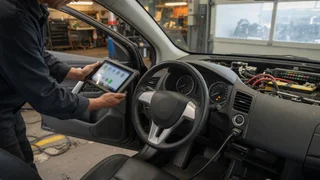
Every CX-90 has a standard OBD-II port under the dashboard on the driver's side. Many parts retailers will read codes free of charge, and inexpensive scan tools are widely available. Codes follow a standard format. P-codes cover powertrain faults. Codes beginning with P0 are generic across manufacturers. Codes beginning with P1 or similar are often manufacturer-specific and may need a more capable scan tool or a dealer to interpret.
Treat a code as evidence to investigate, not proof of a failed part. A code describes what the computer observed, such as a lean mixture, a misfire on a particular cylinder or an implausible sensor signal. It does not say why. A lean code, for example, can come from a vacuum leak, a fuel delivery problem or a faulty sensor reading. Replacing the part named in the code description without testing often wastes money.
• Write down every stored and pending code, not just the first one. Several related codes together often point to a shared cause. • Save the freeze frame data if your tool shows it. It records engine speed, load, temperature and other values at the moment the fault was set. • Do not clear codes before a technician has seen them, unless you are deliberately checking whether a minor fault such as the filler seal returns. Clearing codes erases freeze frame data and resets readiness monitors, which can delay an emissions inspection. • Do not disconnect the battery as a shortcut to reset the light. It erases the same information, and on an electrified vehicle it may cause additional warnings.
Common cause categories and what they suggest
The table below groups code types and symptoms by general system. It is a guide for narrowing the search, not a list of confirmed CX-90 failures. The actual cause depends on your engine configuration, model year and the specific codes stored.
Code type or symptom | Likely system | What it suggests | Next step; Evaporative emissions (EVAP) leak codes, no drivability change | Fuel vapor system | Filler not sealed, leaking hose or purge/vent valve fault | Check filler seal, drive several cycles, then have the system smoke-tested if the code returns; Misfire codes (single or random cylinder) | Ignition, fuel or mechanical | Ignition coil, spark plug, injector, vacuum leak or compression issue | Avoid heavy load; professional testing of ignition and fuel delivery, and compression if indicated; Lean or rich fuel trim codes | Air metering and fuel delivery | Unmetered air leak, sensor error, fuel pressure problem | Smoke test for leaks, compare sensor data, check fuel pressure; Oxygen or air-fuel ratio sensor codes | Emissions monitoring | Sensor or heater circuit fault, or a genuine mixture problem upstream | Test the circuit and data before replacing the sensor; Catalyst efficiency codes | Exhaust aftertreatment | Converter degradation, often a result of earlier misfire or mixture problems | Fix any root cause first, then reassess; Turbocharger boost or pressure codes (inline-six) | Intake and boost control | Boost leak, wastegate or control fault, sensor problem | Inspect intake ducting and connections; professional boost testing; Mild-hybrid or charging system codes (inline-six) | 48-volt system | Fault in the mild-hybrid components or their control | Dealer diagnosis; do not attempt repairs on the 48-volt system yourself; Hybrid or high-voltage codes (PHEV) | High-voltage battery, motor or control | Electrified powertrain fault | Dealer diagnosis only; high-voltage components require trained technicians; Communication or multiple unrelated codes | Electrical network or power supply | Weak 12-volt battery, connector issue or module fault | Test the battery and charging first, then check wiring and modules
Powertrain-specific considerations
3.3-liter turbo inline-six (mild hybrid)
Beyond conventional ignition, fuel and emissions faults, the turbocharged engine adds boost-related components, and the 48-volt mild-hybrid system adds its own electrical parts and control software. A malfunction warning combined with reduced power can come from a boost control or intake leak issue. Warnings that appear alongside start-stop irregularities or electrical messages may point toward the mild-hybrid side. Because the system integrates engine, transmission and electrical controls, a dealer-level scan tool is often needed to see every module's codes.
Plug-in hybrid (PHEV)
In the PHEV, the gasoline engine may run less often and under different conditions than in a conventional vehicle, so some monitors may take longer to run and a fault may appear only when the engine starts. The vehicle may display separate warnings for the hybrid or high-voltage system. Those require dealer diagnosis. Never open or service high-voltage components, which are typically marked with orange cabling, without proper training and equipment.
Check service history, recalls and software updates
Because the CX-90 is a relatively new model, check for manufacturer actions before paying for diagnosis. Look up open recalls by entering your vehicle identification number (VIN) on the NHTSA recall lookup or through Mazda's owner resources, or ask a dealer to run the VIN. Manufacturers also issue technical service bulletins and software updates for known issues. These are not always recalls, but a dealer can see whether one matches your codes and symptoms.
Review your service history too. Recent maintenance, an overdue oil change, aftermarket accessories or a recent repair can all be relevant. If the vehicle is still under its factory warranty, a dealer diagnosis is usually the sensible first stop. Check your warranty booklet for coverage terms, including any separate emissions-component coverage. Independent work on covered components may complicate a later claim if a related failure follows.
What to tell the technician
• Model year, trim and powertrain (Turbo, Turbo S or PHEV), and current mileage; • Every code you or a parts store retrieved, plus freeze frame data if available; • Whether the light was steady or flashing, and whether it has come and gone; • Symptom conditions: cold or warm engine, speed, load, weather, recent refueling; • Any drivability changes, noises, smells or other warnings; • Recent service, repairs, accessory installations or jump-starts
Bottom line
A Mazda CX-90 engine malfunction warning calls for prompt attention, not panic. A flashing light, severe power loss or a red warning means you should stop driving and arrange professional help. A steady light with normal driving gives you time to check the fuel filler, note the symptom conditions, read the diagnostic codes and look up open recalls or service bulletins. Then have the fault confirmed through proper inspection rather than replacing parts based on a code description alone. The dealer is usually the best route for warranty-covered vehicles and for any mild-hybrid or plug-in hybrid fault.