Start/Stop System Malfunction: What It Means and What to Check
The short answer
A start/stop (or auto stop-start) system shuts the engine off when the vehicle is stationary, such as at a traffic light, and restarts it when the driver releases the brake or presses the clutch. When the system stops working or shows a malfunction message, the most common explanation is that the vehicle's control software has decided conditions are not suitable for an automatic stop. The battery is a frequent reason, but sensors, switches and other faults can also be involved.
Two situations should be kept apart. If the engine simply does not shut off at stops and there is no warning, the system may be inhibiting itself on purpose, which is often normal. If the instrument cluster shows a specific start/stop fault message or warning light, the vehicle has likely recorded a fault that is worth investigating. In most cases a start/stop fault does not affect the car's ability to start and drive normally with the key or start button. The exception is any sign that the engine is struggling to restart, which needs prompt attention.
Exact behaviour, warning wording, battery requirements and inhibiting conditions differ by manufacturer, model, model year, powertrain and market. The owner's manual for the specific vehicle is the authoritative source for what a given indicator means. Hybrids, mild hybrids and vehicles with separate auxiliary batteries can work differently from conventional cars with a single 12-volt battery.
Normal reasons the system stays inactive
Start/stop systems monitor many inputs before allowing the engine to switch off. Manufacturers commonly list conditions such as the following as reasons the system may not engage. Which ones apply depends on the vehicle.
Battery state of charge is too low, or the battery is too cold or too hot; Engine or transmission has not reached operating temperature; High demand from climate control, such as heating, cooling or windscreen demisting; Driver's seatbelt unfastened, driver's door open or bonnet (hood) open; Steep incline, large steering angle or very recent restart; Vehicle not yet driven above a low speed since the last stop; Diesel particulate filter regeneration or other engine management activity; System manually switched off with its button, which on many vehicles resets to on at each new journey
If none of these apply and the system has stopped working for a long period, or a warning is displayed, move on to the checks below.
Likely causes and how to check them
1) Weak or ageing battery
Start/stop puts heavy demands on the 12-volt battery, so the system is often the first feature to switch off as the battery weakens. The car may still start normally while start/stop is already disabled to protect restart capability.
What to check: note the battery's age and whether the vehicle does mainly short trips, which may not fully recharge it. Have the battery tested with a proper tester that assesses health, not just voltage, which many parts shops and garages can do. A slow or laboured cold start alongside the start/stop problem points more strongly to the battery.
What the result indicates: a battery that tests weak or fails is a likely explanation, and replacing it may restore the system. If the battery tests healthy, look at the other causes.
2) Wrong battery type or battery not registered
Vehicles with start/stop typically require a specific battery technology, commonly AGM (absorbent glass mat) or EFB (enhanced flooded battery). Fitting a conventional battery in its place can lead to the system being disabled or the battery wearing out quickly. Some manufacturers also require a new battery to be registered or coded to the vehicle with diagnostic equipment, so the charging system and battery monitoring know a new battery has been fitted.
What to check: if the problem began after a battery replacement, confirm that the battery type and specification match the owner's manual or the original battery label, and ask whether registration was carried out. Whether registration is needed depends on the make and model. Check this for your vehicle rather than assuming.
3) Battery sensor or terminal problems
Many start/stop vehicles use a battery monitoring sensor, often mounted on the negative terminal, to report the battery's charge and condition. A faulty sensor, a corroded or loose terminal, or a poor earth connection can make the system think the battery is unfit even when it is not.
What to check: look for corrosion, looseness or damage at the battery terminals and the sensor connector, if they can be seen safely. Avoid disconnecting the battery unless you know the correct procedure for your vehicle, because some vehicles need systems relearned afterwards. A diagnostic scan may show codes related to the sensor or its communication.
4) Bonnet, door or seatbelt switch faults
If a switch wrongly reports that the bonnet, driver's door or seatbelt is open, the system may refuse to stop the engine. A bonnet switch fault on vehicles that use one for this purpose may also affect the alarm.
What to check: see whether the dashboard shows a door-open, bonnet-open or seatbelt warning when everything is closed and fastened. Note whether the alarm behaves oddly. Any mismatch suggests a switch or wiring fault.
5) Auxiliary battery or other system faults
Some vehicles use a secondary battery to support electrical systems during an automatic restart. A failing auxiliary battery can trigger a start/stop warning even if the main battery is healthy. Whether your vehicle has one depends on the model and generation. Faults in the starter motor, alternator or charging system, brake vacuum monitoring or related control modules can also disable the system.
What to check: watch for other warning lights at the same time, especially battery or charging, engine management or brake warnings. These shift the likely cause away from the start/stop system itself and towards the system they relate to.
Using a diagnostic scan
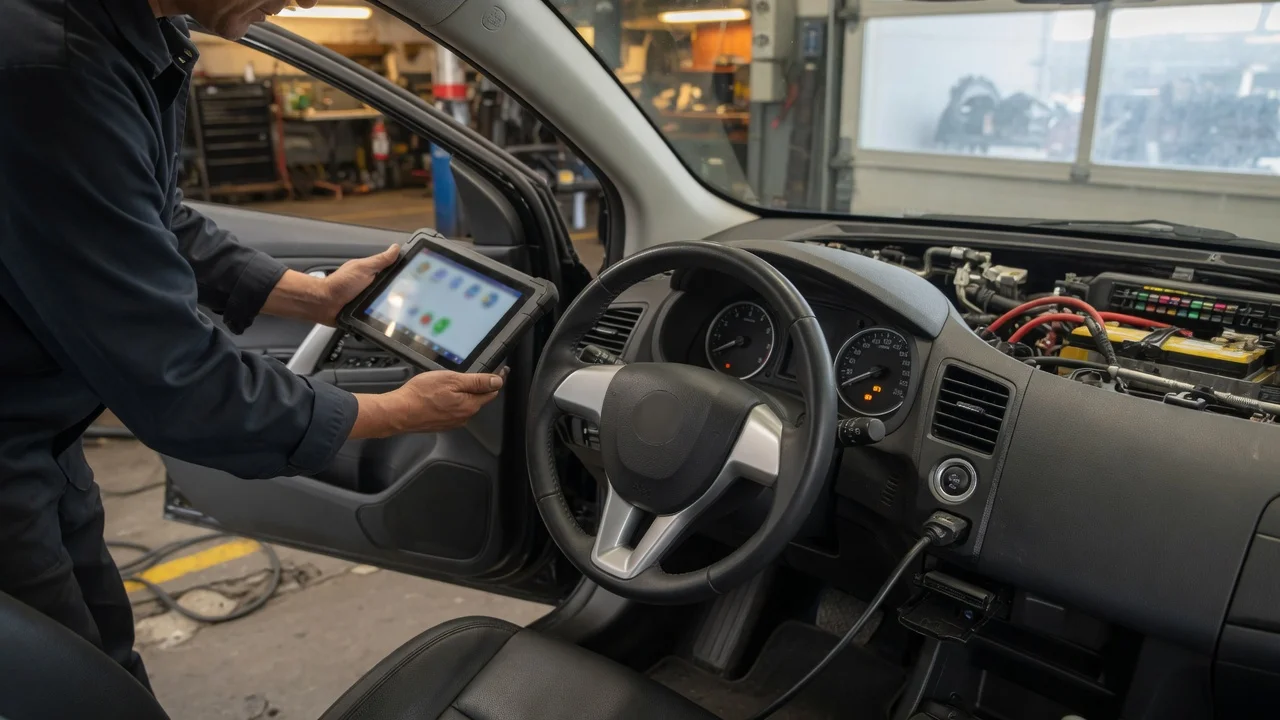
Reading fault codes with a scan tool can narrow down the cause, but a code should be treated as a starting point for investigation rather than proof that a particular part has failed. A code pointing at the battery sensor, for example, could result from the sensor itself, its wiring, a terminal connection or the battery. Basic generic code readers may not access the body and battery management modules where start/stop faults are often stored. A manufacturer-level or more capable tool may be needed.
When to stop driving or get professional help
The engine fails to restart after an automatic stop, or restarts slowly or with difficulty: switch the system off with its button if possible and have the vehicle checked promptly; A battery or charging warning appears alongside the start/stop message: the charging system may not be keeping the battery charged, and the car could lose power or fail to start; Engine overheating, brake, or steering warnings appear: stop safely and follow the owner's manual guidance for that warning; The problem continues after the battery tests healthy and connections look sound; A battery has recently been replaced and the vehicle may need registration or coding
Can you just leave it switched off?
On many vehicles a start/stop fault on its own does not stop the car from being driven, and the feature can be turned off with its button. Ignoring the warning carries some risk, though. The underlying cause is often a weakening battery, which may eventually leave the car unable to start. A fault code may also relate to a wider electrical or charging issue. Fuel consumption may rise somewhat without the system, though by how much depends on the vehicle and driving conditions, and no figures are available here.
Information gaps
This guide is general. It does not cover warning meanings, battery specifications, registration requirements, recalls or service bulletins for any specific make, model or model year. For a particular vehicle, consult the owner's manual and a dealer or qualified technician, who can check for known issues and software updates that apply to it.