How to Use Lucas Heavy Duty Oil Stabilizer
The Short Answer
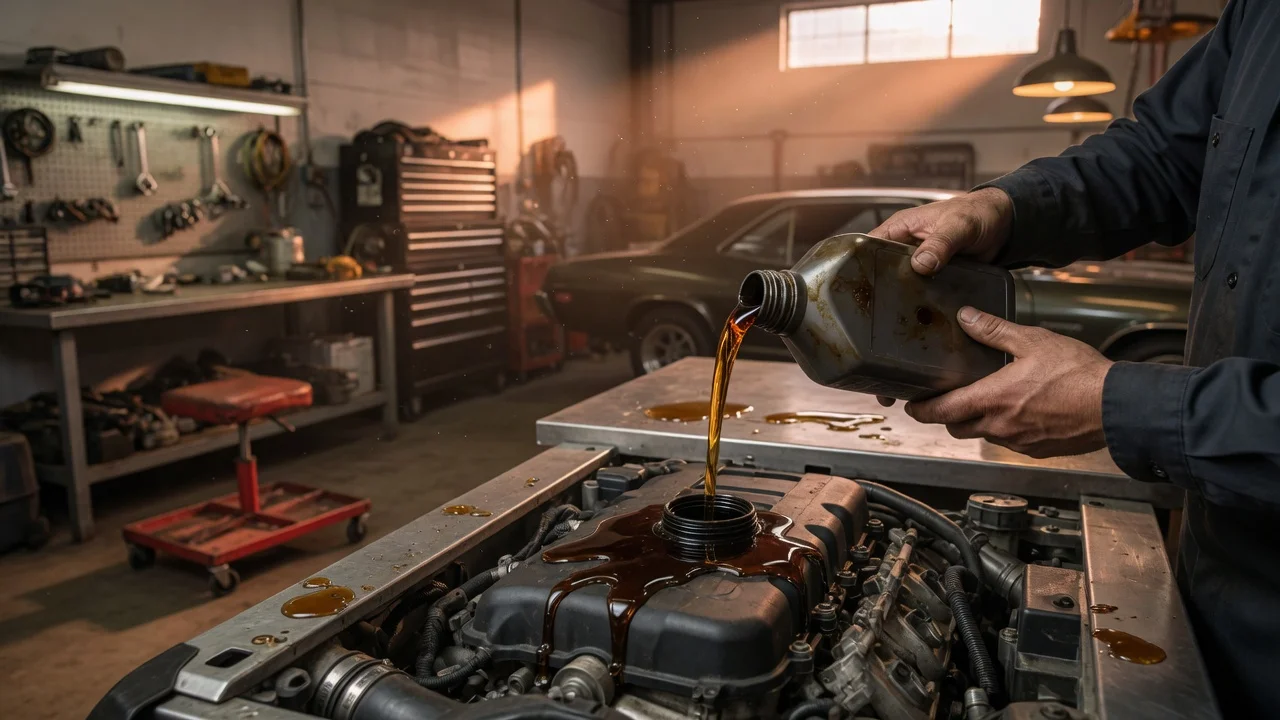
Lucas Heavy Duty Oil Stabilizer is a thick, petroleum-based additive. You mix it with your engine oil. It does not replace the oil. It is usually added at an oil change or used in place of some top-up oil. The basic rule is that the stabilizer takes up part of the engine's oil capacity. Add less oil to make room for it, so the total stays within the dipstick's full mark.
The bottle label sets the mixing ratio. The figure most often given for engines is about 20 percent stabilizer to 80 percent oil. In a 5-quart system, that works out to roughly 1 quart of stabilizer and 4 quarts of oil. Treat that ratio as something to confirm, not a fixed rule. The source documents for this article did not verify it, and label wording can change between packaging versions and applications. Read the directions on the bottle you buy before you pour.
One point can change the answer for your vehicle: the owner's manual and the vehicle's warranty terms. Some manufacturers advise against aftermarket oil additives, and some only accept oil that meets a specific certification. Check this first if the vehicle is new, under warranty, or needs an approved oil specification.
Before You Start
Read the owner's manual for the oil capacity with the filter, the required oil grade and specification, and any guidance on additives. Read the label on the stabilizer bottle for the recommended ratio and the applications it covers. Get the correct motor oil, a new oil filter if you are doing a full change, a funnel, rags, and the usual drain tools: a wrench for the drain plug, a filter wrench and a drain pan. Park on level ground and let the engine cool enough to handle parts safely if you plan to drain the oil.
Working Out the Amounts
Start with the total oil capacity from the owner's manual. Multiply it by the percentage on the stabilizer label to get the stabilizer volume. Subtract that from the total capacity to get the oil volume. Using the 20 percent example, a 6-quart engine would take about 1.2 quarts of stabilizer and 4.8 quarts of oil. Your result depends on the capacity of your engine and the ratio on your bottle. Round down if you are unsure, because the dipstick check at the end will show whether more is needed.
Steps at an Oil Change
1) Drain the old oil and replace the oil filter, following your normal procedure and the manufacturer's drain plug tightening value. If you are not confident doing this safely, including lifting and supporting the vehicle, have a shop do the oil change and ask them to add the stabilizer at the ratio you specify. 2) Pour in most of the fresh oil, keeping back an amount equal to the stabilizer volume you calculated. 3) Pour the stabilizer in through the oil filler opening. It is much thicker than motor oil and flows slowly, so give it time to drain from the bottle and the funnel. 4) Refit the filler cap, start the engine and let it idle briefly so the oil circulates and fills the new filter. Shut it off. 5) Wait a few minutes for the oil to settle, then check the dipstick. Add more oil in small amounts only if the level is below the full mark.
Steps When Topping Off
If the oil level is low between changes, you can use the stabilizer as part of the top-up. With the engine off and the vehicle level, check the dipstick to see how much room there is below the full mark. Add stabilizer, oil, or both, but do not exceed the full mark. Then recheck after the oil has settled. The ratio on the bottle still applies to the total in the engine, so do not keep adding stabilizer at every top-up without tracking how much is already in there.
Completion Check
The dipstick reading is between the minimum and full marks, and not above full. The oil pressure warning light goes out shortly after start-up. There are no leaks at the drain plug, the filter or the filler cap after a short run. The engine runs normally, with no new noises or warning messages.
Precautions and When to See a Professional
Overfilling is the main mistake to avoid. Adding stabilizer on top of a full oil fill raises the level above the full mark. Too much oil can cause foaming and stress the seals. If you overfill, drain the excess before driving.
An oil additive is not a repair. Get the vehicle diagnosed by a qualified technician before relying on an additive if you have any of these: heavy oil consumption; blue exhaust smoke; low oil pressure warnings; knocking or ticking noises; an active oil leak
Some applications have their own requirements that the engine guidance does not cover, including: motorcycles with a wet clutch; transmissions; differentials; engines that need a specific certified oil; For these, check whether the bottle label lists the application, and follow the vehicle manufacturer's fluid requirements.
What This Guide Could Not Verify
No manufacturer documentation or test data was supplied for this article. The 20 percent ratio comes from commonly cited guidance, not a confirmed specification. This article makes no claims about measured benefits such as reduced wear, oil pressure changes, noise reduction or longer oil life. It also does not cover other ratios for worn engines or non-engine uses, compatibility with particular oil specifications, or warranty effects for any specific make, model year or powertrain. Confirm these details with the product label, the manufacturer's published directions and your vehicle's owner's manual.