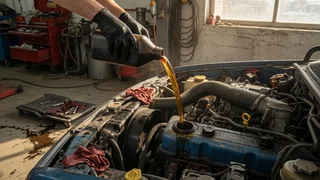
Review Lucas High Mileage Oil Stabilizer
A Lucas High Mileage Oil Stabilizer review usually begins with one practical question: whether this thick honey-colored additive helps an older engine with accumulated miles. Drivers often reach for it after noticing valvetrain noise, mild oil consumption, or lower oil pressure at hot idle. The product is designed to blend with conventional or synthetic motor oil and increase film strength in worn areas. This discussion explains what the stabilizer can reasonably do, what a review should focus on, and which observations matter before you add it to a crankcase.
The direct answer
The direct answer is that Lucas High Mileage Oil Stabilizer is intended to reduce oil consumption, cushion worn bearings, and quiet noisy valvetrains in engines with significant miles. Its condition of usefulness matters: a tired but sound engine with loose clearances tends to show the most noticeable change. If the engine already has tight tolerances or a modern low-viscosity oil requirement, the thicker mixture may be less appropriate. Review the oil cap and owner’s manual first, because the stabilizer increases viscosity and that change should suit the engine’s state of wear and operating climate.
A buyer reviewing this product should treat it as a temporary wear-compensating measure rather than a repair. The meaningful questions are whether the engine has high mileage, whether the current oil pressure behaves normally, and whether the vehicle sees moderate or severe duty. Engines with a visible leak, damaged seals, or a mechanical fault will not be fixed by a thickener. In those cases, the stabilizer may slow a symptom while the root issue continues. For a worn but drivable engine, however, adding it at an oil change is a low-effort way to observe changes in noise, consumption, and pressure.