Load Balancing for Shared Residential EV Charging: How It Works and How It Differs
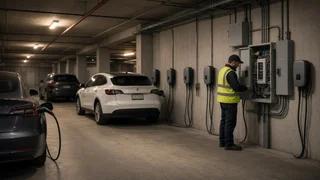
Load balancing for shared residential EV charging is a control method that divides a fixed amount of electrical supply capacity among several chargers, so more vehicles can charge from the same service without overloading it. Instead of giving every charger its full rated output at all times, the system adjusts each charger's current up or down based on how many vehicles are plugged in and, in dynamic setups, how much power the rest of the home or building is using at that moment. The practical result is that more parking spaces can be electrified without an immediate panel or service upgrade, at the cost of slower charging when demand is high. The answer depends on one important qualification: what kind of load balancing is installed. Static load balancing shares a fixed limit among chargers. Dynamic load balancing also measures the building's real-time consumption and gives chargers whatever capacity is left over. That difference determines how much charging power residents actually get and how many chargers a given electrical service can support.
Why shared residential charging needs load management
Every home, duplex, condominium or apartment building has a finite supply capacity set by its utility service, main panel and feeders. A Level 2 charger is a large, continuous load, and in the US, continuous loads are generally sized with extra margin under the National Electrical Code. Adding several chargers at full rated output can quickly exceed what an existing service can handle, especially in older multifamily buildings.
Without load management, the usual options are to limit the number of chargers, install chargers at low fixed settings, or pay for a service upgrade that may involve the utility, new transformers and significant construction. Load balancing offers a middle path: chargers are installed with higher potential output, but software keeps their combined draw within a defined ceiling. The NEC recognizes this approach by allowing an energy management system to limit EV charging load, which can affect how the installation is calculated. Local code adoption and inspector interpretation vary, so the exact treatment should be confirmed with a licensed electrician and the authority having jurisdiction.
How EV charging load balancing works
The core mechanism is simple. A Level 2 charger, technically called EVSE (electric vehicle supply equipment), does not push power into the car. It tells the vehicle how much current it is allowed to draw, and the car's onboard charger follows that limit. For vehicles using the J1772 standard, and for the SAE J3400 (NACS) connector standard in AC charging, this limit is communicated through a pilot signal between the charger and the vehicle. Load balancing works by changing that advertised limit as conditions change.
A controller, which may be built into one lead charger, a separate hub or a cloud platform, decides how much current each charger may offer. When a new car plugs in, the controller recalculates the shares. When a car finishes or unplugs, its share returns to the pool for the remaining vehicles.
Static vs. dynamic load balancing
Static load balancing assigns a fixed maximum for a group of chargers, usually based on a dedicated circuit or a reserved portion of the panel's capacity. The chargers share that number among themselves, but they do not know what else is happening in the building. It is simpler, needs no building metering and behaves predictably. Its weakness is that the limit has to be set conservatively enough for the busiest moments of household or building use, so spare capacity at night or during low-use periods goes unused.
EV charging dynamic load balancing adds measurement. Current sensors, typically clamp-style current transformers (CTs) on the main service or a feeder, report the building's actual consumption to the controller. The system then calculates headroom, the gap between the safe service limit and current usage, and allocates it to the chargers. When residents run air conditioning, electric ranges or dryers, charging slows. When the building is quiet, charging speeds up toward each charger's maximum.
Feature | Static load balancing | Dynamic load balancing; What it limits | Combined charger output to a fixed ceiling | Combined charger output to real-time available headroom; Building metering | Not required | Required (CTs or a meter interface); Use of spare capacity | Limited; ceiling set for worst case | High; follows actual building demand; Complexity | Lower | Higher; more components and configuration; Typical fit | Small groups of chargers on a dedicated circuit | Buildings with variable loads and constrained service
Local vs. networked control
Load balancing can also be categorized by where the decisions are made. In local systems, chargers communicate with one another over a wired link or the site's local network, with one unit acting as the coordinator. These systems keep working even if the internet connection drops, which matters for overnight charging. Local load sharing is often limited to chargers from the same manufacturer, and sometimes to the same product line.
In networked systems, a cloud platform manages the chargers, commonly using the Open Charge Point Protocol (OCPP), a widely used charging protocol that includes smart charging functions for setting power limits. Networked control makes it easier to combine load management with user access, scheduling, per-driver billing and reporting. It also introduces a dependency on connectivity, so it is worth asking how chargers behave when they lose contact with the platform. Well-designed systems fall back to a safe reduced output rather than full power.
How available power is divided
Different systems use different allocation rules, and the rule affects the experience for residents more than most hardware specifications do. Common approaches include:
Equal sharing: available current is split evenly among all connected vehicles. First come, first served: earlier arrivals keep higher output until they finish, and later arrivals get the remainder. Rotation or queuing: chargers take turns at higher output in timed cycles, which can help when demand far exceeds capacity. Priority or scheduling: certain spaces, users or departure times receive preference, which is often configured through a networked platform. Minimum floor: each active charger is guaranteed a small baseline so no vehicle is left completely idle.
As a simplified illustration, suppose a hypothetical system has a fixed amount of current reserved for charging. With one car plugged in, that car can use up to its charger's full setting. With four cars on equal sharing, each receives roughly a quarter of the pool, although vehicles that are nearly full may draw less and free capacity for others. The real numbers depend entirely on the building's service, the chargers' ratings and the system's minimum-current settings. Chargers typically cannot reduce current below a minimum level that vehicles accept, so very constrained sites may pause some sessions rather than run them all at an extremely low rate.
What it means for charging speed and daily use
Load balancing trades peak charging power for access. For most residential use, this is a reasonable trade because cars are parked for long periods overnight, and daily energy consumption for typical commuting is often modest compared to what a few hours of reduced-rate Level 2 charging can replace. Drivers who return late, leave early or travel long distances daily feel the limits more, especially in buildings where many vehicles plug in at the same time each evening.
Vehicle compatibility is rarely an issue at the control level, since current limiting through the pilot signal is a standard part of AC charging. The vehicle's own onboard charger still caps its maximum AC charging power, so a car with a smaller onboard charger will not benefit from extra headroom. Connector standard matters for physical access: newer chargers and vehicles in the US may use J1772 or J3400, and adapters or dual-connector hardware may be needed in mixed-vehicle buildings.
Where each approach fits
Two-EV household: many home chargers offer built-in load sharing between two units on one circuit, which is often the simplest way to charge both cars without a panel upgrade. Single-family home with a tight panel: a charger with dynamic load management and a CT on the main service can use spare capacity while protecting the service from overload. Duplex or small multifamily: local load sharing among a few same-brand chargers is often enough, with separate metering or software tracking if costs must be split. Condominiums and apartments: networked dynamic load balancing is usually the practical choice because it combines capacity management with access control, scheduling and per-user billing.
Questions to settle before choosing a system
What is the building's available supply capacity, based on a load calculation by a licensed electrician? Is static sharing sufficient, or does the site need dynamic control based on real-time building load? How many spaces need charging now, and how many might in the future, so wiring and controllers can scale? Does load sharing require all chargers to be the same brand, and is the system OCPP-compatible if management changes later? What happens during an internet or controller failure? How is energy consumption measured and billed to each resident, and does that approach meet local rules for reselling electricity? What allocation rule will residents experience, and can it be adjusted as usage grows?
The bottom line
EV charging load balancing lets shared residential parking support more chargers from existing electrical capacity by controlling how much current each charger offers. Static systems share a fixed limit and are simple and predictable. Dynamic systems track building demand in real time and make better use of available capacity, but they require metering and more careful setup. For a two-car household, built-in load sharing is often enough. For multifamily buildings, dynamic and usually networked control is the more scalable option. In every case, the starting point is a professional load calculation, since the building's real supply capacity sets the limits that load balancing will manage.