Level 2 EV Charging Station Installation: A Practical Guide for Homes and Shared Residential Buildings
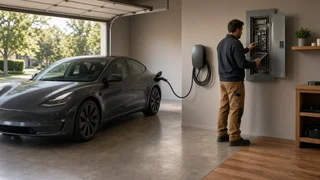
Installing a Level 2 EV charging station means adding a dedicated 208- or 240-volt circuit and a charging unit, often called EVSE (electric vehicle supply equipment), at the place you park. In most cases it is the most practical way to charge an electric vehicle overnight at home. In a single-family house, the main questions are panel capacity and charger placement. In shared residential settings such as condominiums, apartments and townhome communities with common garages, two more questions decide the project: who controls the electrical supply and parking, and how the electricity will be measured and paid for. Level 2 electric vehicle charger installation should be planned with a licensed electrician and, where required, a permit and inspection.
What Level 2 Charging Is and How It Differs
In North America, EV charging is usually grouped into three tiers. Level 1 and Level 2 both supply alternating current (AC) to the car. The vehicle's onboard charger then converts it to direct current (DC) for the battery. DC fast charging bypasses the onboard charger and is normally found at public stations, not homes.
Type | Supply | Typical setting | Practical role; Level 1 | 120 V AC, standard household outlet | Home, occasional use | Slow; can suit low daily mileage or plug-in hybrids; Level 2 | 208 V or 240 V AC, dedicated circuit | Homes, multifamily parking, workplaces | Full overnight recharge for most daily driving; DC fast charging | High-power DC from commercial equipment | Public corridors and hubs | Rapid top-ups on trips; not a typical residential install
Voltage matters in shared buildings. Many single-family homes have 240-volt split-phase service. Many apartment and condo buildings have three-phase service that delivers 208 volts between conductors instead. At the same current, a charger on 208 volts delivers roughly 13 percent less power than on 240 volts. The difference is noticeable but rarely decisive for overnight charging.
Charging Power and Vehicle Compatibility
Charging power is roughly voltage multiplied by current. For example, a charger delivering 32 amps at 240 volts supplies about 7.7 kW, and one delivering 48 amps supplies about 11.5 kW. The rate the car actually accepts is capped by its onboard charger, which varies by manufacturer, model, model year and sometimes trim. A higher-rated wall unit will not charge a car faster than its onboard charger allows. Check the AC charging rating for your specific vehicle, and any vehicle you expect to own soon, before you size the circuit.
Daily energy consumption is often more useful to plan around than peak power. A driver covering moderate daily distances may need only a few hours of Level 2 charging per night. That is why shared parking can often serve several vehicles with modest power per space, especially when charging is managed.
Connector Standards
Two connector standards dominate Level 2 charging in the US. SAE J1772 has long been the common AC connector for most non-Tesla vehicles. SAE J3400, based on the North American Charging Standard (NACS) that Tesla introduced, is being adopted by many automakers for newer models. Adapters let vehicles use either connector type for AC charging. Even so, a shared installation that serves residents with different cars should consider which connector will cover most users, whether units with both connector types or swappable cables are available, and whether residents will be expected to supply their own adapters.
Supply Capacity: The Deciding Factor
Before choosing a charger, an electrician should confirm how much capacity the existing service can spare. EV charging is treated as a continuous load under the National Electrical Code, so the circuit and breaker are sized at 125 percent of the charger's output current. A charger set to 32 amps typically needs a 40-amp circuit, and one set to 48 amps typically needs a 60-amp circuit. Many Level 2 units can be configured to a lower current, which helps when panel capacity is limited.
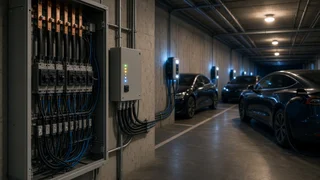
In a house, the assessment usually covers the main panel rating, existing loads and the conductor route to the parking spot. In a multifamily building, supply capacity questions extend further:
Whether the charger will be fed from a resident's own unit panel, a common house panel or a new dedicated service; How much spare capacity the building's main service and transformer have once existing loads are counted; How far conduit must run from the electrical room to the parking area, and through which common spaces; Whether future spaces should be prepared with conduit and capacity now, even if chargers are added later; Whether the utility must be involved for a service upgrade or new meter
Load Management in Shared Parking
Load management, also called power sharing or energy management, lets several chargers share a fixed amount of capacity. They divide the available current among connected vehicles or rotate charging over the night. This can allow more spaces to be equipped without a full service upgrade, at the cost of slower charging per vehicle at peak times. Some products handle this between units directly. Others rely on a networked management platform. Whether load management is permitted in place of full-capacity circuits depends on the electrical code edition adopted locally and on how the system is listed and installed, so this is a question for the electrician and the local inspector.
Hardwired Units Versus Plug-In Units
Level 2 chargers come either hardwired to the circuit or plugged into a 240-volt receptacle, commonly a NEMA 14-50 type. Hardwiring is often preferred in shared or outdoor locations. It reduces wear on receptacles and makes tampering harder, and it can permit higher current settings. Plug-in units can be moved when a resident relocates, which matters to renters. Newer code editions add ground-fault protection requirements for many such receptacles, so the installer should confirm what applies locally.
Networked Chargers, Protocols and Billing
In shared residential access, the charger's communication features often matter more than its maximum power. Networked or "smart" chargers connect to software that can authorize users, record each session's energy consumption, apply pricing and report faults. Many commercial units support the Open Charge Point Protocol (OCPP), an open charging protocol that lets the hardware work with different management platforms. Choosing OCPP-compatible equipment can reduce the risk of being locked into one software provider if that service changes or ends.
Common billing approaches in multifamily buildings include the following. The right choice depends on the building's metering, governing documents and any utility or state rules on reselling electricity.
Wiring the charger to the resident's own unit meter, so usage appears on their utility bill; Installing a separate utility meter for the charger or the charging area; Using networked chargers that meter each session and bill users through an app or account; Charging a flat fee for access, which is simple but may not track actual usage fairly
Approvals, Rights and Cost Allocation
In a condominium or homeowners association, installation in common areas or assigned parking usually requires board approval and a written agreement. The agreement typically covers who pays for installation, electricity, maintenance and eventual removal, and whether the owner must carry insurance. Renters generally need landlord consent, and the lease or an addendum should state who owns the equipment and what happens at move-out. Some states, including California, have "right-to-charge" laws that limit how associations or landlords can refuse reasonable charger requests and that set conditions residents must meet. These rules vary by state and change over time, so check the current law where the property is located.
Utility rebates, state programs and federal tax incentives for charging equipment have changed repeatedly and differ by location and property type. Check what is currently available through your utility and state energy office before committing, rather than assuming a past incentive still applies.
How the Installation Process Usually Runs
Confirm your vehicle's AC charging rating and your realistic daily energy needs; In a shared building, raise the request with the board, manager or landlord and learn the approval process; Have a licensed electrician assess panel and service capacity, conductor routing and any load management options; Choose a charger that fits the circuit, connector standard, location, and any networking or billing requirements; Secure written approvals and agreements on cost, ownership, insurance and maintenance; Obtain the electrical permit where required and schedule the work; Complete installation and pass the local inspection; Set up the charger's app, access control or billing account, and test a full charging session
Questions to Settle Before You Buy a Charger
How much spare supply capacity exists, and at what voltage, 208 V or 240 V? What current can the circuit support after the 125 percent continuous-load sizing? What is the maximum AC charging rate of the vehicles that will use it? Which connector standard, J1772 or J3400, suits current and expected users? Does the unit need networking, user authorization, session metering or OCPP support? Is the location outdoors or in a public-facing garage, requiring weather resistance and tamper resistance? Who owns, maintains and insures the equipment, and what happens if the resident moves? Should extra spaces be prepared now for future chargers?
Bottom Line
A Level 2 charging station installation is usually straightforward in a single-family home once panel capacity is confirmed. In shared residential properties, the electrical work is often the easier part. Capacity planning, metering, approvals and cost allocation take more time to resolve. Start with your vehicle's charging needs and a professional capacity assessment, then choose hardware that fits the circuit, the connector your cars use, and the building's access and billing arrangements.