Electrical Load and Power Requirements for EV Charging Stations
The Short Answer
An EV charging station's power requirement depends on three things: the charging level, the current the charger is set to draw, and the voltage the building supplies. In apartment complexes, condominiums and other shared residential properties, the per-charger number is only part of the answer. The deciding factor is usually whether the building's electrical service has enough spare capacity to serve several chargers at once, and whether load management can let more chargers share the capacity that already exists.
This guide covers general electrical principles that apply in the US. It does not cover the rules, utility requirements, equipment ratings or costs for any particular building, product or jurisdiction. Those details decide what an actual installation needs, and a licensed electrician or engineer should confirm them.
Charging Levels and What They Draw
Level 1: uses a standard 120-volt outlet. Its power demand is low, but it adds energy slowly. In shared parking it can work where vehicles stay parked for long periods and electrical capacity is tight. Level 2: runs on 240 volts in most single-family homes, or on 208 volts in many multifamily and commercial buildings that have three-phase service. This is the most common choice for residential shared charging. The power drawn depends on the charger's current setting. DC fast charging: needs much higher power and usually a dedicated three-phase supply. It is uncommon at residential properties because of the service capacity and equipment it requires.
How to Estimate a Charger's Power Draw
Power in watts is roughly voltage multiplied by current. Voltage matters in shared buildings. A charger set to the same current delivers less power at 208 volts than at 240 volts, so a vehicle charges more slowly on a typical apartment-building supply than in a single-family garage.
Charger current setting | At 240 volts (approx.) | At 208 volts (approx.); 16 amps | 3.8 kW | 3.3 kW; 32 amps | 7.7 kW | 6.7 kW; 48 amps | 11.5 kW | 10.0 kW
These figures are arithmetic examples, not specifications for any product. A charger's rated output, and the rate a given vehicle can actually accept, can be lower than the circuit allows. The onboard charger limits differ by vehicle model, model year and trim.
Why Circuits Are Sized Above the Charger's Draw
The National Electrical Code treats EV charging as a continuous load, meaning it can run at full current for three hours or more. For a continuous load, the branch circuit and its breaker must be rated for at least 125 percent of the charger's continuous current. For example, a charger drawing 32 amps continuously needs a circuit rated for at least 40 amps. Wire size, breaker type and other details follow the code edition adopted locally, and local amendments can change the requirements.
Building Load: The Real Constraint in Shared Housing
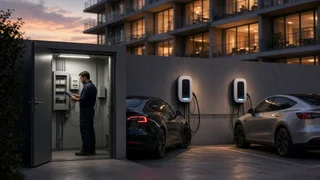
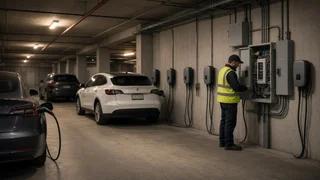
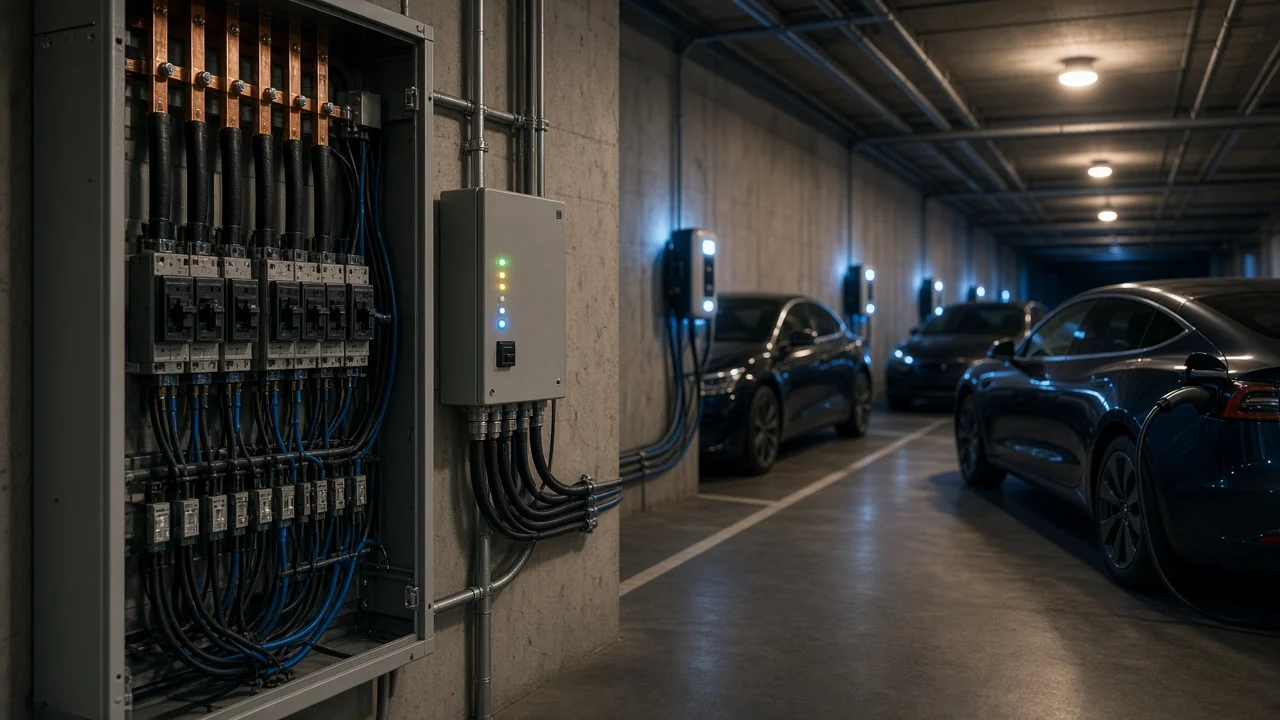
In a multifamily property, the question is whether the panel or service can carry all of the chargers on top of the building's existing demand. Lighting, elevators, HVAC, laundry and the individual units already use part of the service capacity. An electrician or engineer does a load calculation, or reviews the building's historical demand data, to find out how much capacity remains. If the remaining capacity is too small, the options are usually fewer chargers, lower current settings, load management, or a service upgrade coordinated with the utility.
Where the power comes from also matters. Chargers can be fed from a house or common-area meter, from individual unit meters, or from a separately metered service. The choice affects the electrical design and how charging costs are billed to residents.
How Load Management Changes the Requirement
Load management systems are also called power sharing or energy management. They split a fixed amount of capacity among several chargers and lower each charger's output when many vehicles are plugged in. The code allows such a system to limit the load used in the calculation. As a result, a building can often install more charging ports than it could if every charger were assumed to run at full output at the same time. The trade-off is slower charging per vehicle during busy periods. For many residents whose cars sit parked overnight, that trade-off is acceptable.
What This Guide Cannot Tell You
No verified data was available for specific chargers, installation costs, utility upgrade timelines, incentive programs, or state and local rules such as EV-ready building mandates or condo right-to-charge laws. Before planning an installation, get a site-specific load assessment, ask the utility about service capacity, and check which code edition and permit requirements apply locally.