Inspecting Brake Rotors Before Resurfacing: Thickness, Wear and Damage
The Essential Answer
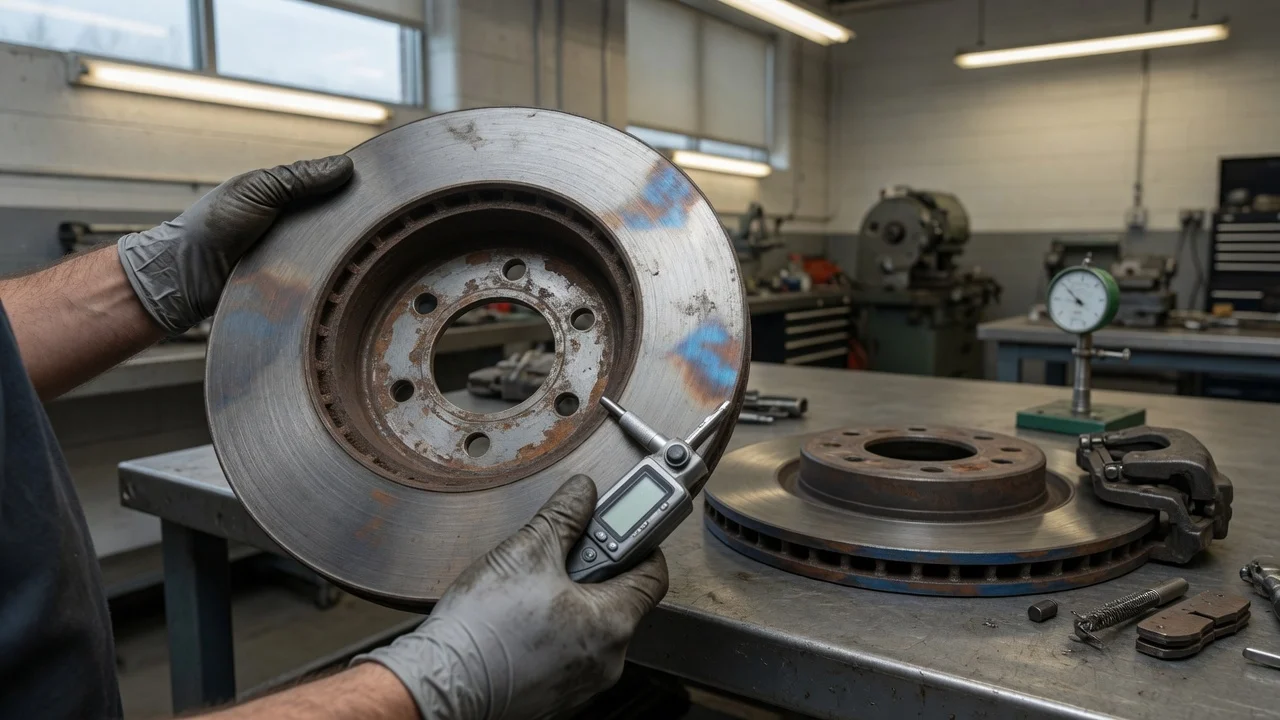
Before resurfacing a brake rotor, inspect its thickness, both friction surfaces, and the mounting area for wear or damage. A rotor can be machined only if its remaining thickness is at or above the specified minimum machine-to dimension and its defects are within correctable limits. If the thinnest measured point is below that threshold, if cracking is present, or if runout, hard spots, or deep grooving exceed the allowable range, replace the rotor instead of resurfacing it.
Why Inspection Comes Before Machining
Resurfacing removes a small layer of metal from each friction face to restore a flat, even braking surface. That removal is only safe when enough material remains to handle heat, stress, and future wear. Rotor thickness specifications vary by vehicle, model year, and brake package, so the published minimum machine-to dimension for the specific rotor must be the reference point rather than a generic rule.
Two thickness figures are commonly listed. The minimum machine-to thickness is the lower limit after resurfacing. The discard thickness is the absolute minimum for continued service. A rotor already near discard thickness has no realistic material left for a clean machine cut.
Checking Rotor Thickness
Use a micrometer or a dedicated brake-rotor thickness gauge to measure multiple points around the friction surface. Do not rely on a single measurement. Rotors wear unevenly and can develop thickness variation, so the controlling value is the lowest stable measurement, not the average.
Record the smallest measured thickness and compare it with the machine-to specification. If the rotor has enough material beyond the minimum to allow a documented clean-up cut, resurfacing may be possible. If the lowest point is at or below the machine-to dimension, replacement is required. Some rotors also carry a discard dimension stamped or cast into the rotor, but the service specification is the dependable reference when available.
Wear and Damage to Look For
Inspect both friction faces and the hat area before any machining decision. Condition-based checks include the following:
Deep grooves or scoring: shallow, even wear may machine clean, but deep scoring that extends beyond a safe cut means replacement. Heat checking: a network of fine surface cracks from repeated heating and cooling is a rejection condition. Hard spots: discolored or raised areas can resist cutting and affect brake performance, often requiring replacement. Cracks: cracks radiating from the edge, holes, or slots, and cracks extending to the rotor edge are structural defects and call for replacement regardless of thickness. Uneven wear or thickness variation: measure for variation across the face and between faces; significant variation may not leave enough material for a clean cut. Rust or corrosion: light surface rust on a stored or lightly used rotor may be removed, but pitting that weakens the friction surface or mounting area is a concern. Damage to the hat or mounting surface: distortion, deep corrosion, or damage around the hub area affects how the rotor sits and runs.
Runout and Flatness
Lateral runout is the side-to-side movement of the rotor as it turns. It is checked with a dial indicator mounted against the friction surface. If runout is within the service limit and enough thickness remains, machining may be appropriate. If runout comes from a distorted rotor or mounting surface rather than removable variation, resurfacing may not correct the problem reliably.
Flatness is related but distinct. A rotor with wavy or uneven friction faces may have thickness variation that produces brake pedal pulsation. Machining can correct some thickness variation, but only if the required cut does not drop the rotor below its allowed thickness.
When Resurfacing Is Not the Answer
Replace the rotor rather than resurfacing it when the thinnest measurement is below the machine-to specification, when cracks or extended heat checking are present, or when the defect cannot be removed without violating the minimum thickness. Replacement is also the safer option when hard spots, deep pitting, or mounting-area damage would leave an unreliable result even after a successful cut.
Finally, resurfaced rotors should remain at or above the minimum machine-to thickness after the cut, not merely the discard limit. If the shop or equipment cannot confirm that final dimension for the specific rotor, use a replacement rotor instead.