Inspect brake pad wear and thickness
What brake pad inspection should tell you
Brake pad inspection answers one practical question: how much friction material remains between the backing plate and the rotor. The measurement that matters most is the thickness of the pad material, not the total pad assembly including the steel backing plate. Manufacturers and workshops generally consider a friction material thickness of about 3 mm to 4 mm as the service limit where replacement should be planned. A new pad often starts with roughly 10 mm to 12 mm of friction material, though exact figures vary by vehicle, axle, and pad compound. Once the friction surface reaches the minimum thickness specified for that brake system, heat dissipation and structural integrity can decline, even if the brakes still feel acceptable in gentle street use.
Tools and access
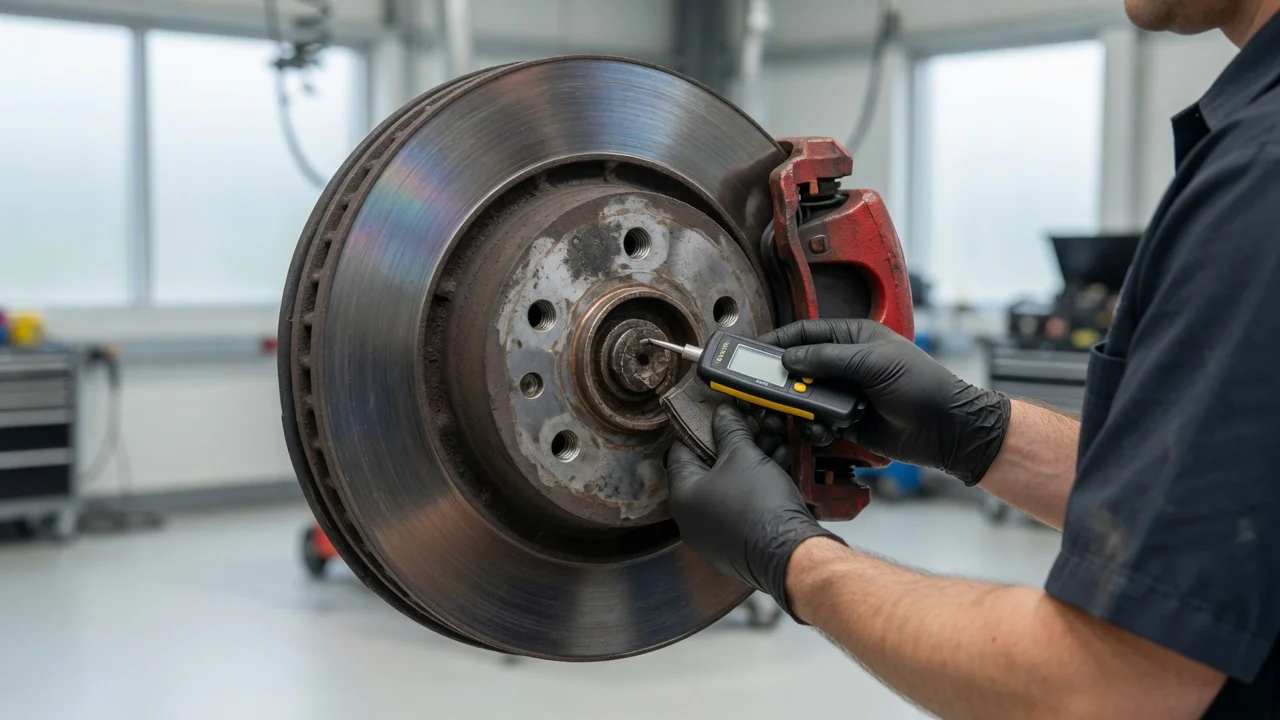
A visual inspection can be done through the wheel spokes on many cars, but an accurate measurement usually requires lifting the vehicle safely and removing the wheel. A flashlight helps show the inner and outer pads, while a brake pad thickness gauge gives a direct reading in millimeters. Vernier calipers or a small ruler can also work if they fit past the caliper. A brake pad gauge is typically color-coded or marked with ranges such as safe, advisory, and replace, but the numerical reading is more useful than the color band because minimum specifications differ between vehicles.
When inspecting, measure the thinnest accessible point on the pad. Compare the inner and outer pads because caliper slide issues can produce uneven wear. Do not measure the backing plate. If the friction lining is visibly thinner than the backing plate, it is usually near or below the service limit.
Interpreting pad thickness readings
A brake pad thickness chart is an approximate guide, not a replacement for the vehicle manufacturer's specification. In general, 8 mm to 12 mm indicates a healthy amount of friction material. At 5 mm to 6 mm, the pad is roughly half worn and continued use is normal, but inspection intervals should shorten. At 3 mm to 4 mm, replacement should be scheduled promptly. Below 3 mm, the pad is considered worn to the service limit on many vehicles and should be replaced before further driving. These figures are editorial guidance; the controlling number is the minimum thickness published for the specific model, year, and brake package.
Friction material thickness | Typical interpretation; 10 mm to 12 mm | Near-new condition; 6 mm to 8 mm | Normal wear, continued use; 4 mm to 5 mm | Plan replacement soon; 3 mm to 4 mm | Service limit for many systems; Below 3 mm | Replacement required on most vehicles
Wear indicators and wear sensors
Many pads include a mechanical wear indicator: a small metal tab that contacts the rotor when the friction material reaches roughly 3 mm to 4 mm. This produces a high-pitched squeal during braking. The noise may disappear when the brakes are applied harder, but the wear condition remains. A pad that is loose in the caliper bracket can also produce rattling or clunking, which is a mounting or hardware concern rather than a direct thickness measurement.
Electronic brake pad wear sensors are fitted on some vehicles, commonly on one pad per axle or on specific corner positions. A sensor typically embeds a wire in a plastic housing that wears through at a set thickness, triggering a dashboard warning. Sensor placement varies by manufacturer; some systems may not indicate wear on all four wheels. A triggered sensor should be treated as a request for physical inspection, not as a standalone measurement of pad condition.
Signs of a bad pad beyond thickness
Low thickness is not the only failure mode. Cracks, crumbling edges, contamination with brake fluid or grease, glazing, and separation from the backing plate all justify replacement even if the measured thickness appears adequate. Uneven taper across the length of the pad may indicate caliper or guide pin problems. A bad brake pad can also damage the rotor, so replacement decisions should consider the rotor surface condition alongside the pad thickness.
Brake pad lifespan expectations
Brake pad lifespan is highly variable. Front pads often wear faster than rear pads because of forward weight transfer under braking. Hybrid and electric vehicles may show extended pad life due to regenerative braking, while heavy use, mountainous driving, towing, or aggressive braking shortens it. Manufacturer maintenance schedules for some vehicles give inspection intervals rather than replacement intervals. Any lifespan figure should be treated as a broad estimate, not a promise for a specific vehicle or driving pattern.
Next action after measurement
If the thinnest pad measures at or below the manufacturer's minimum thickness, replace the pads in axle sets. If inner and outer pad thickness differs significantly, inspect the caliper slides, pad abutments, and hardware. If a wear sensor has triggered, replace the sensor along with the pads according to the vehicle procedure. The information here is based on common industry practice and published service guidance; actual minimum thickness values should be confirmed for the exact model year, trim, and brake option.