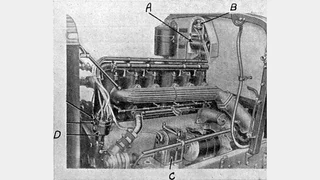
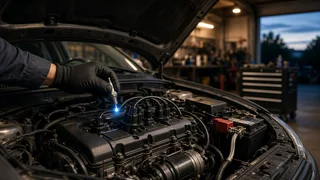
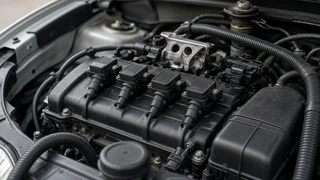
Identify parts of the ignition system
When a gasoline engine cranks but will not fire, the fault often sits somewhere in the sequence that turns low-voltage battery energy into a timed high-voltage spark. Identifying the parts of the ignition system helps separate an electrical issue from a fuel delivery or compression problem, because each component plays a distinct role in creating and distributing that spark. The starter circuit spins the engine, but ignition requires the switch, coil, triggering device, distributor or module, wires, and plugs to cooperate. Battery state of charge and cranking speed also matter, since slow rotation weakens the whole starting sequence.
Essential answer
The core parts of the ignition system are the power source, switching circuit, coil, trigger or points, distributor or electronic control, high-tension leads, and spark plugs. Older systems use a distributor and mechanical points, while many modern engines use coil-on-plug or coil-near-plug arrangements controlled by an engine computer. The job remains the same: store energy, step it up to thousands of volts, and deliver it at the correct cylinder during the compression stroke.
The system cannot be judged only by whether the engine turns over, because the starter circuit is separate from spark generation. A weak battery may still spin the engine slowly, but reduced voltage can prevent reliable coil saturation and firing. Diagnostic checks should therefore include battery state of charge, cranking speed, spark presence at a plug wire or coil, and confirmation that fuel delivery is not the real cause of a no-start.
Identification and location
The ignition switch is typically activated by the key cylinder or start button and sends a signal to the starter circuit and ignition system. The coil often sits near the engine or firewall and can be found by tracing a thick secondary wire from its center tower. On distributor engines, that tower feeds the distributor cap, where internal contacts route spark to each cylinder through the rotor and spark plug wires in firing order.
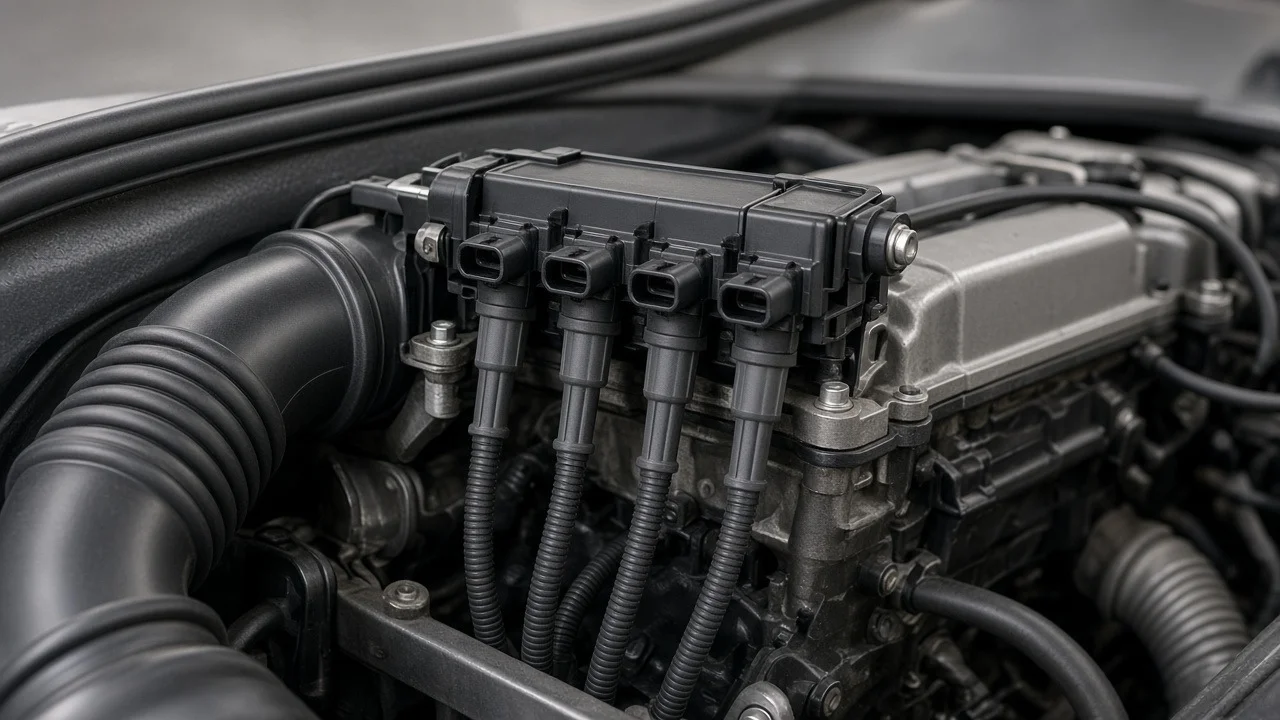
Coil-on-plug systems remove the long high-tension wires and place an individual coil directly above each spark plug or connect it through a very short boot. Triggering hardware may be a reluctor, Hall-effect sensor, or crankshaft position sensor, depending on the vehicle configuration. Because appearance and location vary widely, vehicle-specific documentation is the most reliable way to confirm which exact style is installed before replacing any part.