How to Test Fuel Pressure Without a Gauge
A no-start or low-power condition often points toward fuel delivery, but not everyone has a dedicated pressure gauge on hand. You can still gather useful clues about fuel pressure without a gauge by observing spray patterns, pump behavior, and system response during key-on and cranking events. These indirect checks will not produce a calibrated psi reading, yet they can separate a dead fuel pump, a restricted line, or a failed relay from other faults. Use them as preliminary diagnostics, and remain aware that manufacturer-dependent systems may respond differently.
Direct answer
The essential answer is that you cannot measure exact fuel pressure without a pressure gauge, but you can perform practical tests that strongly indicate whether the system can build and hold usable pressure. A common substitute is to depress a Schrader test port valve briefly with a small tool while the pump is running and watch for a solid fuel stream. If the port only dribbles or remains dry, the fuel pump, fuel filter, regulator, or electrical circuit deserves closer attention.
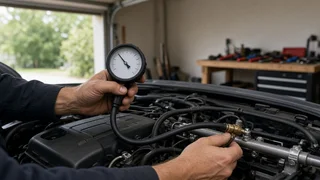
Another functional check involves listening for the in-tank pump when the ignition is first switched on. Many vehicles briefly energize the pump to prime the system. If you hear no hum, the relay, fuse, wiring, or pump may be at fault. A tire gauge can sometimes be used on a Schrader test port, but it is not calibrated for fuel, and repeated exposure can damage its seals. Treat that method only as a quick presence check rather than an accurate measurement.
How to proceed
Begin with the key-on, engine-off listening test. Turn the ignition to the run position without cranking and listen near the fuel tank for a short whir or hum. If the pump is quiet, check the fuel pump fuse and relay before condemning the pump. On vehicles with an easily accessible fuel rail test port, wear eye protection and cover the valve with a shop cloth. Briefly depress the valve after the key-on cycle. A sharp spray indicates some residual pressure, while a weak seep suggests the system is not maintaining pressure.
For a running-engine check, have an assistant start the engine while you observe the test port flow with the valve depressed only long enough to see the stream. A vigorous fuel discharge that strengthens briefly as the throttle is opened suggests acceptable pump response. If the stream falters, disconnecting a vacuum line from the fuel pressure regulator may reveal a change in delivery, indicating the regulator is responding. Stop any test immediately if fuel leaks onto hot surfaces or open ignition sources, and avoid introducing dirt into an open test port.