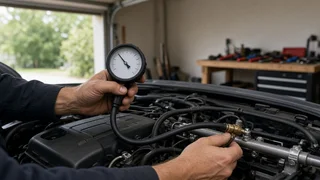
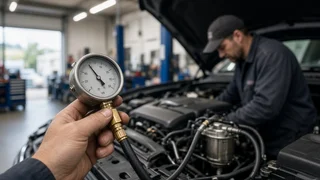
How to Test Fuel Pressure with a Gauge
A fuel pressure gauge test helps you compare actual rail or line pressure with the vehicle specification under different operating conditions. Pressure that is low, high, or slow to build can point toward common causes such as a restricted filter, a weak pump, a faulty regulator, or a leaking injector. The key is not the gauge reading alone; it is the pattern of pressure when the pump primes, the engine idles, and throttle demand increases. A steady, specification-range result on a properly connected gauge gives useful evidence that the delivery side is functioning.
Direct answer
You connect a fuel pressure test gauge to the service port or an adapter in the delivery line, then read the pressure with the key on, at idle, and under load or with the vacuum line removed from the regulator where applicable. The basic answer is that the gauge allows you to verify whether measured fuel pressure rises quickly, remains within the intended range, and responds correctly when engine demand changes. A stable reading near the vehicle specification generally indicates the pump and pressure control components are delivering adequate fuel.
A single number is not enough. Pressure may test acceptable while the engine is idling but collapse under acceleration, pointing to restricted delivery or a pump that cannot maintain flow. Likewise, a reading that remains high may indicate a regulator or return circuit problem. For this reason, testing should be treated as a sequence of observations using a reliable measurement range and appropriate units, not as a pass-or-fail check based only on the first reading shown by the gauge.
How to proceed
Begin by confirming the correct connection point and depressurizing the system safely, following the vehicle-specific procedure. Connect the test gauge securely to the Schrader-style service port or an approved line adapter, making sure the fitting is seated and the gauge scale suits the expected pressure. When you turn the key to the run position without starting the engine, the pump should briefly prime and the gauge should climb promptly. A slow or absent rise may indicate a relay, wiring, or pump issue rather than a faulty regulator.
Start the engine and observe pressure at idle, then note how the reading changes during throttle opening or during a short load simulation. On many return-type systems, removing the vacuum line from the pressure regulator should produce a predictable rise because manifold vacuum is reduced. After testing the accuracy of the connection and confirming the readings match the expected specification and units, depressurize the system again before removing the gauge to avoid fuel spray. If the pattern is abnormal, a calibration issue with the gauge or a vehicle fault may be involved, so verify repeatability and follow the manufacturer’s specified test sequence for that configuration.