How to Make a Rear Axle Bearing Puller
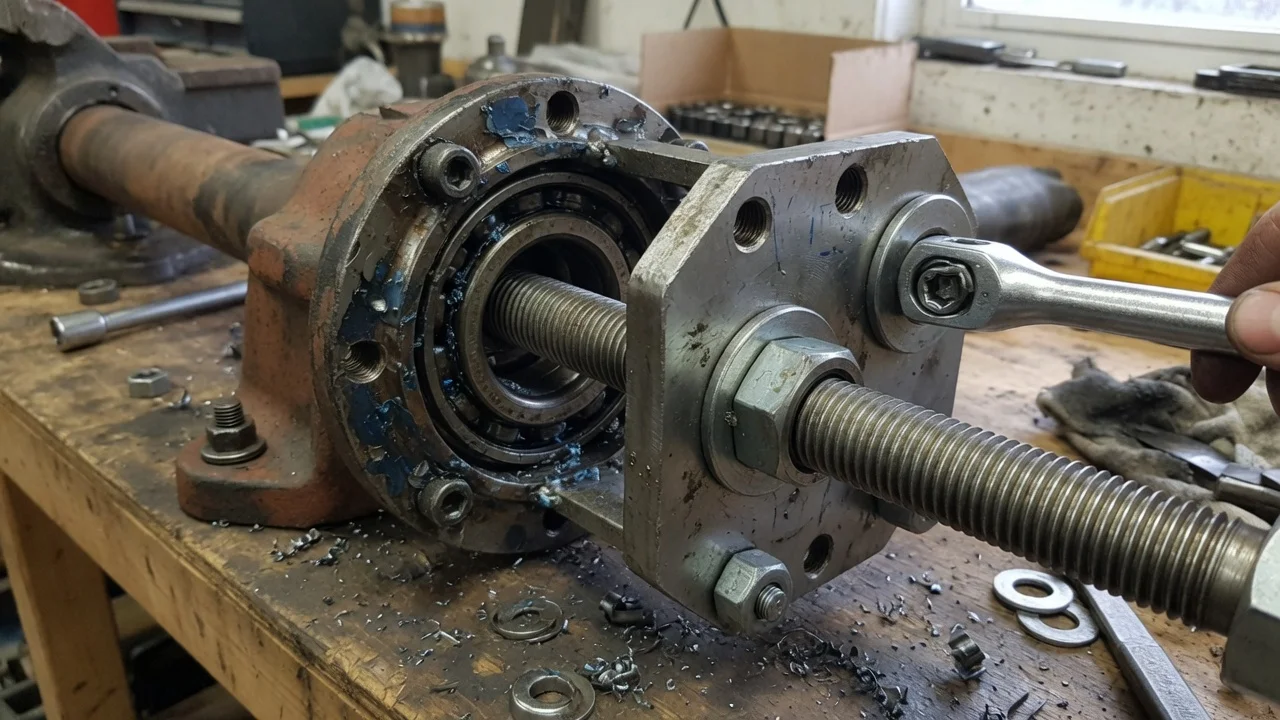
A homemade rear axle bearing puller can save a trip to the tool rental counter, but it only works if it matches how the bearing is held in your axle. On some rear axles the bearing comes out still pressed onto the shaft. On others the bearing stays in the housing. This guide explains which homemade designs suit each layout, how they apply force, and where a shop-made tool stops being a sensible choice.
The short answer
For many rear-wheel-drive vehicles, the most practical homemade puller is a slide hammer with a steel plate drilled to match the wheel stud pattern on the axle flange. You bolt the plate to the flange with lug nuts. The sliding weight then jars the axle and bearing outward. This approach suits axles where the bearing is pressed onto the shaft and held by a retainer plate bolted to the housing. If your axle uses C-clips at the differential, the bearing stays in the housing when the shaft comes out. In that case you need an internal, or blind-hole, puller, which is much harder to build well at home. Either way, confirm the axle type for your exact vehicle configuration before you cut or weld anything.
How a rear axle bearing puller works
Rear axle bearings are installed with an interference fit. The bearing is slightly tight in its bore or on the shaft, so friction holds it in place along with retainers, seals or clips. A puller overcomes that fit in one of two ways. A slide hammer delivers repeated sharp impacts along the axis of the shaft and breaks the bearing loose in small steps. A screw-type puller applies steady force through a threaded rod that pushes against a fixed point, such as the face of the axle housing or a bridge across it.
What matters most is where the force travels. A puller should load the race that is actually press-fitted. Pulling on the wrong race, or pulling at an angle, can cock the bearing in its bore, gouge the housing, or bend the tool. For this reason, homemade pullers usually fail at the attachment point rather than at the handle or the weight.
What changes the answer
Axle design is the biggest variable. On semi-floating axles with a bolted retainer plate, the bearing comes out with the shaft, so a flange-mounted slide hammer is usually enough. Getting that bearing off the shaft afterward is a separate job. The bearing and its retaining ring are typically pressed on, so removal normally means carefully cutting or splitting the old ring, then using a hydraulic press with a bearing separator. A threaded-rod puller rarely produces enough controlled force for that step.
On C-clip axles, the shaft slides out once the differential cover is off and the clip is removed, which leaves the bearing and seal in the axle tube. The puller has to grip behind the outer race through the bearing's bore. That requires jaws that expand behind the race without catching the tube. Full-floating axles, found on many heavy-duty trucks, carry their bearings in the hub, so a shaft puller does not apply. Many front-wheel-drive vehicles use bolt-on rear hub bearing assemblies that are replaced as a unit rather than pulled. Corrosion, age and operating conditions such as road salt or water crossings also affect how much force a stuck bearing needs.
Building a basic slide hammer puller
A typical shop-built slide hammer has four parts. You need a straight steel shaft, a heavy weight with a bore that slides freely on it, a solid stop or handle at the outer end, and an adapter at the inner end. For axle work, the adapter is a thick steel plate. It needs holes that match the flange's stud pattern and a center hole that clears the axle pilot. Measure the stud spacing on your own flange instead of relying on published bolt pattern charts. A plate that binds on the studs will load them unevenly.
Fix the shaft to the plate on the axle's centerline, either by threading it into a nut welded to the plate or by welding it directly. Weld quality matters because the joint takes every impact. A weak or off-center weld can crack and let the weight fly off the end of the shaft. Leave room for the lug nuts to seat fully, and make sure there is enough thread engagement that the nuts cannot strip. Some owners instead bolt the brake drum or a wheel back onto the flange and use it as a pulling point. That can work on a lightly stuck axle, but it puts impact loads on parts that were not designed for them.
What the owner can do before and during removal
Start with an inspection and a look at the service history. Note whether the axle has been apart before, because earlier repairs may have changed the seals, retainers or bearing type. Remove the wheel, the brake drum or caliper and rotor, and any parking brake hardware that blocks the flange. On retainer-plate axles, remove the retainer nuts through the access hole in the flange. On C-clip axles, drain or catch the gear oil, remove the differential cover and pinion shaft as the service information describes, and push the axle inward to free the clip.
Use controlled strikes and check your progress often. If the axle or bearing starts to move, keep the pull straight. If nothing moves after reasonable effort, stop and reassess instead of adding a heavier weight. Look for a retainer you missed, a seized brake component, or a failed bearing that is binding. Wear eye protection, keep your hands out of the weight's path, and support the axle so it cannot drop when it releases. Afterward, inspect the bearing and seal surfaces on the shaft for scoring or wear, because a new bearing will not fix a damaged shaft. Treat installation as a separate step: a new bearing goes in with a driver that contacts the correct race, not with the puller.
Limitations and next step
A homemade tool cannot tell you which bearing, seal or retainer your vehicle uses. It also cannot give you the correct torque for the retainer and backing plate, or tell you whether the axle needs a specific installation method. Those details come from the manufacturer specifications and the repair procedure for your exact model, axle code and drivetrain. There is also no universal interval for replacing rear axle bearings. Noise, play, leaks and the gear oil service items in the maintenance schedule are more useful guides than mileage alone.
A machine shop or repair facility with a press is usually the safer route in three situations: the bearing must be pressed off the shaft, the axle housing is damaged, or you are unsure of the axle design. You can still save money by removing the axle yourself and bringing in only the shaft. For blind-hole removal on C-clip axles, a rented internal puller is often more reliable than one fabricated at home.