How to Check a Car Title Before Buying
To check a car title before buying, compare three things: the paper title, the vehicle itself, and an independent title history pulled by its vehicle identification number (VIN). Confirm that the VIN matches in all three places. Confirm that the seller is the owner named on the title. Look for any brand, such as salvage, rebuilt or flood. Make sure no lienholder is still listed without a release. If any of these checks fails, stop and resolve the problem before any money changes hands. Title rules are set by each US state, so details such as brand names, lien procedures and transfer requirements vary depending on where the vehicle is titled and where you will register it.
What a Car Title Is and Why Checking It Matters
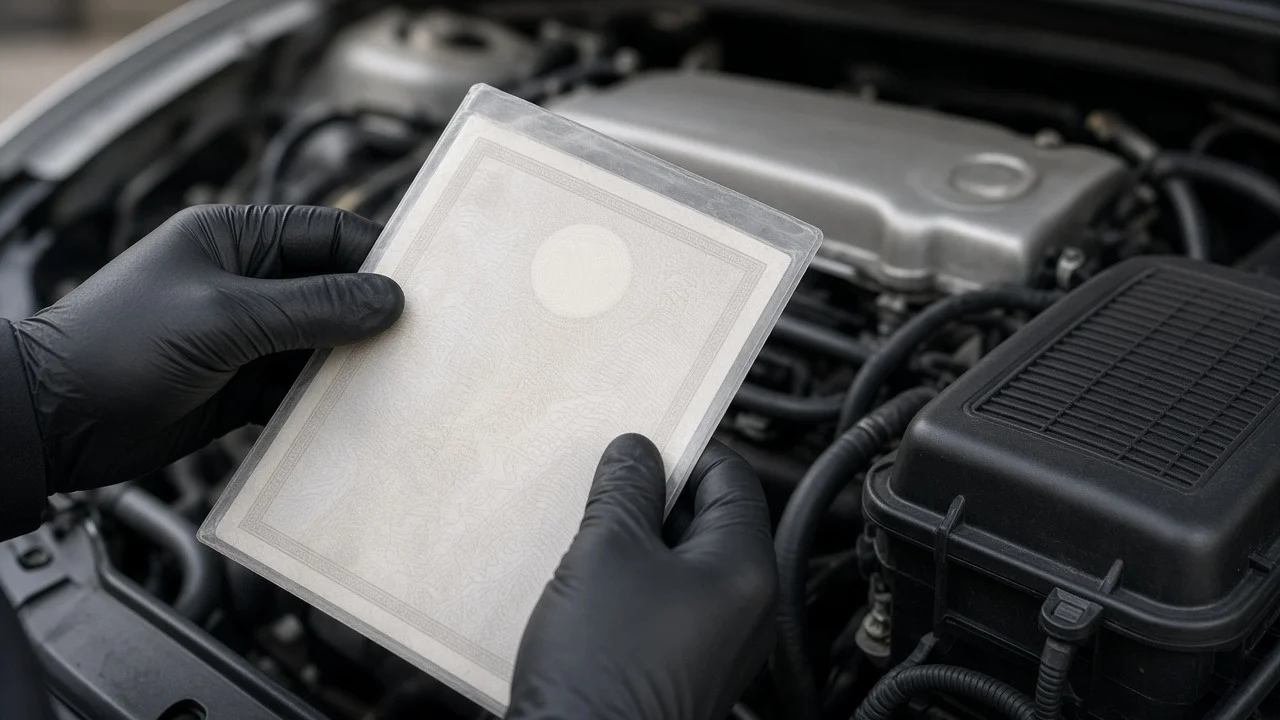
A certificate of title is the state-issued document that records legal ownership of a vehicle. It typically lists the VIN, the year, make and model, the registered owner or owners, any lienholder (a lender with a financial claim on the car), and any brand describing a significant event in the vehicle's history. When you buy a used car, the title is what proves the seller has the right to sell it and lets you register it in your name.
A title check protects you from the most costly used-car problems. You might buy a car that is still owed to a bank, a stolen vehicle, a car with a hidden total-loss history, or a car whose mileage has been misrepresented. Some of these problems can leave you unable to register the vehicle. Others leave you with a car worth far less than you paid.
What You Need Before You Start
Access to the vehicle in person, in daylight, so you can read the VIN in more than one location; The original paper title, or for electronic titles, the seller's documentation showing how the title will be transferred in your state; The seller's government-issued photo ID; A phone or notepad to record the VIN exactly as it appears; A vehicle history report or title history obtained using the VIN; Your state's motor vehicle agency requirements for title transfer, which you can confirm with the agency directly
Step 1: Find and Record the VIN on the Vehicle
The VIN is a unique code assigned to each vehicle. For vehicles built for the US market from the 1981 model year onward, it is standardized at 17 characters. The letters I, O and Q are not used, which avoids confusion with the numbers 1 and 0. Older vehicles may have shorter, non-standard identification numbers, which makes some of the checks below less straightforward.
On most modern cars, the VIN appears in at least two places. One is at the base of the windshield on the driver's side, readable from outside. Another is on a label on the driver's door jamb. It may also be stamped on the frame or on other body parts, and it often appears on registration and insurance documents. Write it down from the dashboard, then compare it against the door jamb label.
Stop condition: if the VIN plates look scratched, loose, glued, riveted with non-matching fasteners, or covered over, or if the dashboard and door VINs differ, do not proceed with the purchase. Tampered or mismatched VINs can indicate theft or a vehicle assembled from multiple cars. Report your concern to local law enforcement rather than confronting the seller.
Step 2: Decode the VIN and Compare It With the Car
A VIN decoder translates the code into the vehicle's basic identity. This lets you confirm that the car in front of you is the car described on the title and in the listing. In the standard 17-character format, different positions carry different information.
Position 1-3 World manufacturer identifier (maker and country of origin); Position 4-8 Vehicle descriptor section (model, body, engine, restraints; varies by maker); Position 9 Check digit (used to detect invalid or altered VINs); Position 10 Model year; Position 11 Assembly plant; Position 12-17 Production sequence number
Check that the decoded make, model, model year and body style match the vehicle and the title. A decoder may also report the engine and the assembly plant. Some manufacturer-specific decoders go further and show the trim code, factory equipment and market specification, meaning the country or region the car was originally built for. Decoders differ in how much detail they can return for a given brand and year. Treat these extra details as a cross-check rather than a guarantee.
A mismatch is a warning sign. Examples include a VIN that decodes to a different engine, a base model being sold as a higher trim, or a car built for another market. Sometimes the cause is innocent, such as a decoder limitation or a legitimately replaced engine. Other times it points to misrepresentation or a re-identified vehicle. Ask the seller to explain, and get the explanation confirmed by an independent source before you continue.
Step 3: Examine the Paper Title
Ask to see the original title, not a photocopy or photo. Read it carefully and check each of the following points.
VIN: it must match the vehicle exactly, character for character; Owner name: it must match the seller's photo ID; if two owners are listed, your state may require both to sign; Issuing state: note it, because brand definitions and transfer procedures depend on that state's rules; Title brand: look for any word or notation such as salvage, rebuilt, reconstructed, flood, junk or manufacturer buyback; Lienholder section: check whether a lender is listed, and if so, whether the lien has been released; Odometer reading: compare the recorded mileage with the car's odometer and look for notations such as not actual mileage or exceeds mechanical limits; Duplicate or replacement status: some states mark reissued titles; a recent duplicate is not proof of fraud but deserves a question; Physical condition: look for erasures, white-out, mismatched fonts or ink, or signs the document has been altered
Stop condition: do not buy if the seller cannot produce the title, says it will be mailed later, or is not the person named on it. Also walk away if the seller offers a title already signed by someone else with the buyer section left blank. Passing along a title without first transferring it into the seller's own name is commonly called title jumping or an open title. Many states prohibit it, and it can leave you unable to register the car.
Step 4: Understand Common Title Brands
A title brand is a permanent notation recording a serious event in the vehicle's history. Exact terms and the conditions that trigger them are defined by each state, so the same history may be labeled differently depending on where the car was titled. The table below describes common brands in general terms.
Brand | General meaning | What it means for a buyer; Salvage | Declared a total loss, typically by an insurer, after damage, theft or another event | Often cannot be registered for road use until repaired and inspected under state rules; Rebuilt or reconstructed | A former salvage vehicle repaired and approved to return to the road | Can usually be registered, but resale value and insurability may be affected; repair quality varies widely; Flood or water damage | Damaged by water to a degree recognized by the state | Water can cause delayed electrical, corrosion and mold problems; Junk, non-repairable or parts only | Not intended to return to the road | Generally cannot be titled for road use again; Lemon or manufacturer buyback | Repurchased by the manufacturer under a state lemon law or similar program | Ask what defect led to the buyback and whether it was fixed; Odometer brands | Mileage recorded as not actual or beyond the odometer's mechanical limits | True mileage is unknown or higher than displayed
A branded title is not automatically a reason to walk away. Some buyers knowingly purchase rebuilt vehicles at a lower price. What matters is that the brand is disclosed, priced in, and evaluated with an independent inspection. Check with your insurer before buying, because some insurers limit coverage on branded vehicles.
Step 5: Run a Title History by VIN
The paper title only shows the current state's record. A title history search by VIN number looks across records from multiple sources. This matters because a damaged car can be moved and retitled in another state in a way that drops or obscures a brand. That practice is known as title washing. An independent check helps catch it.
National Motor Vehicle Title Information System (NMVTIS): a federal database of title and brand information reported by participating states, insurers, salvage yards and junkyards; consumers access it through approved third-party report providers; National Insurance Crime Bureau VINCheck: a free lookup that shows whether participating insurers have reported the vehicle as stolen and unrecovered or as a total loss; Commercial vehicle history reports: combine title records with other data such as reported accidents, service entries, ownership changes and odometer readings; Your state motor vehicle agency: some states offer title or lien status lookups, or can confirm title status in person
Compare the report against the paper title and the seller's story. Pay attention to brands that appear in the history but not on the current title. Also watch for title transfers between several states in a short period, mileage readings that go backward or jump unexpectedly, and total-loss or theft records.
Understand the limits of any report. Not every event is reported. An accident that was repaired privately without an insurance claim may never appear. Coverage varies by data source and by state, and a clean report is not proof of a clean history. Use the report as one input alongside the title and a physical inspection.
Step 6: Confirm There Is No Active Lien
If a lender is listed on the title, the vehicle may still serve as collateral for a loan. Buying a car with an unreleased lien can leave you unable to get a clean title in your name, and in some situations the lender may have a claim on the vehicle.
If a lienholder appears, ask for proof that the loan has been paid off. This usually means a lien release document from the lender, or a title that shows the lien as released according to your state's procedure. If the seller still owes money, a common approach is to complete the sale at the lender's office or through an arrangement in which the lender is paid directly and releases the title. Confirm the exact process with the lender and your state agency. In states with electronic titles, the lender may hold the title electronically, and the transfer steps differ from a paper title.
Step 7: Complete the Transfer Paperwork Correctly
Have the seller sign and date the title in the designated seller section, exactly as their name appears on the front; Fill in your name and address as the buyer where required; Record the odometer reading on the title or on a separate odometer disclosure form if your state requires one; Get a bill of sale listing the VIN, sale date, price, and the names and signatures of both parties; some states require one, and it is useful even where it is optional; Collect any lien release documents; Avoid crossing out, correcting or using white-out on the title, because alterations can void it; if a mistake is made, ask your state agency how to correct it; Submit the title and paperwork to your state motor vehicle agency within the deadline your state sets
How to Know the Title Check Is Complete
Your check is complete when all of the following are true. The VIN matches on the dashboard, the door jamb, the paper title and the history report. The decoded vehicle details match the car and the listing. The seller's ID matches the owner named on the title. Any title brand is identified and understood. Any lien is released in writing. The history report shows no unexplained theft, total-loss or odometer records.
If any item is unresolved, pause the purchase until it is resolved. For a branded or rebuilt vehicle, or any car where the history raises questions, have a qualified independent mechanic inspect it before you buy. A title check verifies the vehicle's legal status and recorded history. It does not tell you about the car's current mechanical condition.
When to Walk Away
The seller cannot produce the title or is not the owner named on it; The VIN differs between locations on the car, or between the car and the title; The VIN plates or labels show signs of tampering; The title appears altered or damaged in a way that obscures key information; A lien is listed and the seller cannot provide a release or a clear payoff arrangement; The history report shows theft or a total loss that the seller did not disclose; The seller pressures you to pay in cash immediately, discourages a history check, or refuses an independent inspection