How Does an Engine Keep Crankshaft and Camshaft in Sync?
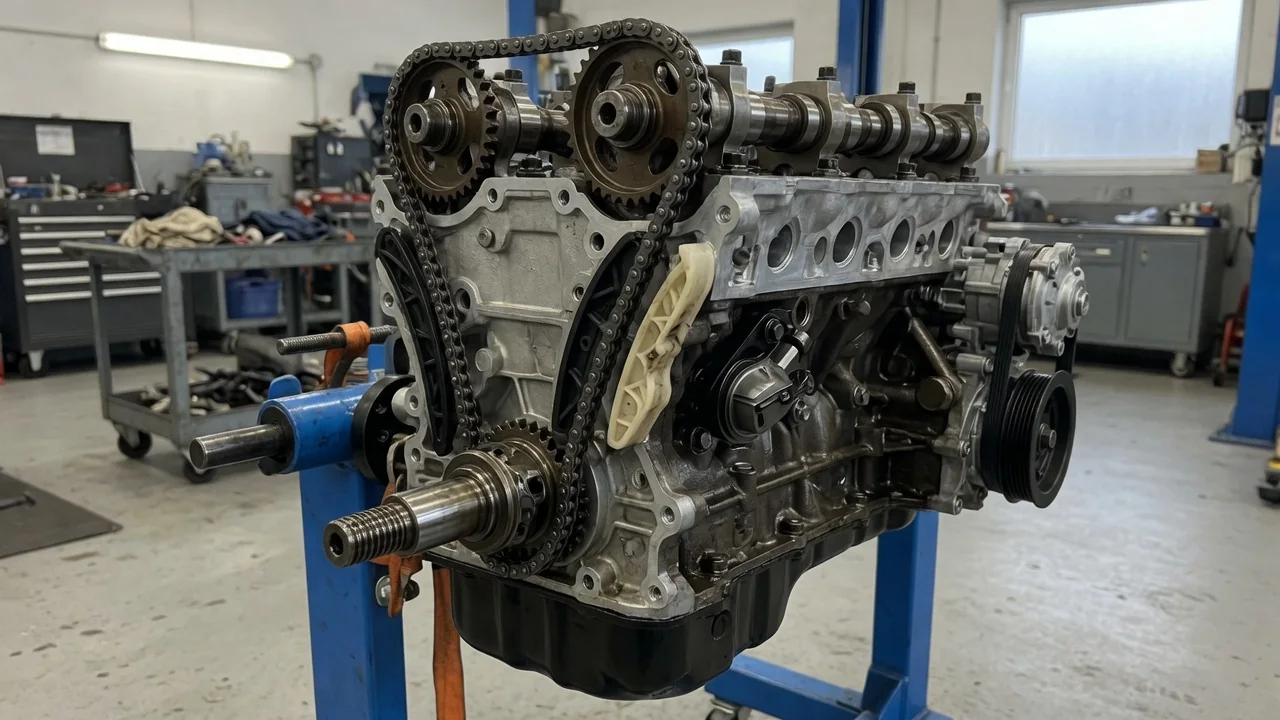
Every four-stroke piston engine depends on a fixed relationship between the crankshaft, which turns with the pistons, and the camshaft or camshafts, which open and close the valves. Engine crank cam synchronization means the cams turn at exactly half crankshaft speed and stay at the correct angle relative to it. This article explains the drive that links them, the marks used to set that relationship, and the faults that can disturb it.
Belt or chain
The basic answer to how an engine keeps the crankshaft and camshaft in sync is a positive mechanical drive. In the simplest layout, a sprocket on the front of the crankshaft drives a sprocket on each camshaft, and each cam sprocket has twice as many teeth as the crank sprocket. Because a four-stroke cycle takes two crankshaft revolutions while each valve opens once, this 2:1 ratio makes the camshaft turn once for every two turns of the crank. The drive must not slip, so it relies on teeth or links rather than the friction grip used by accessory drive belts.
A timing belt is a toothed belt made of a reinforced rubber compound, usually running dry behind a protective cover. Its teeth mesh with matching grooves on the sprockets, and a tensioner keeps it tight enough that it cannot skip. Idler pulleys guide its path, and on many engines the same belt also turns the water pump. Belts run quietly and are light, but the material ages and wears, so manufacturers specify a replacement interval based on mileage, time, or both.
A timing chain is a metal roller or inverted-tooth chain that runs inside the engine and is lubricated by engine oil. Most chain drives use a tensioner that is pushed outward by oil pressure, sometimes assisted by a spring, plus plastic or composite guides that control chain movement. Chains are generally designed to last much longer than belts, though they still wear. Some engines, particularly certain heavy-duty and older pushrod designs, use meshing gears instead of either a belt or a chain. Whatever the drive, its job is to hold a fixed angular relationship between the shafts.
Timing marks
Because a sprocket can be fitted to a belt or chain in many positions, the engine needs reference points that identify the correct one. Timing marks are notches, dots, lines, or arrows on the crankshaft sprocket or pulley and on each camshaft sprocket, which line up with matching marks on the block, cylinder head, timing cover, or each other. In many designs the reference position is with cylinder number one at top dead center on its compression stroke, but the exact alignment differs from engine to engine. Some timing chains include colored or plated links meant to line up with sprocket marks during assembly, and some engines rely on special locking tools or pins rather than visible marks alone.
When a belt or chain is installed, the marks are aligned, the drive is fitted so that slack sits where the procedure specifies, and the tensioner is set. The crankshaft is then usually turned by hand through two full revolutions to confirm that every mark lines up again. If a mark lands a tooth off, the drive has to be removed and reinstalled. The factory service procedure for the specific engine is the authority, since mark locations, rotation direction, and tool requirements are not universal.
Timing marks set the mechanical baseline, but many modern engines also vary cam timing while running. A cam phaser can rotate the camshaft a limited amount relative to its sprocket, typically using oil pressure directed by a solenoid that the engine computer controls. To manage this, and to time fuel injection and spark, the computer reads a crankshaft position sensor and one or more camshaft position sensors. Comparing those signals lets it detect when the actual relationship falls outside the range it expects.
Faults
A timing belt can lose teeth, crack, fray, or snap, and a worn tensioner or seized idler pulley can lead to the same outcome. If the belt breaks, the camshaft stops while the crankshaft coasts on, and the engine shuts off and will not restart. In an interference engine, where valves and pistons occupy some of the same space at different moments, pistons can strike open valves, bending them and potentially damaging other parts. In a non-interference engine, a broken belt typically stops the engine without that contact, although the belt still has to be replaced and the timing reset. Oil or coolant leaking onto a belt can also shorten its life.
Timing chains wear differently. Small amounts of wear at each pin and bushing add up and make the chain effectively longer, which lets the camshafts lag behind the crankshaft. Tensioners and guides can wear or break, and a tensioner that depends on oil pressure may not take up slack properly if oil is low, degraded, or slow to reach it after starting. Common warning signs include a rattle from the front of the engine, often most noticeable at a cold start, along with a check engine light and stored codes pointing to crankshaft and camshaft correlation problems.
If a belt or chain skips one or more teeth, the engine may still run, but poorly. Symptoms can include hard starting, rough idle, misfires, low power, and reduced compression. None of these are unique to timing problems: a failing crankshaft or camshaft sensor, a sticking phaser, or a faulty oil control solenoid can produce similar symptoms and codes. Confirming a mechanical timing fault usually means checking the marks directly or using another verification method recommended for that engine.
Practical implications and limits
For owners, the most useful step is knowing which drive the engine uses, whether it is an interference design, and what the owner's manual or maintenance schedule says about inspection or replacement. Replacing a belt on schedule is generally far less costly than repairing an interference engine after a failure, and timing belt jobs often include the tensioner, idlers, and sometimes the water pump because they share most of the labor. Many chain-driven engines have no routine chain replacement interval, which makes oil change intervals and the correct oil specification more important, since the chain, tensioner, and any phasers depend on clean oil at proper pressure.
General guidance has clear limits. Tensioner designs, locking tools, and even whether an engine may safely be turned backward vary between manufacturers and engine families, so a procedure from one engine should not be applied to another. A new noise or a correlation code is a reason to have the engine inspected, not proof that a chain or belt has failed. Position sensors only report the crank-to-cam relationship; replacing one cannot correct a stretched chain or a belt that has jumped a tooth. On interference engines, cranking or running with incorrect timing risks valve damage, so suspected timing errors are best resolved before the engine is run again.